When the Standard Rollout Plan Meets Enterprise Reality
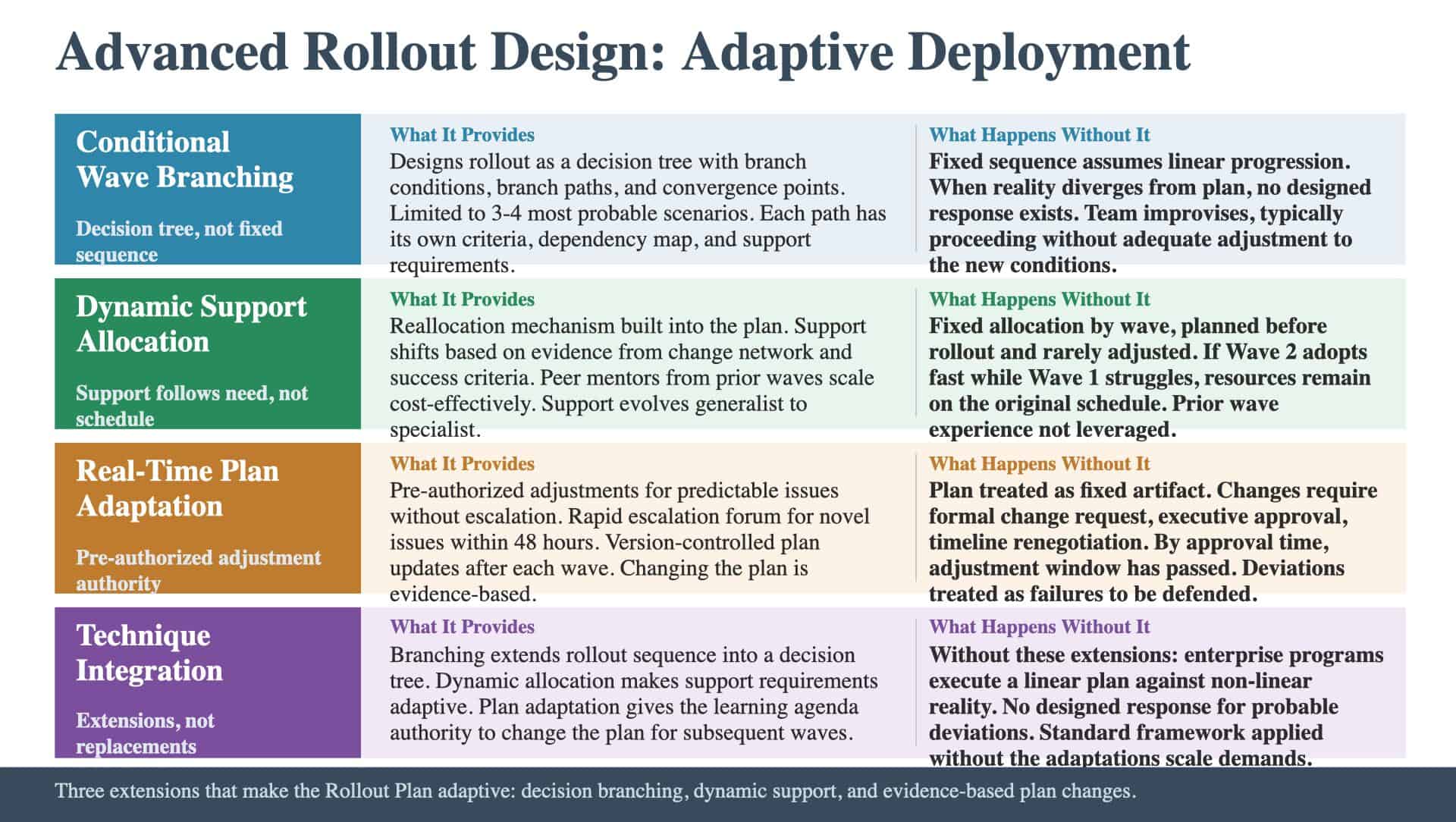
The five-component Rollout Plan works for programs with a linear wave sequence and manageable scale. Most enterprise transformations are messier. They involve parallel workstreams that roll out on different schedules. They span geographies with different regulatory environments, organizational cultures, and change readiness levels. They encounter surprises in early waves that demand fundamental plan changes, not just adjustments. The standard framework still applies, but enterprise-scale programs need three additional capabilities: conditional wave branching, dynamic support allocation, and real-time plan adaptation.
Technique 1: Conditional Wave Branching
A linear wave sequence assumes that the program progresses in a fixed order: Pilot, Wave 1, Wave 2, Wave 3. Enterprise reality is rarely that simple. Different workstreams may be ready for different waves at different times. Some geographies may need to skip ahead because of regulatory deadlines. Some audiences may need to be pulled out of their assigned wave because the readiness assessment revealed capacity problems. Conditional wave branching designs the rollout as a decision tree rather than a fixed sequence. At each transition point, the team evaluates evidence and chooses between predefined paths. The branching structure captures:
- Branch conditions. What evidence determines which path the program takes. “If Wave 1 success criteria are met across all metrics, proceed to Wave 2 as planned. If criteria are met for the core process but not the analytics module, proceed to Wave 2 for core only and re-pilot analytics.”
- Branch paths. The specific wave configurations for each condition. Each path has its own success criteria, dependency map, and support requirements.
- Convergence points. Where the branches reconnect. Even if the program splits into parallel paths, there should be defined points where the paths merge back into a unified deployment.
This approach requires more upfront planning than a linear sequence, but it prevents the most common enterprise failure: a rigid plan that encounters unexpected conditions and has no designed response. The team improvises, which typically means proceeding without adequate adjustment. The conditional branches should be limited to the most likely scenarios. The team can’t design for every possibility. But designing for the three or four most probable outcomes produces a plan that handles 80 percent of what enterprise reality will deliver.
Technique 2: Dynamic Support Allocation
The standard approach allocates support resources by wave: Wave 1 gets X trainers, Wave 2 gets Y, Wave 3 gets Z. The allocation is planned before the rollout begins and rarely adjusts. Dynamic support allocation builds a reallocation mechanism into the plan. Support resources shift based on evidence from the change network and the success criteria data. Three principles guide dynamic allocation: Support follows need, not schedule. If Wave 2 audiences are adopting faster than expected while Wave 1 audiences are still struggling, support resources should shift back to Wave 1 rather than proceeding on the planned allocation. The trigger for reallocation should be specific: if escalation rates exceed a threshold, if adoption metrics fall below a floor, if the change network reports capability gaps. Peer support scales. After each wave, successful adopters become available as peer mentors for subsequent waves. This is the most cost-effective support mechanism at enterprise scale. The plan should explicitly design for it: identifying peer mentor candidates from each wave, providing them with materials and a brief orientation, and integrating them into the support model for subsequent waves. This connects to the change network from the Change Plan. Support specialization evolves. Early waves need generalist support that covers everything from technical issues to process questions to change management. Later waves benefit from specialized support because the most common issues have been cataloged. The support model should evolve from generalist to specialist as the rollout progresses, concentrating expertise where the data shows it’s needed. The mechanism for dynamic allocation is a periodic review cadence, aligned with the operating model’s governance rhythm, where the team evaluates support effectiveness and reallocates based on evidence.
Technique 3: Real-Time Plan Adaptation
The learning agenda creates the data. The wave dependencies create the decision points. Real-time plan adaptation creates the authority and process to change the plan based on what the data reveals. Most rollout plans are treated as fixed artifacts. The plan is created, approved, and executed. Changes require a formal change request, executive approval, and timeline renegotiation. By the time the change is approved, the window for it to matter has often passed. Adaptive deployment builds change authority into the plan from the beginning: Pre-authorized adjustments. The plan defines a set of adjustments that the program team can make without escalation. “If error rates in a wave exceed 20 percent, the team can extend the wave by one week and add two support sessions without approval.” Pre-authorization speeds response time for predictable issues. Rapid escalation for novel issues. Issues that fall outside pre-authorized adjustments get escalated through a fast-track process. Not the standard change control board. A dedicated decision forum that can convene within 48 hours and make binding decisions. The forum membership and decision authority should be established before the rollout begins. Version-controlled plan updates. Each wave produces a revised plan for subsequent waves. The updates are documented, version-controlled, and communicated to all stakeholders. The team is always executing against the latest version of the plan, not the original version. This is where the learning agenda produces its practical impact: each wave’s lessons become changes in the next wave’s plan. The cultural prerequisite for adaptive deployment is that changing the plan is not a failure. Programs that treat the original plan as a commitment to be defended will resist adaptation even when the evidence demands it. Programs that treat the plan as a hypothesis to be tested will adapt naturally.
How These Techniques Connect
Conditional branching designs the decision tree for the rollout. Dynamic support allocation ensures resources follow need rather than schedule. Real-time plan adaptation ensures the team can act on what the learning agenda reveals. All three extend rather than replace the five-component Rollout Plan. The rollout sequence becomes a branching decision tree. The success criteria gain branch conditions that determine which path the program takes. The wave dependencies include reallocation triggers for support resources. The support requirements become dynamic rather than fixed. The learning agenda gains the authority structure that turns observations into plan changes. The question is whether the team builds a deployment system that adapts based on evidence and reallocates based on need: or whether it executes a fixed plan and treats every deviation as a failure rather than a signal.
Keep Reading
Explore the foundations and common gaps: