The Readout Was Excellent. The Context Disappeared in Six Months.
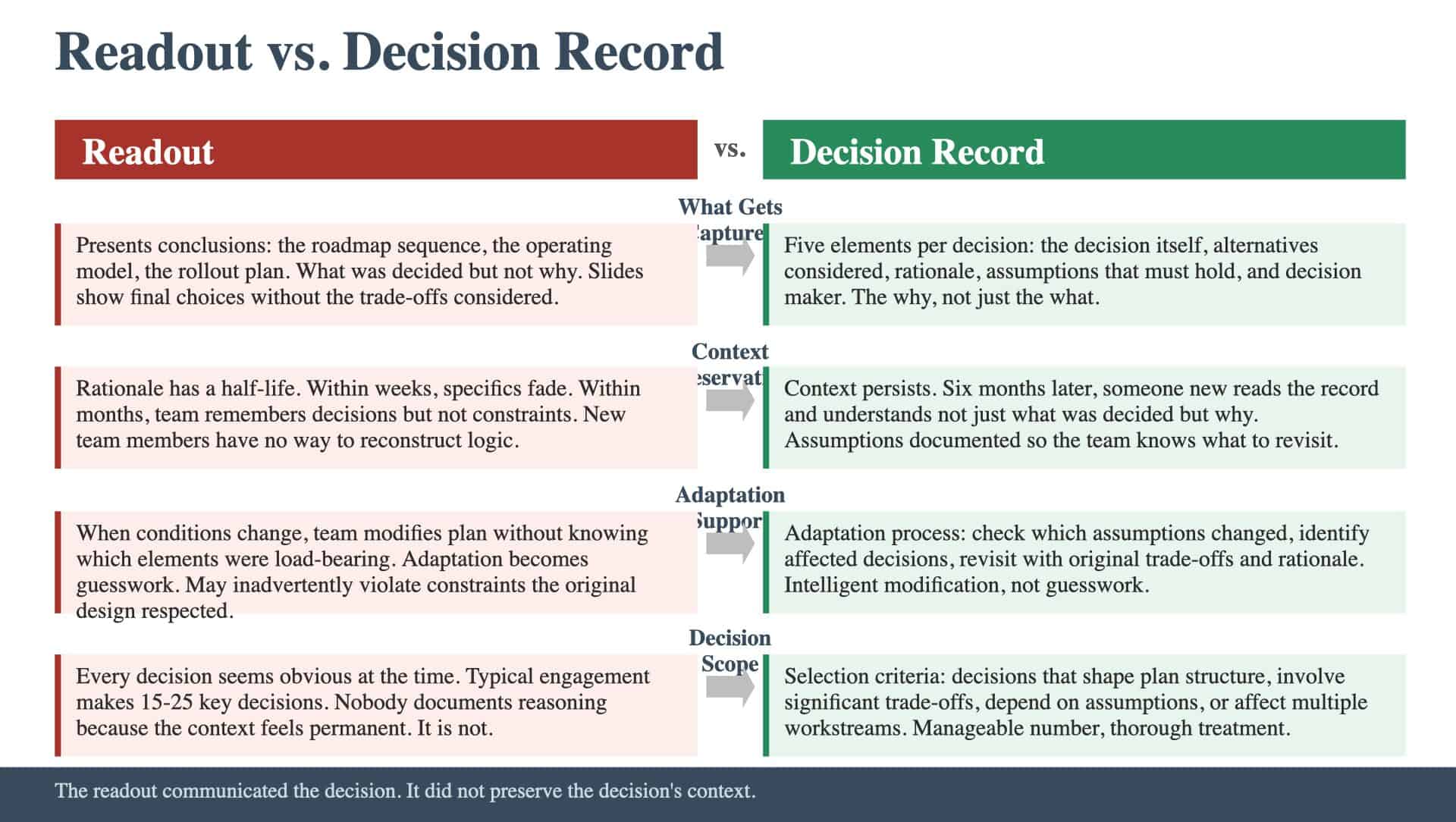
The planning engagement ended with a thorough readout. Leadership heard the plan. They saw the roadmap, the operating model, the risk landscape. They asked questions. The consultants answered them. Everyone left aligned. Six months later, the program hits a situation the original plan didn’t anticipate. A vendor delays a critical deliverable. The team needs to resequence two workstreams. To do this intelligently, they need to understand why the workstreams were ordered the way they were. What constraints drove the sequence? What trade-offs were considered? Nobody can answer these questions with precision. The people who were in the room remember discussing it, but not the specifics. The consultants are gone. The readout slides show the final sequence but not the reasoning. The team resequences based on their best interpretation, inadvertently violating a constraint the original design was built to respect. The readout communicated the decision. It didn’t preserve the decision’s context. That’s the gap a decision record closes.
What Gets Lost When You Only Capture Conclusions
Every planning engagement produces dozens of decisions. Most of them seem obvious at the time. The team chose a four-wave rollout. The team prioritized the operations workstream before procurement. The team excluded the Asia-Pacific region from the first phase. Each decision had a rationale that felt clear when it was made. The rationale has a half-life. Within weeks, the specifics start to fade. Within months, the team remembers the decision but not the constraints that shaped it. Within a year, new team members have joined who never knew the context. The decisions persist as facts without foundations. This creates two problems. Adaptation without understanding. When conditions change and the team needs to modify the plan, they don’t know which elements were load-bearing. They might change a sequence that was designed to respect a dependency. They might adjust timing that was calibrated to resource availability. They might expand scope into an area that was deliberately excluded for a specific reason. Relitigating settled questions. Without documented rationale, decisions get reopened. A new leader joins and asks why the program isn’t starting with the largest region. The team can’t explain why without reconstructing the original analysis. The conversation that took the planning team two hours to resolve now takes another two hours, reaching the same conclusion or, worse, a different one that ignores the constraints the original team understood.
What a Decision Record Actually Contains
A decision record captures five elements for each key decision: The decision itself. Stated clearly enough that someone who wasn’t in the room can understand it. Not “we decided on a phased approach” but “we chose a four-wave rollout with Singapore as pilot, APAC as Wave 1, Europe as Wave 2, and Americas as Wave 3.” The alternatives considered. What other options were on the table. A three-wave rollout. A region-by-function matrix. A big-bang launch with heavy support. The alternatives provide context that makes the chosen path meaningful. The rationale. Why this option was chosen over the alternatives. The specific factors that drove the choice: the support team can only cover two sites simultaneously, the regulatory requirements in Europe demand more preparation time, the Americas have the largest population and benefit from the most learning. The assumptions. What has to remain true for this decision to hold. “This sequence assumes the support team will have six dedicated members by Wave 1” or “This timing assumes the vendor delivers the integration module by March 15.” When assumptions change, the organization knows which decisions to revisit. The decision maker. Who made the call and who was consulted. This matters for accountability and for identifying who to involve when the decision needs to be revisited.
Which Decisions to Document
Not every decision warrants a record. The selection criteria: Decisions that shape the plan’s structure. The rollout sequence, the workstream prioritization, the governance model design, the wave dependencies. These are the load-bearing decisions. If someone changed them without understanding the context, the plan could fail. Decisions where significant trade-offs were made. Any decision where the team chose between meaningfully different options. If the team debated between two approaches for more than 30 minutes, the trade-offs were significant enough to document. Decisions that depend on assumptions. Any decision that relies on a condition that might change. Vendor timelines, budget approvals, resource commitments, regulatory requirements. When these assumptions change, the decision record tells the team which decisions to reconsider. Decisions that affect multiple workstreams. Cross-cutting decisions have the highest risk of being misunderstood because they affect people who weren’t part of the original conversation. Documenting them ensures that downstream teams understand the reasoning. A typical planning engagement produces 15 to 25 decisions that meet these criteria. That’s a manageable number to document thoroughly.
The Connection to Plan Adaptation
The decision record’s primary value is not historical. It’s adaptive. The record exists so the organization can change the plan intelligently when conditions change. The adaptation process:
- Something changes. A vendor delays, a budget shifts, a regulatory requirement emerges, a key person leaves.
- Check the assumptions. The decision record lists the assumptions behind each decision. Scan for any assumption that the change invalidates.
- Identify affected decisions. Which decisions relied on the invalidated assumption?
- Revisit with context. The decision record provides the alternatives considered and the rationale. The team can evaluate whether the original choice still holds or whether a different option is now better.
- Document the update. Add the new decision to the record with the new rationale. The record grows as the plan adapts.
Without the decision record, steps 2 through 4 are guesswork. The team changes the plan based on current judgment without reference to the constraints and trade-offs that shaped the original design. This is how programs inadvertently undo the work the planning engagement produced.
How to Build the Decision Record from What You Have
Programs at this stage have a readout and a set of artifacts. The decisions are embedded in the artifacts but not extracted into a standalone record.
- Start with the major artifacts. The roadmap, the operating model, the rollout plan, and the change plan each contain embedded decisions. For each artifact, ask: what choices were made here? What alternatives existed? Why was this option chosen?
- Then check with the people who were in the room. While the context is still relatively fresh, ask the planning team to reconstruct the rationale for the 15 to 25 key decisions. This is easier to do two months after the engagement than two years after it.
- Finally, identify the assumptions. For each decision, document what has to remain true. The question is whether the organization preserves the reasoning behind its decisions: or whether the plan becomes a set of conclusions that nobody can explain when conditions change.
Keep Reading
New to the Close Package? Start with the foundations:
Ready to benchmark your work against best-in-class? See what excellence looks like: