The Close Package Exists. The Question Is Whether It’s Execution-Grade.
A Close Package can be many things. It can be a polished readout deck with summary slides and a handshake. It can be a shared folder with templates and a knowledge transfer session. Or it can be the thing that actually enables the organization to run the plan after the consultants leave: a structured handoff that transfers documents, decisions, capability, and accountability. Programs that score high on Pillar 9 have a Close Package. The question is whether what they have meets the quality bar for each of its five sections. A Close Package that covers three sections thoroughly and two superficially still leaves gaps that surface during execution. This article defines the quality benchmark for each section. The standard is not theoretical. It comes from what the best planning engagements produce and what organizations need to operate independently.
Section 1: The Decision Record
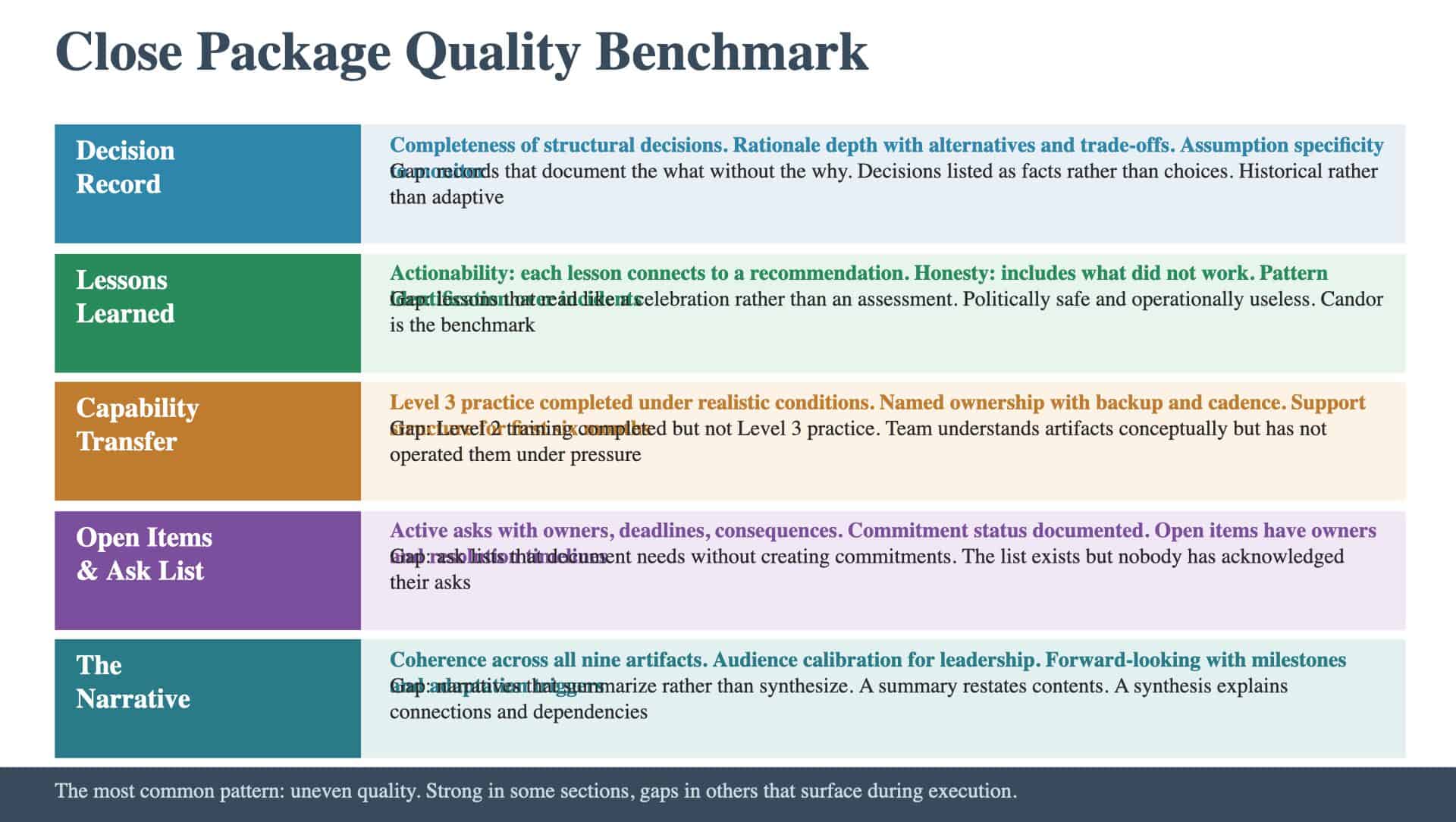
The decision record captures the key decisions made during the planning engagement, along with the rationale, alternatives considered, assumptions, and decision makers. The quality bar: Completeness. Every structural decision is documented. The roadmap sequencing, the governance model design, the rollout wave structure, the workstream prioritization, the scope boundaries. If someone changed any of these without reading the decision record, the plan could break. All of them need to be in the record. Rationale depth. Each decision includes the choice and the reasoning. The alternatives that were considered. The trade-offs that were weighed. The factors that tipped the balance. Someone reading the record six months later should be able to understand what was decided and why this option was chosen over the others. Assumption specificity. Each decision lists the assumptions that must hold for it to remain valid. The assumptions are specific enough to monitor: “vendor delivers integration module by March 15” rather than “vendor stays on track.” When assumptions break, the team knows which decisions to revisit. The gap at this level: Decision records that document the what without the why. The record lists decisions but treats them as facts rather than choices. This makes the record historical rather than adaptive. The team knows what was decided but can’t evaluate whether the decision still holds when conditions change.
Section 2: The Lessons Learned
The lessons learned capture what the engagement discovered about the organization, the program, and the planning process itself. The quality bar: Actionability. Each lesson connects to a specific recommendation. “Stakeholder alignment took longer than expected” is an observation. “Future phases should allocate two weeks for stakeholder alignment rather than one, and should include the regional leaders in the initial sessions rather than briefing them afterward” is a lesson. The difference is whether someone can act on it. Honesty. The lessons include what didn’t work, not just what did. The pre-mortem identified risks that materialized. The change plan had assumptions that proved wrong. The rollout sequence encountered friction that wasn’t anticipated. Documenting failures is more valuable than documenting successes because failures reveal the adjustments the next phase needs. Pattern identification. The lessons identify patterns rather than isolated incidents. If stakeholder alignment was difficult across three workstreams, the pattern is organizational, not workstream-specific. Pattern-level lessons inform structural changes. Incident-level lessons inform tactical fixes. The gap at this level: Lessons learned that read like a celebration rather than an assessment. Everything worked, the team was great, the timeline was met. These documents are politically safe and operationally useless. The quality benchmark requires candor.
Section 3: The Capability Transfer
The capability transfer ensures the receiving team can operate the artifacts independently. The quality bar: Level 3 practice completed. The receiving team has actually used each artifact under realistic conditions while the consulting team was available to guide them. They’ve updated the roadmap when a dependency shifted. They’ve facilitated a governance meeting. They’ve assessed a new risk. They’ve designed a communication cycle. They’ve evaluated wave success criteria. The test is performance, not comprehension. Named ownership. Every artifact and process has a specific person assigned as owner, with a named backup, a maintenance cadence, and a support plan for questions that arise after the engagement ends. The ownership is visible, agreed to, and supported with time allocation. Support structure defined. The first six months of independent operation will produce questions the training didn’t cover. The Close Package defines how those questions get answered: a retained advisor, a knowledge base, office hours, or a named contact. The gap at this level: Capability transfer that completed Level 2 (training) but not Level 3 (practice). The team understands the artifacts conceptually but hasn’t operated them under pressure. The first time they need to update the roadmap in response to a real change, they discover the gap between knowing and doing.
Section 4: The Open Items and Ask List
The open items capture unresolved questions. The ask list captures the specific leadership support the program needs during execution. The quality bar: Active asks, not passive needs. Each ask names an owner, specifies a deadline tied to the program timeline, and states the consequence of non-delivery. “We need budget confirmation” is passive. “The CFO needs to confirm the Q3 allocation by March 15 because Wave 2 staffing decisions depend on it” is active. Active asks create accountability. Commitment documented. For each ask, the Close Package records whether the owner has committed, deferred, or declined. Uncommitted asks have a follow-up date and a follow-up owner. Nothing is left in the ambiguous state of “discussed but not resolved.” Open items have owners and timelines. Unresolved questions from the planning engagement are listed with the person responsible for resolving them and the date by which resolution is needed. Open items without owners are forgotten items. The gap at this level: Ask lists that document needs without creating commitments. The list exists, but nobody has acknowledged their asks. The program has identified what it needs from leadership without securing agreement to provide it.
Section 5: The Narrative
The narrative is the synthesis that ties all artifacts together into a coherent story: what the program is, why it matters, how it will work, and what success looks like. The quality bar: Coherence across artifacts. The narrative connects the landscape brief’s findings to the architecture blueprint’s design to the roadmap’s sequence to the rollout’s execution plan. A reader who only reads the narrative should understand how the pieces fit together and why the plan is designed the way it is. Audience calibration. The narrative is written for the audience that will use it: leadership stakeholders who need to understand the program well enough to support it, defend it, and make decisions about it. It’s not a technical document. It’s a leadership document. Forward-looking. The narrative doesn’t just summarize what the engagement produced. It describes what happens next, what success looks like at defined milestones, and what conditions would require the plan to adapt. The narrative gives leadership a framework for evaluating progress, not just a summary of the starting position. The gap at this level: Narratives that summarize rather than synthesize. A summary restates what each artifact contains. A synthesis explains how they connect, where the critical dependencies are, and what the organization should watch for. The quality benchmark is synthesis.
Using This Benchmark
For each of the five sections, evaluate the Close Package against the quality bar described above. The assessment is binary for each criterion: either the section meets the standard or it doesn’t. The most common pattern at this score level is uneven quality. The decision record might be strong while the capability transfer is incomplete. The ask list might be thorough while the narrative is a summary rather than a synthesis. The benchmark helps identify which sections need attention rather than treating the Close Package as uniformly adequate or inadequate. The sections are also interdependent. A strong decision record supports capability transfer because the receiving team can reference the reasoning behind the plan. A strong narrative supports the ask list because leadership understands why their support matters. The question is whether the Close Package meets the quality bar across all five sections: or whether uneven quality leaves gaps that surface during execution.
Keep Reading
Explore the foundations and common gaps: