A Communications Plan Is One Quarter of the Work
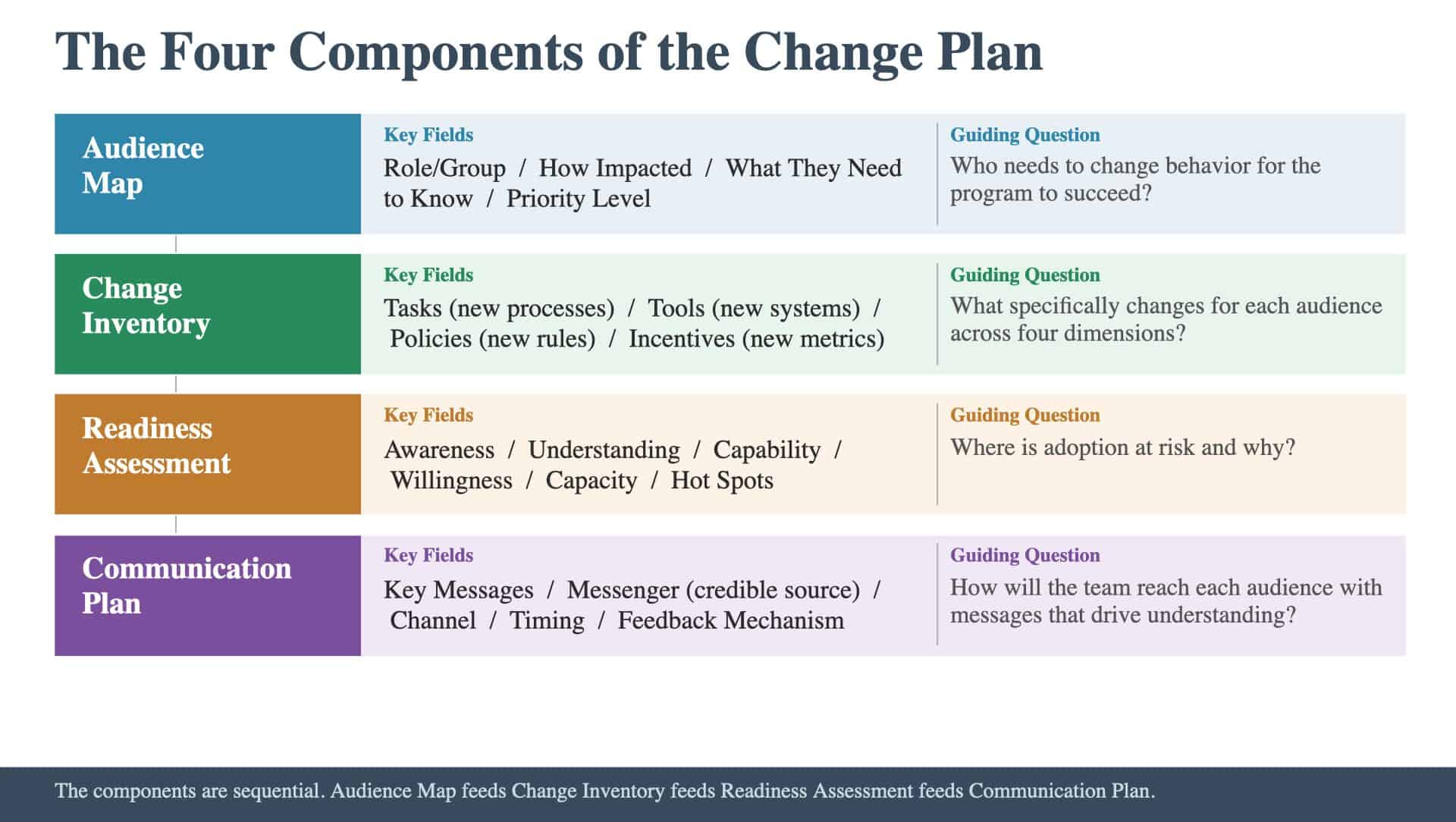
Most organizations that claim to have a change management plan actually have a communications plan. They know what messages they want to send and roughly when they want to send them. That’s useful, but it covers only one of the four components that make a Change Plan operational. The other three components do the harder work: identifying who needs to change and mapping what specifically changes for them, then assessing where adoption is at risk. Without those, the communications plan has nothing substantive to communicate. The messages become announcements about the program rather than preparation for the people affected by it. Here is what each component contains and what separates a useful version from one that checks the box without driving adoption.
Component 1: The Audience Map
The Audience Map identifies every group whose behavior needs to change for the program to succeed. The key word is specific. “Operations” is not an audience. “Store managers who will need to learn the new inventory system” is an audience. “Finance” is not an audience. “Regional controllers who will shift from monthly to weekly reporting cycles” is an audience. The capture structure for each audience includes:
- Role or group (specific enough to describe their daily work)
- How they’re impacted (what changes in their world)
- What they need to know (the information required for them to act)
- Priority level (based on how critical their adoption is to program success)
The quality bar: the team can look at the map and identify every group whose non-adoption would threaten the program. No critical audience is missing, and no audience is described so broadly that the change approach can’t be tailored to them. The stakeholder mapping done earlier in the method provides a foundation, but the Audience Map goes further. Stakeholder mapping identifies who has influence and perspective. The Audience Map identifies who has to change their behavior. These overlap but aren’t identical. A stakeholder who shapes the decision but doesn’t change their own workflow appears on the stakeholder map but not on the audience map.
Component 2: The Change Inventory
The Change Inventory maps the specific changes each audience faces. Change is multi-dimensional, and missing any dimension leaves the adoption effort incomplete. For each audience, the inventory captures four categories:
- Tasks: What will they do differently? New processes, workflows, responsibilities.
- Tools: What will they use to do it? New systems, platforms, interfaces.
- Policies: What rules will govern their work? New standards, approval processes, compliance requirements.
- Incentives: What motivates compliance? New metrics, performance criteria, reward structures.
The quality bar: for each priority audience, the team can describe the concrete changes across all four dimensions. If the consulting team can only articulate the task changes but hasn’t thought through tools, policies, and incentives, the inventory is incomplete. This is where most change efforts fall short. They identify what people need to do differently but neglect to address whether the tools support the new behavior, whether the policies align with the new expectations, and whether the incentive structure rewards the right outcomes. A new process without the tools to support it creates frustration; a new expectation without aligned incentives creates confusion about what actually matters.
Component 3: The Readiness Assessment
The Readiness Assessment evaluates where adoption is at risk. Every change effort encounters resistance. The question isn’t whether resistance will exist, but where it concentrates and why. The assessment evaluates each audience against multiple dimensions:
- Awareness: Do they know the change is coming?
- Understanding: Do they understand what’s changing for them specifically?
- Capability: Do they have the skills and tools to execute the new way of working?
- Willingness: Are they motivated to change, or does the change threaten something they value?
- Capacity: Do they have bandwidth for this change given everything else on their plate?
The capacity dimension connects to change saturation, one of the most overlooked factors in adoption planning. Organizations have a limited capacity for change. If this initiative lands on top of three other major changes, adoption suffers because people are overwhelmed, not because the change management is poor. Part of the readiness assessment is understanding the broader change landscape: what else is hitting these audiences and how much capacity remains. The quality bar: the assessment identifies specific hot spots (the audiences or changes where adoption is most at risk) and makes them visible. An honest readiness assessment names the problems so the team can address them, rather than reporting that everything is “on track” when it isn’t.
Component 4: The Communication Plan
The Communication Plan specifies how the organization will reach each audience with messages that are credible and actionable. It builds on the first three components: the Audience Map tells the team who to reach, the Change Inventory tells them what to communicate, and the Readiness Assessment tells them where to focus energy. For each audience, the plan captures:
- Key messages: What does this audience need to hear? (Tied to their specific changes from the inventory)
- Messenger: Who delivers the message? (The person with credibility for this audience)
- Channel: How is the message delivered? (The medium this audience actually uses)
- Timing: When does the message land? (Sequenced to the program timeline)
- Feedback mechanism: How does the team know the message was received? (The loop that closes the broadcast trap)
The feedback mechanism is what separates a communication plan from a broadcast schedule. Without it, the team sends messages into the void and assumes they landed. With it, the team gets signal on whether audiences understand what’s coming, which messages need reinforcement, and where confusion persists. The quality bar: the plan is audience-specific, not generic. Each audience gets messages tailored to their changes, delivered by messengers they trust, through channels they use. The plan includes feedback loops so the team knows whether communication is driving understanding or generating noise.
How the Four Components Work Together
The components are sequential and interdependent. The Audience Map feeds the Change Inventory (you can’t map changes without knowing who’s affected), and the Change Inventory feeds the Readiness Assessment (you can’t assess readiness without knowing what’s changing). Both feed the Communication Plan (you can’t communicate effectively without understanding the audience, the changes, and the risks). Skipping to communication without doing the upstream work is the most common failure pattern. It produces generic messages about the program’s goals and timeline rather than targeted preparation for the people who need to act. The result is an organization that has been informed about the change but hasn’t been prepared for it. Teams that do this upstream work before communication begins build a Change Plan that drives adoption. Teams that skip it discover that awareness without preparation produces announcements the organization hears but cannot act on.
Go Deeper: The Change Plan
This article covers one dimension of the Change Plan, the seventh of nine artifacts in the Planning & Roadmapping method. The Change Plan answers the board question: “How will people adopt this?” Explore the full Change Plan → Want us to build this with you? Book a consultation →
Keep Reading
Ready to close specific gaps in your Change Plan? These articles show you how: