The Communication Calendar That Generated Activity Without Understanding
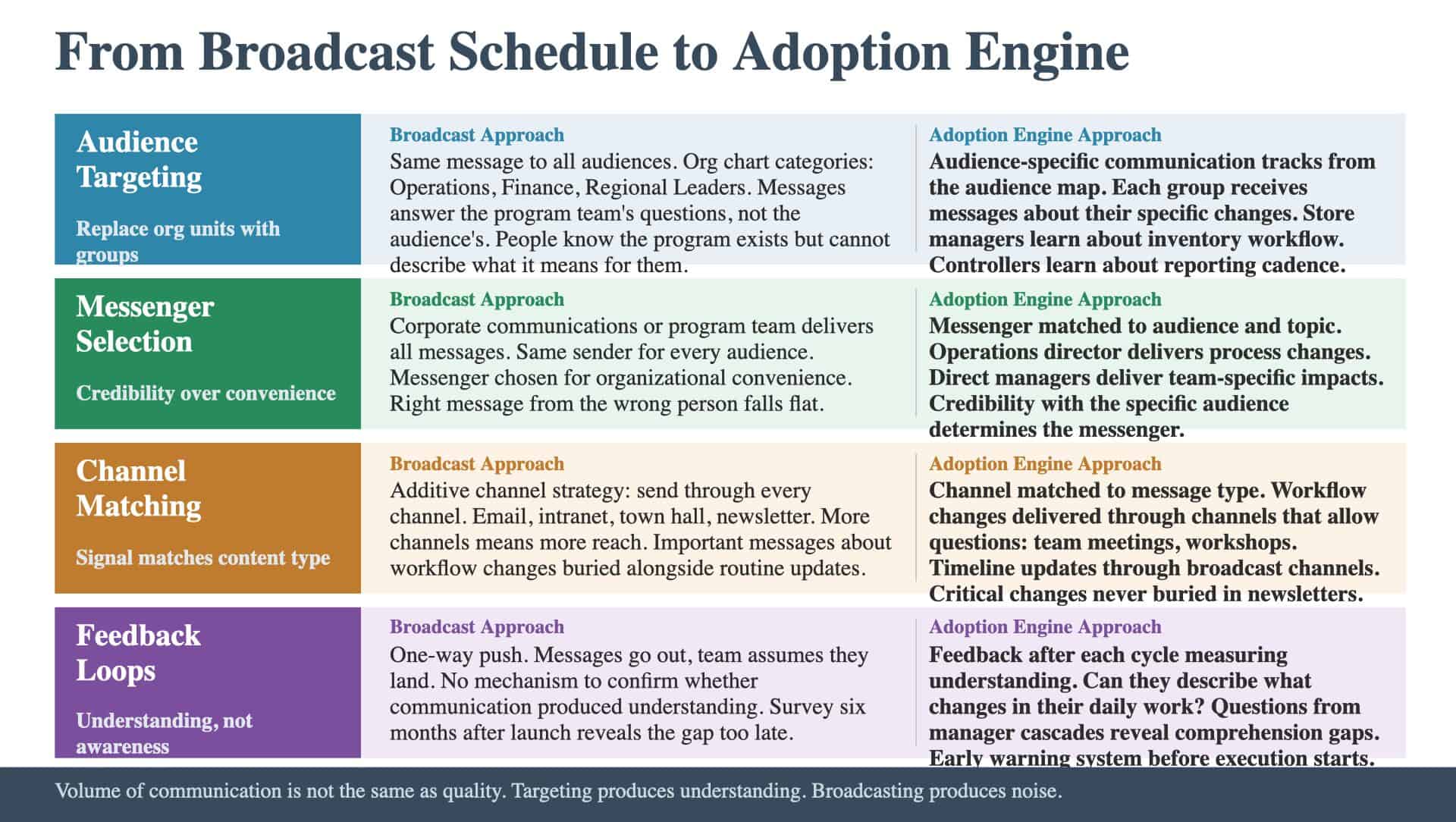
The program has a communications calendar. It’s detailed and well-maintained. Weekly updates go out on Monday; town halls happen monthly. The executive sponsor sends a personal note after each steering committee, the intranet page is current, and the newsletter has a consistent cadence. By every activity metric, communication is healthy. Then the readiness assessment reveals that the people who need to change their behavior can name the program but cannot describe what it means for their role. Awareness is high; understanding is low. The communication plan is generating noise, not adoption. This is the gap between a broadcast schedule and a communication plan that drives adoption. The schedule describes what gets sent and when. The adoption-driving plan starts with who needs to hear what and works backward to messenger, channel, timing, and feedback.
Why Generic Messages Produce Awareness Without Understanding
The default communication approach sends the same message to all audiences. The program’s vision, timeline, key milestones, and leadership commitment appear in every update. These messages are accurate and well-intentioned; they’re also useless for the person trying to understand what changes in their daily work. A store manager learning a new inventory system doesn’t need to know the program’s strategic rationale. That manager needs to know when the system changes, what the new workflow looks like, what training is available, and who to call when something breaks. A regional controller shifting to a new reporting cadence doesn’t need the executive sponsor’s vision statement. That controller needs to know what data changes, which reports are affected, and what the new deadlines are. Generic messages fail because they answer the program team’s questions (“How do we build awareness?”) instead of the audience’s questions (“What does this mean for me?”). The shift from broadcast to targeted communication requires the audience map and change inventory to be in place. Without knowing who the audiences are and what specifically changes for each one, the communication plan has nothing specific to communicate.
The Messenger Problem
People don’t evaluate messages on content alone; they evaluate them based on who delivers them. The same information about a new process lands differently when it comes from the CIO’s office versus a respected operations director who has been through similar changes. The same reassurance about job impact lands differently from a corporate communications department versus a direct manager who is also navigating the change. Credibility is audience-specific and topic-specific. The CIO has credibility on technology strategy; the operations director has credibility on what the change means for daily work. The direct manager has credibility on what it means for this team. A communication plan that drives adoption specifies the messenger for each audience and each message type. It asks: who does this audience listen to? Who has credibility with them on this topic? Who can deliver this message in a way that produces understanding rather than just compliance? The messenger selection often reveals organizational dynamics. If the only credible messenger for a key audience is someone who hasn’t been included in the program, that’s a gap in stakeholder engagement. If the most credible messenger is resistant to the change, the team has a readiness hot spot that no amount of communication from other messengers will resolve.
Channels Are Not Interchangeable
The default channel strategy is additive: send the message through every channel available. Email, intranet, town hall, newsletter, manager cascade, digital signage. The assumption is that more channels mean more reach. But channels carry different signals about the importance and nature of the message. An all-hands town hall signals organizational significance; a direct manager conversation signals personal relevance; an email from corporate communications signals administrative information. The same message delivered through different channels is received as different messages. The communication plan should match the channel to the message and the audience. Information about what’s changing in someone’s daily work is best delivered through a channel that allows questions (a team meeting or a manager one-on-one). Information about the program’s progress and timeline can travel through broadcast channels. Information about training and support should travel through channels that enable action (a link to the training platform, a calendar invite for the workshop). The worst outcome is important messages delivered through low-signal channels. When a critical change to someone’s workflow appears in a newsletter alongside program updates and leadership quotes, it gets the same attention as everything else in the newsletter: minimal.
The Feedback Loop That Closes the Broadcast Trap
The broadcast trap is communication as a one-way push. Messages go out, the team assumes they land, and the program moves forward on the assumption that awareness equals readiness. The antidote is a feedback mechanism for each audience. Not a survey six months after launch, but a structured way to know, within weeks, whether the communication is producing understanding. Feedback mechanisms can be simple. After a manager cascade, ask managers to report what questions their teams asked (the questions reveal whether the message was understood). After a training session, assess whether participants can describe the new workflow, not whether they can pass a quiz about it. After a town hall, poll attendees on what they think changes for their role specifically. The pattern is consistent: feedback should measure understanding, not awareness. People who have been informed can answer the question “Have you heard about the program?” People who have been prepared can answer the question “What changes in your daily work, and when?” The feedback loop also serves as an early warning system. If three consecutive feedback cycles show that a particular audience still can’t describe what’s changing for them, the team knows the communication isn’t working for that group. That’s a signal to change the message, the messenger, or the channel before execution starts.
How to Upgrade What You Have
Programs at this stage have a communications calendar. The upgrade is structural.
- Replace the audience column. If the calendar lists organizational units (“Operations,” “Finance”), replace them with specific audiences from the audience map. Each audience gets its own communication track.
- Add the messenger column. For each audience and message type, identify who delivers it. If the answer is always “corporate communications” or “the program team,” the plan needs work. The messenger should be the person with credibility for that audience on that topic.
- Tailor the messages. Replace generic program updates with audience-specific messages tied to the change inventory. Each audience should receive messages about what’s changing for them, not about the program in general.
- Add the feedback column. For each communication, define how the team will know whether it produced understanding. If there’s no feedback mechanism, the team is broadcasting and hoping.
The Communication Calendar sub-artifact provides the operational structure for this upgrade, sequencing audience-specific messages, messenger assignments, and feedback checkpoints into a single tracking instrument. The result is a communication plan that’s audience-specific and feedback-enabled. It’s harder to execute than a broadcast calendar, but it’s capable of producing actual behavior change.
Go Deeper: The Change Plan
This article covers one dimension of the Change Plan, the seventh of nine artifacts in the Planning & Roadmapping method. The Change Plan answers the board question: “How will people adopt this?” Explore the full Change Plan → Want us to build this with you? Book a consultation →
Keep Reading
New to the Change Plan? Start with the foundations:
- What a Change Plan Is and Why Good Programs Fail at Adoption
Ready to benchmark your work against best-in-class? See what excellence looks like:
- The Change Plan as Quality Benchmark