When the Standard Change Plan Meets Enterprise Complexity
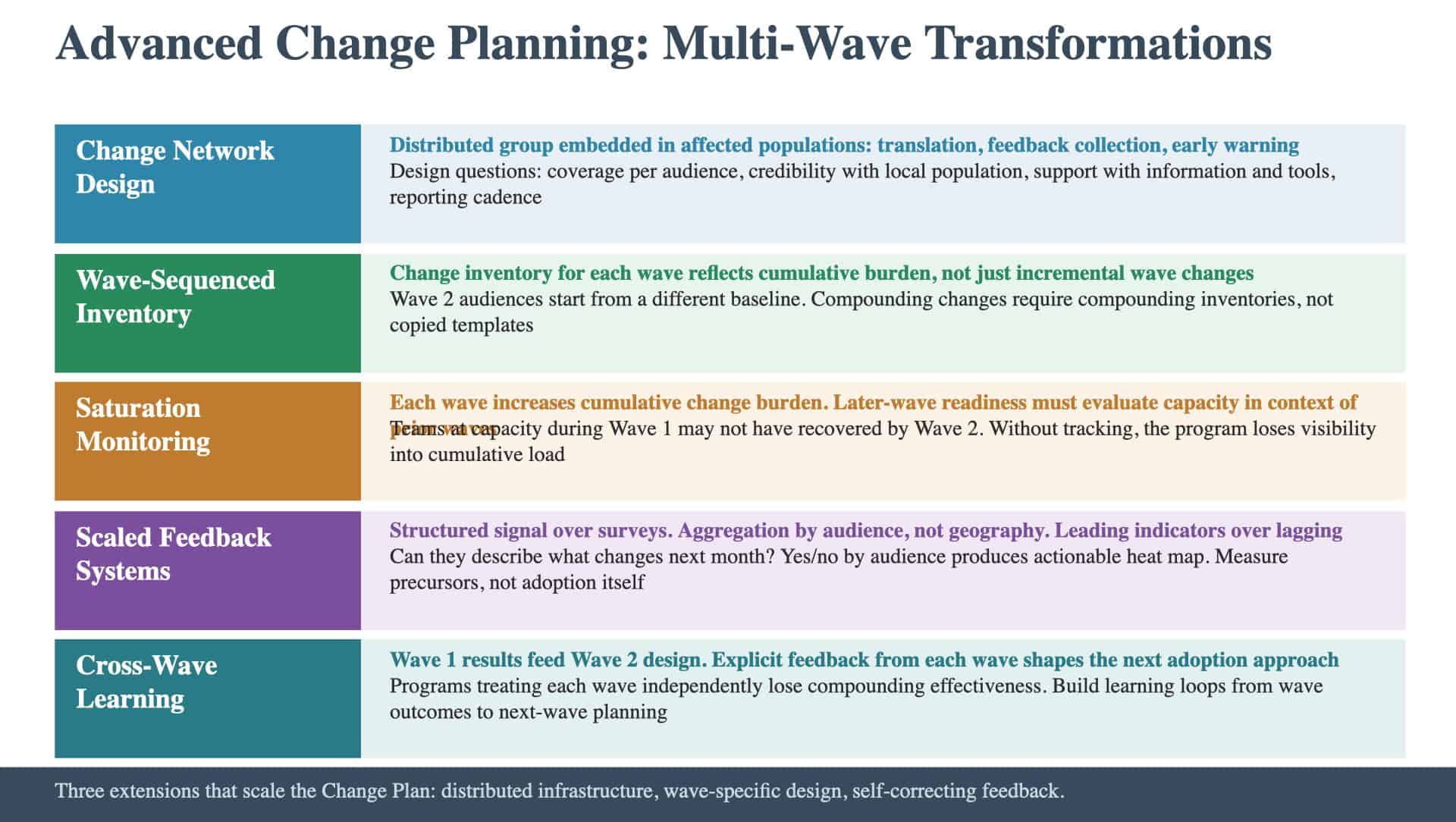
The four-component Change Plan (audience map, change inventory, readiness assessment, and communication plan) works for a single-wave change affecting a bounded population. Most enterprise transformations are more complex than that. They involve multiple waves rolling across different geographies, affect audiences that overlap across workstreams, and create change saturation problems that compound as waves accumulate. The standard framework still applies, but it needs extension to handle that complexity. This article covers three advanced techniques that programs with strong Change Plans use to scale adoption infrastructure beyond the first wave.
Technique 1: The Change Network
A change network is a distributed group of people embedded in the affected populations who serve as local translators, feedback collectors, and adoption champions. We design the network as part of the Change Plan rather than building it reactively when adoption stalls. The network is not a committee. It’s an infrastructure layer. Each member has a defined role: Translation. They convert program-level communication into audience-specific language. The corporate message says “we’re implementing a new operating model.” The change network member in the regional office translates that into “here’s what changes for our team on March 15, and here’s what we need to do before then.” Feedback collection. They report back what they’re hearing from their population. Not satisfaction surveys, but specific signal: what questions are people asking? What concerns are surfacing? Where is understanding breaking down? This closes the feedback loop that broadcast communication lacks. Early warning. They identify adoption risks before they become visible to the program team. A change network member in procurement notices that the team hasn’t received training materials and is simultaneously managing a vendor consolidation. That signal reaches the program team weeks before it would surface through formal channels. The design questions for the change network are structural:
- Coverage. Does every priority audience have at least one network member embedded in their population?
- Credibility. Are network members selected for their credibility with the local audience, not for organizational rank?
- Support. Do network members receive the information and tools they need to translate, collect feedback, and signal risks?
- Cadence. How frequently does the network report back, and to whom?
The change network connects directly to the operating model’s governance cadence. Network feedback should flow into the same decision-making rhythm that governs program execution, so adoption risks receive the same attention as delivery risks.
Technique 2: Wave-Sequenced Adoption Planning
In a multi-wave rollout, the Change Plan for Wave 2 is not the same as the Change Plan for Wave 1. The audiences may overlap, the change inventory differs because the changes compound, and the readiness landscape shifts because the organization has already absorbed one wave of change. Wave-sequenced adoption planning treats each wave as a distinct adoption challenge while maintaining continuity across the program. Compounding change inventory. Wave 2 audiences aren’t starting from the same baseline as Wave 1 audiences. They’ve already absorbed (or partially absorbed) the Wave 1 changes. The change inventory for Wave 2 must account for the cumulative change burden, not just the incremental changes in this wave. A team that shifted to weekly reporting in Wave 1 and is now adopting a new analytics platform in Wave 2 is managing a different adoption challenge than a team encountering the analytics platform in isolation. Saturation monitoring. Each wave increases the cumulative change burden on the organization. The readiness assessment for later waves must evaluate capacity in the context of what came before. The teams that were at capacity during Wave 1 may not have recovered by Wave 2. Without explicit tracking, the program team loses visibility into cumulative load. Wave 1 lessons feeding Wave 2 design. The most valuable input into the Wave 2 Change Plan is what actually happened during Wave 1. Where did adoption stall? Which audiences struggled? Which readiness gaps were underestimated? Which communication approaches worked and which didn’t? Programs that treat each wave as an independent planning exercise lose this learning; programs that build explicit feedback from each wave into the next wave’s plan compound their effectiveness. The rollout plan defines the wave sequence and success criteria. The Change Plan adds the adoption layer: for each wave, what are the audiences, what changes for them (cumulatively), what’s their readiness, and how will the team communicate?
Technique 3: Scaled Feedback Systems
Feedback mechanisms that work for a single audience in a single location don’t scale to enterprise transformations affecting thousands of people across multiple geographies. The feedback system needs to be designed for scale from the beginning. Three design principles: Structured signal over surveys. Large-scale surveys produce data that’s averaged into meaninglessness. “Overall readiness: 3.7 out of 5” tells the team nothing actionable. Instead, design feedback around specific questions that produce actionable signal: “Can you describe what changes in your daily work next month?” A yes-or-no answer to that question, aggregated by audience, produces a heat map of understanding gaps. Aggregation by audience, not by geography. The natural instinct is to aggregate feedback by region or business unit because that maps to the org chart. But the Change Plan is organized by audience, and the feedback should match. Store managers across all regions are an audience; their adoption trajectory should be visible as a population, not fragmented across regional reports. Leading indicators over lagging indicators. By the time adoption metrics (system usage, process compliance, outcome metrics) show a problem, the opportunity to intervene has passed. The feedback system should measure the precursors of adoption: understanding, capability, willingness, and capacity. These are leading indicators that allow intervention before the adoption gap becomes visible in the metrics. The scaled feedback system connects back to the change network. Network members provide the ground-level signal; the feedback system aggregates and structures that signal so the program team can act on it. Without the network, the feedback system has no data sources. Without the system, the network produces anecdotes rather than patterns.
How These Techniques Connect
The change network provides distributed adoption infrastructure; wave-sequenced planning ensures each rollout wave gets its own adoption approach; and scaled feedback systems close the loop between communication and understanding. All three extend rather than replace the four-component Change Plan. The audience map expands to include change network coverage. The change inventory becomes wave-specific. The readiness assessment incorporates cumulative saturation tracking. The communication plan gains the feedback infrastructure that makes it self-correcting. At the multi-wave level, two sub-artifacts become especially critical. The Resistance Analysis must be refreshed for each wave as resistance patterns shift based on earlier adoption experiences. Teams that build adoption infrastructure that scales with each wave and learns from every one compound their effectiveness; teams that copy the Wave 1 plan across subsequent waves watch adoption degrade.
Go Deeper: The Change Plan
This article covers one dimension of the Change Plan, the seventh of nine artifacts in the Planning & Roadmapping method. The Change Plan answers the board question: “How will people adopt this?” Explore the full Change Plan → Want us to build this with you? Book a consultation →
Keep Reading
Explore the foundations and common gaps:
- What a Change Plan Is and Why Good Programs Fail at Adoption
- You Have a Communications Plan but Not an Audience Map