The Program
A Fortune 500 manufacturing company is replacing its legacy ERP system across 14 plants in three regions over 18 months. The program touches every function: operations, finance, procurement, quality, maintenance, and supply chain. The integrated roadmap defines four rollout waves. The operating model establishes governance, cadence, and decision rights.
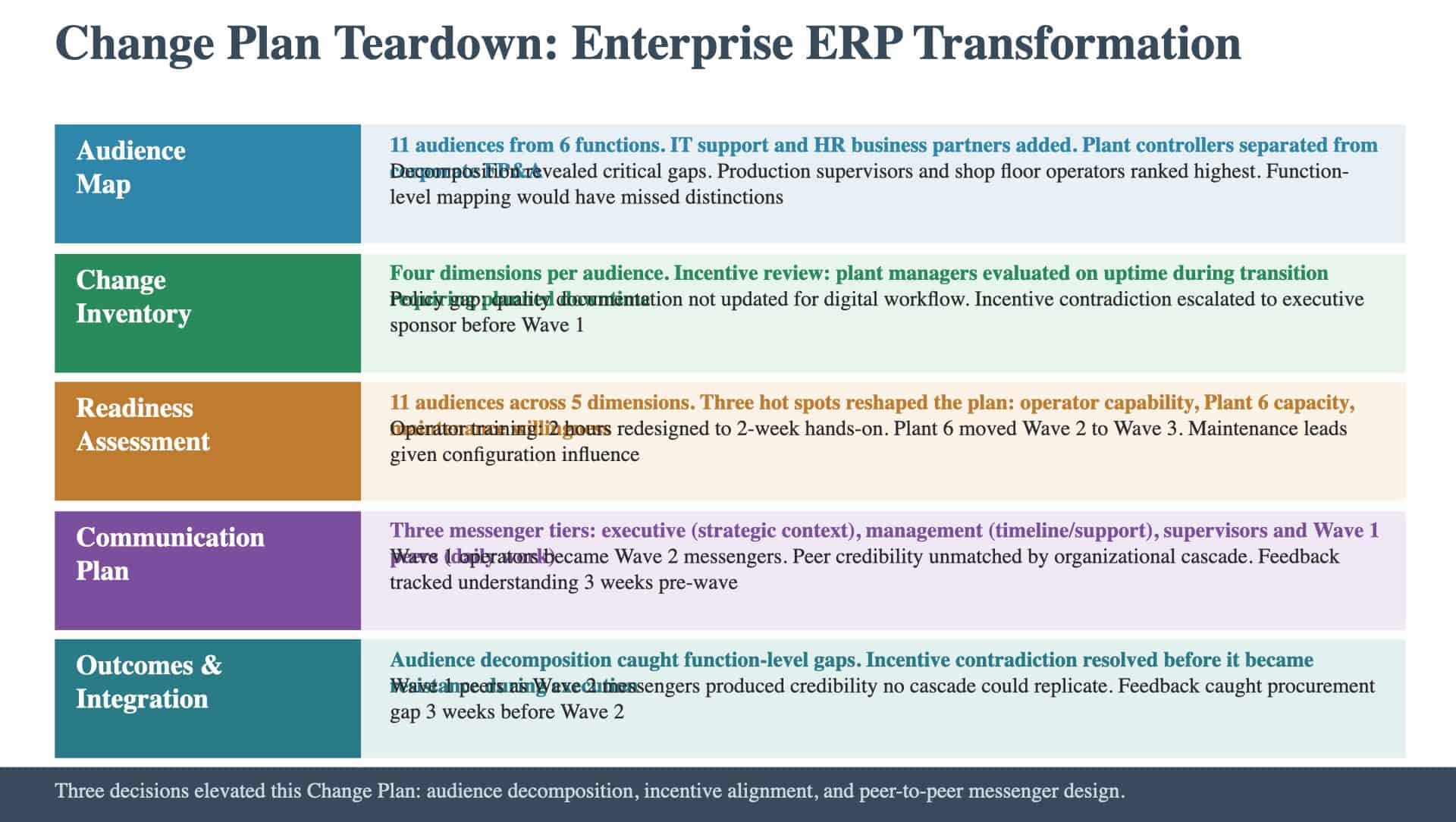
The Change Plan was built during Step 7, after the roadmap and operating model were in place. Here is what each component looked like in the completed artifact and what drove the decisions behind it.
The Audience Map: 11 Audiences, Not 6 Functions
The initial draft of the audience map listed six functions: Operations, Finance, Procurement, Quality, Maintenance, and Supply Chain. This is the org chart default. The consulting team pushed for further decomposition. The final audience map identified 11 distinct audiences:
- Plant managers who would oversee the transition at each facility
- Production supervisors whose daily scheduling workflow changes entirely
- Shop floor operators who would use new interfaces for work orders and time tracking
- Plant controllers shifting from legacy reporting to real-time dashboards
- Corporate FP&A analysts whose consolidation process changes
- Procurement managers moving to a new vendor management workflow
- Quality engineers whose inspection and documentation process migrates to the new system
- Maintenance technicians shifting from paper work orders to digital
- IT support staff at each plant who would handle first-level troubleshooting
- HR business partners supporting the affected populations through the transition
- Warehouse supervisors whose inventory management process converts
The decomposition from 6 functions to 11 audiences revealed critical gaps. IT support staff and HR business partners were not in the original plan. Neither was the distinction between plant controllers and corporate FP&A analysts, who have different change experiences despite both being “Finance.” Each audience was prioritized by adoption criticality. Production supervisors and shop floor operators ranked highest because the new system couldn’t function without their daily use. Plant managers ranked high because they owned local adoption. Corporate FP&A analysts ranked lower because their changes were significant but could be managed on a longer timeline.
The Change Inventory: Where Incentive Alignment Failed the First Draft
The initial change inventory covered tasks and tools comprehensively. For each audience, the team documented what they would do differently and which systems they would use. We pushed for the other two dimensions. The policy review revealed a gap: the quality inspection documentation requirements hadn’t been updated to reflect the new digital workflow. Quality engineers would be using a new system while the formal quality policy still referenced the paper-based process. Without updating the policy, the engineers would face a contradiction between what the system required and what the quality standards prescribed. The incentive review revealed a larger problem. Plant managers were evaluated on production uptime. The ERP transition would require planned downtime for each wave. Under the existing incentive structure, plant managers who cooperated fully with the transition would take a hit on their performance metrics. The team had to escalate to the executive sponsor to modify the performance evaluation framework for the transition period. Without the incentive dimension in the change inventory, this contradiction would have identified during Wave 1 as plant manager resistance.
The Readiness Assessment: Three Hot Spots That Reshaped the Plan
The readiness assessment evaluated all 11 audiences across all five dimensions. Three hot spots reshaped the program’s approach. Hot Spot 1: Shop floor operator capability. The operators had the lowest baseline technology comfort of any audience. The new system required tablet-based interaction for work orders and time tracking. The initial training plan allocated two hours per operator. The readiness assessment flagged this as insufficient based on capability evaluation. The team redesigned the training approach to include hands-on practice sessions over two weeks before each wave, with peer mentors (experienced operators from earlier waves) supporting the transition. Hot Spot 2: Plant 6 capacity. The readiness assessment mapped the broader change landscape and discovered that Plant 6 was simultaneously implementing a new safety management system and undergoing a leadership transition. The plant’s change capacity was exhausted. The team moved Plant 6 from Wave 2 to Wave 3, giving the safety system implementation time to stabilize and the new plant manager time to settle before the ERP transition arrived. Hot Spot 3: Maintenance technician willingness. The maintenance team at three plants had strong loyalty to the existing paper-based work order system, which they had customized over years. The digital system would standardize workflows and reduce the autonomy the team had built. The readiness assessment identified this as a willingness gap, not a capability gap. The team couldn’t solve it with training. They solved it by involving the maintenance leads in the system configuration for their workflows, giving them influence over how the new system worked rather than imposing a standard they hadn’t shaped.
The Communication Plan: Why the Messenger Decision Changed Everything
The initial communication plan followed a standard cascade: executive sponsor to regional leaders to plant managers to their teams. The consulting team challenged the messenger selection for frontline audiences. The assessment showed that shop floor operators and maintenance technicians didn’t trust communications from corporate or even from plant management on technology topics. The credible messengers for these audiences were their direct supervisors and, for later waves, their peers at plants that had already made the transition. The communication plan was redesigned around three messenger tiers:
- Executive sponsor and regional leaders communicated strategic context and organizational commitment (broadcast-appropriate messages through broadcast channels)
- Plant managers and functional leads communicated timeline, support resources, and local adaptation (management meetings, one-on-ones)
- Direct supervisors and Wave 1 peers communicated what the change actually looks like in daily work (team huddles, floor walks, peer mentoring sessions)
The third tier was the innovation. After Wave 1, operators and technicians who had successfully transitioned became the messengers for Wave 2 audiences. Their credibility was unimpeachable: they did the same job, faced the same concerns, and came through the other side. No amount of corporate communication could match the impact of a peer saying, “Here’s what I was worried about, and here’s how it actually went.” The feedback system tracked understanding by audience after each communication cycle. Three weeks before Wave 2, the team discovered that procurement managers at two plants still couldn’t describe the new vendor management workflow. The feedback surfaced the gap in time to add targeted workshops before the wave launched.
What Made This Change Plan Work
Two decisions elevated this Change Plan from competent to effective. The audience decomposition caught gaps that function-level mapping would have missed, and the incentive dimension in the change inventory surfaced the plant manager performance metric contradiction before it became resistance. The messenger redesign, particularly the use of Wave 1 peers as Wave 2 messengers, produced credibility that no organizational cascade could replicate. The Impact Assessment provided the analytical rigor behind the audience decomposition, quantifying what was at stake for each of the 11 audiences across all four change dimensions. The Communication Calendar operationalized the three-tier messenger model, sequencing peer-to-peer sessions alongside management cascades across all four waves. The question is whether the team treats the Change Plan as a living system that learns from every wave and adapts to what the feedback reveals: or whether it files the artifact after Step 7 and wonders why adoption stalls when execution begins.
Download the Change Plan template and a filled example to see what each section looks like in practice. Access the template library