Nine Artifacts. One Program. Zero Narrative.
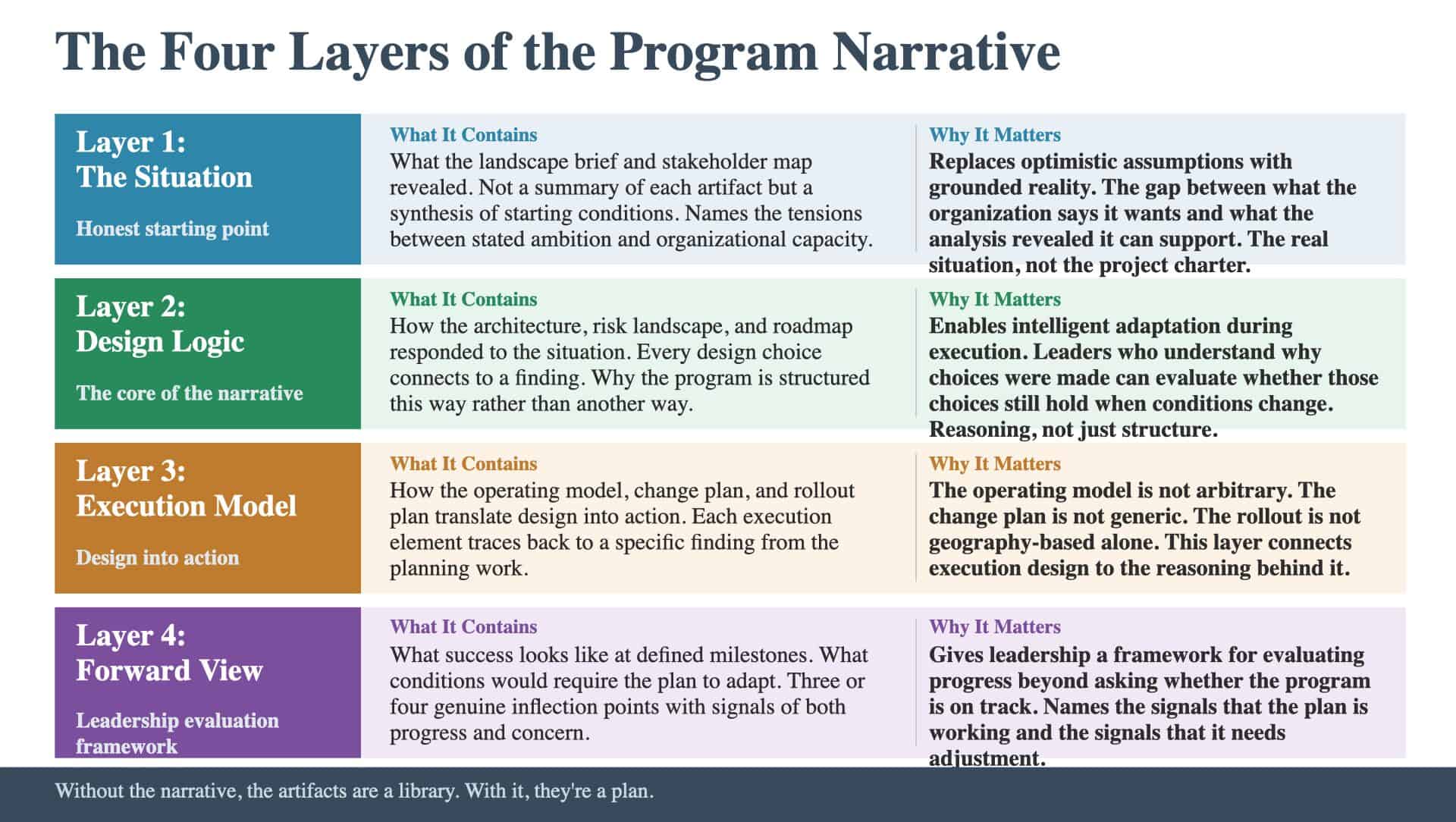
The planning engagement produced all nine artifacts. The landscape brief documented the starting conditions. The stakeholder map captured the political landscape. The architecture blueprint defined the structure. The risk landscape identified the threats. The integrated roadmap sequenced the work. The operating model defined how the program would run. The change plan designed the adoption path. The rollout plan structured the deployment. The close package prepared the handoff. Each artifact is complete. Each one answers its own questions. Together, they contain everything the organization needs to execute the program. But leadership doesn’t read nine artifacts. Leadership reads a narrative. The narrative is the synthesis layer that sits above the individual artifacts and explains how they connect, why the program is designed the way it is, and what the organization should expect during execution. Without the narrative, the artifacts are a library. With it, they’re a plan.
Why Summaries Fail and Synthesis Succeeds
The most common attempt at a narrative is a summary: a document that restates what each artifact contains. The landscape brief found these conditions. The stakeholder map identified these dynamics. The roadmap follows this sequence. The operating model works this way. Summaries fail because they preserve the artifact structure rather than transcending it. A leader reading a summary sees nine separate tools. They don’t see how the stakeholder dynamics shaped the architecture, how the architecture drove the sequencing, how the sequencing informed the rollout design, and how the rollout design determined the change approach. Synthesis reveals the connections that live between the artifacts. It answers the question that no individual artifact answers: why is this program designed the way it is?
The Four Layers of the Program Narrative
The narrative is built in four layers. Each layer adds depth. Together, they create the document that leadership needs to operate the plan.
Layer 1: The Situation
What the landscape brief and stakeholder map revealed. Not a summary of each artifact but a synthesis of the starting conditions. The synthesis question: given everything the consulting team learned during intake and stakeholder interviews, what is the actual situation this program is responding to? Not the stated situation from the project charter but the real situation that emerged from the analysis. This layer should name the tensions. The organization says it wants speed, but the stakeholder interviews revealed that three of the five workstream sponsors have competing priorities. The landscape brief found four prior initiatives that addressed similar territory, none of which were completed. The gap between stated ambition and organizational capacity is the real situation. The situation layer gives leadership an honest starting point. It replaces the optimistic assumptions that typically open a program with the grounded reality that the planning engagement uncovered.
Layer 2: The Design Logic
How the architecture blueprint, risk landscape, and integrated roadmap responded to the situation. This is the core of the narrative: the reasoning that connects conditions to structure to sequence. The synthesis question: given the situation, why is the program designed this way rather than some other way? The architecture was structured around five workstreams because the dependency analysis showed three natural clusters that couldn’t be separated and two that could run in parallel. The roadmap sequences operations before procurement because the stakeholder map revealed that the operations leader is the strongest sponsor and early success there builds credibility for the harder workstreams. The risk landscape identified the vendor dependency as the highest-severity risk, which is why the roadmap includes a contingency sequence that doesn’t require the integration module. Every design choice connects to a finding. The narrative makes those connections explicit. A leader reading this layer understands what the plan looks like and why it looks this way. That understanding is what enables them to make intelligent adjustments during execution.
Layer 3: The Execution Model
How the operating model, change plan, and rollout plan translate the design into action. This layer explains how the program will actually run. The synthesis question: how does the organization get from the plan on paper to results in practice? The operating model defines a weekly cadence with workstream leads and a biweekly steering committee because the risk landscape identified cross-workstream dependencies that need frequent coordination. The change plan sequences communications by audience because the stakeholder map showed that front-line teams and middle management have different concerns and different information needs. The rollout uses a four-wave structure because the architecture analysis showed that the pilot region has the simplest dependency profile and the highest leadership engagement. This layer connects the execution design to the program design. The operating model isn’t arbitrary. The change plan isn’t generic. The rollout isn’t based on geography alone. Each element of the execution model traces back to a specific finding from the planning work.
Layer 4: The Forward View
What success looks like at defined milestones, what conditions would require the plan to adapt, and what the organization should watch for. This layer connects directly to the Post-Engagement Success Criteria. The synthesis question: what should leadership expect, and what should concern them? The forward view names the milestones that matter. Not every milestone in the roadmap, but the three or four that represent genuine inflection points: the pilot completion, the first cross-workstream dependency resolution, the Wave 2 go/no-go decision, and the operating model transition from consultant-facilitated to internally-led. It names the signals that the plan is working: the operating rhythm is being maintained, the risk register is being updated, the governance meetings are producing decisions. It also names the signals that the plan needs adjustment: if the pilot identifies more than five unplanned dependencies, if the Wave 2 go/no-go criteria aren’t met on the first assessment, if the capability transfer stalls at Level 2. The forward view gives leadership a framework for evaluating progress. Without it, they default to asking whether the program is “on track,” which is a question that can always be answered yes until it can’t.
The Synthesis Process
Building the narrative requires working across artifacts rather than within them. The process: Start with the connections, not the contents. For each pair of adjacent artifacts, identify the link. What did the landscape brief reveal that shaped the architecture? What did the stakeholder map uncover that drove the roadmap sequence? What did the risk landscape identify that informed the rollout design? These connections are the narrative’s skeleton. Write the design logic first. Layer 2 is the hardest and most valuable. It forces the writer to articulate why the program is designed this way. If the reasoning can’t be articulated, it might not exist, and the design might be based on convention rather than analysis. Test with a reader who wasn’t in the room. The narrative succeeds when someone who didn’t participate in the planning engagement can read it and understand the program’s logic. If they need to ask “why did you sequence it this way?” the narrative hasn’t done its job. Keep it under 10 pages. The narrative is a leadership document, not a technical reference. It should take 20 minutes to read. Leaders who need more detail can go to the individual artifacts. The question is whether the organization builds a narrative that turns nine artifacts into one coherent program: or whether leadership inherits a library of documents without the synthesis to connect them.
Keep Reading
Explore the foundations and common gaps: