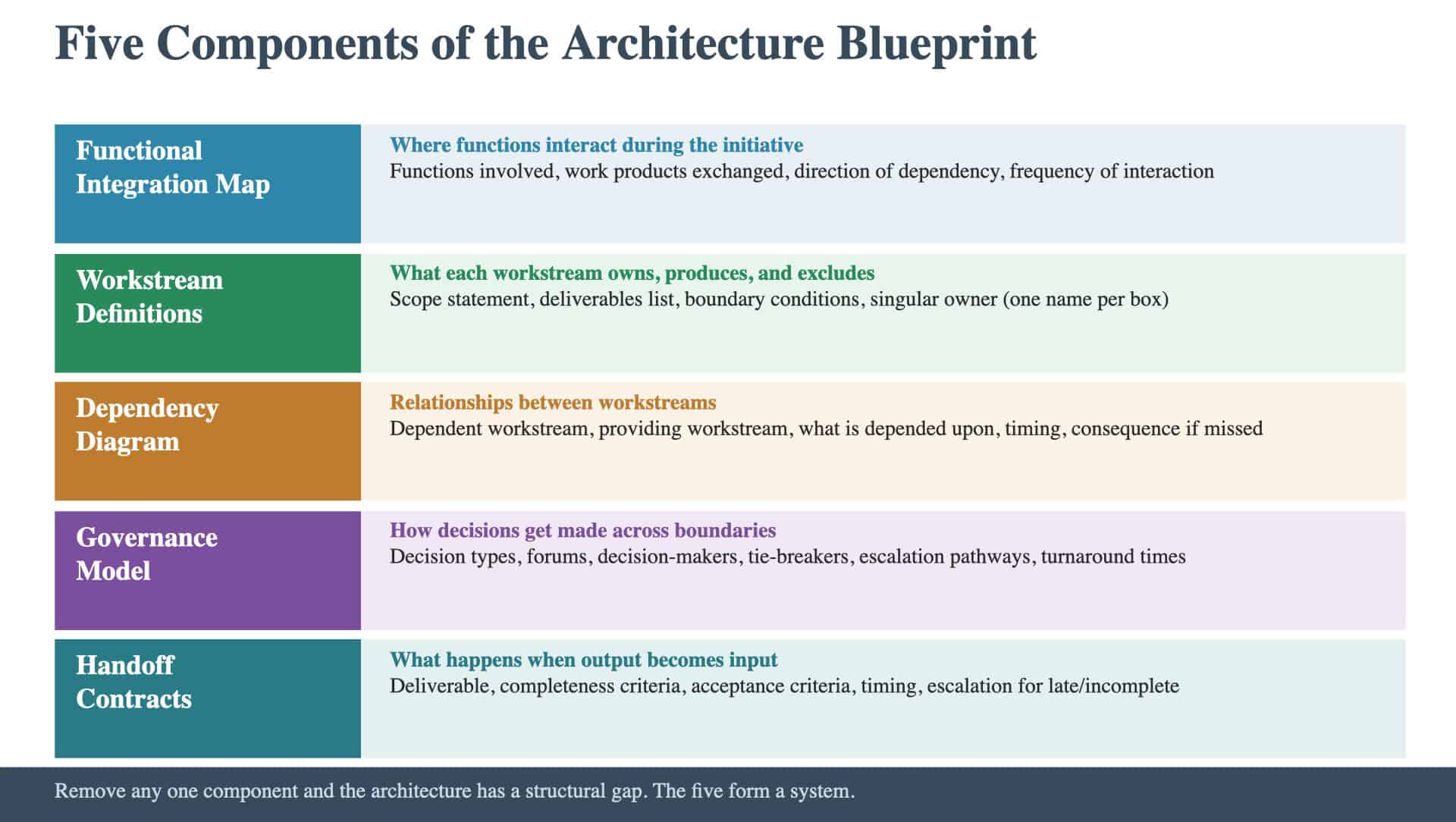
A structure diagram is a starting point. It shows boxes (workstreams, leadership roles, integration points) and lines (reporting relationships, coordination pathways). Most programs produce some version of this during planning. The question is whether the structure diagram has been developed into an Architecture Blueprint with the specificity required to govern execution. The Architecture Blueprint has five components. Each one addresses a different governance question that execution will force the team to answer. Programs that answer these questions during planning prevent the decision stalls, ownership gaps, and integration failures that characterize programs that skip architecture.
Component 1: The Functional Integration Map
The Functional Integration Map identifies where functions interact during the initiative. It’s a diagram of where work crosses functional boundaries (not the org chart) and where coordination is required. For each integration point, the map captures: which functions are involved, what work product flows between them, the direction of the dependency (who sends and who receives), and the frequency of interaction (one-time handoff, periodic sync, or continuous collaboration). The quality bar: the map includes every cross-functional touchpoint that will require coordination during execution. If integration points are discovered during execution that should have been visible during planning, the map was incomplete. The architecture nobody builds describes why functional integration mapping is skipped: teams assume integration will happen naturally. It does not.
Component 2: Workstream Definitions
Workstream Definitions specify what each workstream owns, what it produces, and where its boundaries are. A workstream definition includes: the scope (what is inside the workstream’s boundary), the deliverables (what the workstream produces), the owner (one name, singular accountability), and the boundary conditions (what is explicitly outside the workstream’s scope). The quality bar: workstream boundaries are explicit enough that two reasonable people would agree on whether a given task belongs to Workstream A or Workstream B. If tasks can plausibly belong to multiple workstreams, the boundaries are ambiguous, and ambiguous boundaries produce ownership gaps during execution. Boundary conditions matter as much as scope statements. Stating what a workstream does not own prevents the assumption creep where tasks migrate to whichever workstream seems closest, regardless of capacity or expertise.
Component 3: The Dependency Diagram
The Dependency Diagram maps the relationships between workstreams: which workstreams depend on others for inputs, which produce outputs that others consume, and which share resources that create scheduling constraints. For each dependency, the diagram captures: the dependent workstream, the providing workstream, what is being depended upon (a deliverable, a resource, a decision, or access), the timing (when the dependency must be fulfilled), and the consequence of the dependency being missed. The dependency diagram draws directly from the Cross-Functional Dependencies section of the Stakeholder Map (Beat 2). Dependencies identified during one-on-ones are translated into workstream-level dependencies in the architecture. New dependencies are also identified during architecture sessions as workstream boundaries are defined and the team recognizes connections that were not visible at the stakeholder level. Making the invisible visible connects to why dependency identification during architecture prevents the execution collisions that occur when dependencies are discovered in real time.
Component 4: The Governance Model
The Governance Model defines how decisions get made. It specifies decision types, decision forums, decision-makers, and escalation pathways. Decision types are categorized by scope and impact. Workstream-level decisions (affecting only one workstream) are made by the workstream owner. Cross-workstream decisions (affecting multiple workstreams) are made in a defined forum with representation from affected workstreams. Program-level decisions (affecting scope, timeline, or resources) are made by program leadership with sponsor input. For each decision type, the model specifies: who participates, who decides, how ties are broken, and what the expected turnaround time is. The turnaround time matters because decision latency is one of the primary execution killers in cross-functional programs. The quality bar: no decision type requires escalation to the executive sponsor as the default pathway. If every cross-functional decision goes to the sponsor, the governance model has failed to distribute decision authority appropriately. The governance problem nobody talks about documents how programs with RACI charts but no governance models experience decision paralysis at cross-functional boundaries.
Component 5: Handoff Contracts
Handoff Contracts define what happens at every point where one workstream’s output becomes another workstream’s input. For each handoff, the contract specifies: what is being handed off (the deliverable), the format and completeness criteria (what “done” means for the sender), the acceptance criteria (what “ready to receive” means for the receiver), the timing (when the handoff occurs), and the escalation pathway (what happens if the handoff is late or incomplete). Handoff contracts are the most frequently skipped component of program architecture, and their absence is the most common source of integration failures during execution. Without contracts, each side operates on assumptions about what the other side will deliver, in what format, and when. Those assumptions diverge. The divergence becomes visible only when the handoff occurs and the receiving team discovers that what was delivered does not match what was expected. The quality bar: both the sending and receiving workstream have reviewed and agreed to the handoff contract. A contract written by only one side reflects only one side’s assumptions. Programs that failed with good plans traces integration failures to the absence of handoff contracts. The workstreams each executed their plans successfully. The failures occurred at the handoff points between them.
How the Five Components Work Together
The five components form a system. The Functional Integration Map identifies where coordination is needed. Workstream Definitions assign ownership. The Dependency Diagram maps the relationships between owners. The Governance Model defines how decisions get made across those relationships. Handoff Contracts specify what happens at each connection point. Remove any one component and the architecture has a structural gap. Without integration mapping, the team does not know where coordination is needed. Without workstream definitions, ownership is ambiguous. Without dependency mapping, scheduling assumptions go untested. Without governance, cross-functional decisions stall. Without handoff contracts, integration points become collision points. The Architecture Blueprint is complete when all five components are defined and the architecture team can trace any piece of cross-functional work from the integration map through workstream ownership, dependency relationships, governance pathways, and handoff contracts. The question is whether your architecture will trace cleanly from integration map to handoff contract before execution begins: or whether execution will reveal the gaps your planning process left behind.
Keep Reading
Ready to close specific gaps in your Architecture Blueprint? These articles show you how: