Everyone Agreed the Support Was Needed. Nobody Committed to Providing It.
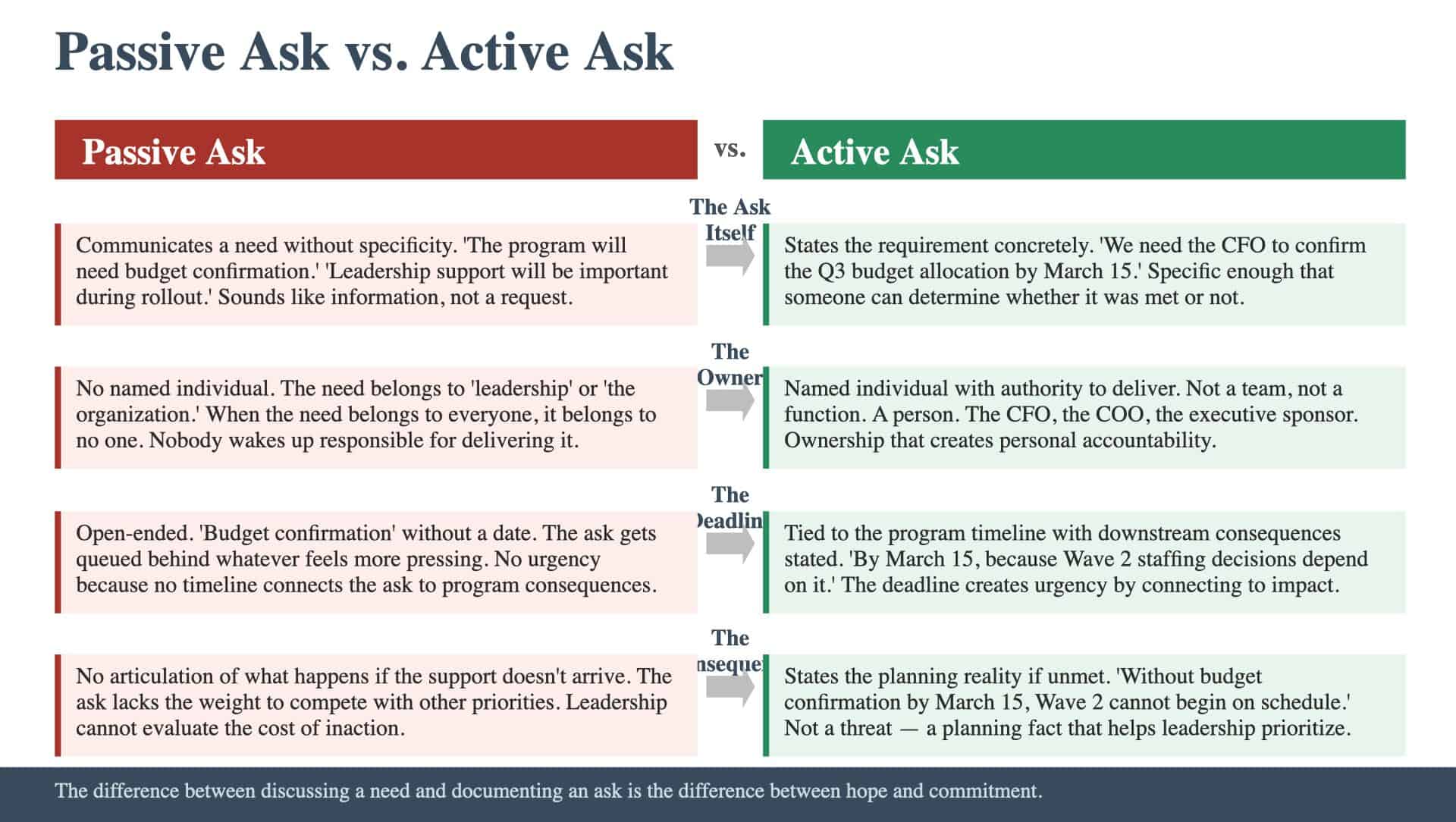
The planning engagement identified clear requirements for execution success. The program needed a confirmed budget allocation for Q3. It needed a staffing decision about dedicated resources. It needed the executive sponsor to provide visible support during the first wave of the rollout. It needed the COO to resolve a competing initiative that was consuming the same resources. These needs were discussed during the engagement. They were mentioned in meetings. Everyone agreed they were important. The readout included a slide titled “Key Dependencies” that listed them in bullet points. None of them were delivered. The budget commitment slipped because the CFO’s attention moved to a different priority. The staffing decision was deferred. The executive sponsor provided generic support but didn’t know what specific actions were needed. The competing initiative continued unchecked. The program had identified what it needed. It hadn’t created accountability for delivering it. The difference between discussing a need and documenting an ask is the difference between hope and commitment. The Open Items sub-artifact is where these asks live and get tracked.
Why Readout Slides Don’t Create Accountability
A readout slide that says “Key Dependencies” is informational. It communicates what the program needs. It doesn’t create the conditions for those needs to be met. Two reasons: No owner. The slide lists what’s needed but not who specifically needs to deliver it. “Budget confirmation” is a need. “The CFO needs to confirm the Q3 allocation” assigns ownership. Without a named owner, the need belongs to everyone, which means it belongs to no one. No deadline. The slide doesn’t specify when the support is needed. “Budget confirmation” is open-ended. “The CFO needs to confirm by March 15 because Wave 2 staffing decisions depend on it” creates urgency. Without a deadline, the ask gets queued behind whatever feels more pressing: and without stated consequences, it lacks the weight to compete with other priorities.
What an Ask List Actually Contains
An ask list captures four elements for each requirement: The ask. What’s needed, stated concretely. Not “leadership support” but “the executive sponsor to attend the Wave 1 launch meeting and communicate the program’s priority to the regional leadership team.” The specificity determines whether the ask can be acted on. The owner. Who needs to deliver it. A named individual. If the ask requires action from multiple people, each person gets their own ask with their own deliverable. The deadline. When it’s needed. Tied to the program timeline. The deadline should reference the downstream consequence: “by March 15, because Wave 2 staffing decisions depend on this input.” The consequence of non-delivery. What happens if the ask isn’t met. This isn’t a threat. It’s a planning reality. If the budget isn’t confirmed, the wave can’t start. If the staffing decision isn’t made, the support model is under-resourced. Stating consequences helps leadership prioritize among competing demands. The quality bar: each ask is specific enough to create accountability. Someone reading the ask list six months later can determine whether each ask was met, partially met, or unmet.
The Passive-Ask Trap
The most common failure in ask lists is passivity. The team presents the list as information rather than as requests requiring commitment. Passive asks sound like: “The program will need budget confirmation.” “Leadership support will be important during rollout.” “Staffing decisions should be made soon.” Active asks sound like: “We need the CFO to confirm the Q3 budget allocation by March 15. Without it, Wave 2 cannot begin on schedule.” “We need the executive sponsor to attend the Wave 1 launch meeting on April 3 and communicate the program’s priority to the regional leadership team.” “We need the COO to make the dedicated resource allocation decision by February 28.” The difference is operational. Passive asks communicate needs. Active asks create commitments. The readout should end with each ask owner acknowledging their ask and either committing or specifying when the commitment will be made. If a commitment can’t be made in the room, the ask shouldn’t disappear. It should get a follow-up date, a follow-up owner, and a tracking mechanism. Uncommitted asks are the most dangerous category because they feel addressed (they were discussed) while remaining unresolved (nobody committed).
Categories of Asks Most Programs Need
Planning engagements typically produce asks in five categories: Budget asks. Specific funding commitments for execution. Not “the program needs budget” but “the program needs $X confirmed for the following line items by the following dates.” Staffing asks. Specific decisions about dedicated resources. Who is assigned to the program full-time? Who is shared? When does the assignment start? These decisions often require trade-offs with other priorities, which is why they need explicit asks rather than assumed support. Decision asks. Specific decisions that leadership needs to make before execution can proceed. Strategic choices that are above the program team’s authority. If these decisions are delayed, execution is blocked. Air cover asks. Specific instances where leadership needs to visibly support the program. During rollout resistance, during budget negotiations, during competing priority discussions. Air cover can’t be generic. The ask should specify the situation, the audience, and the message. Sequencing asks. Specific requests to adjust competing initiatives. If the change plan’s readiness assessment identified change saturation, the ask might be to defer a competing initiative or to sequence it differently.
How to Build the Ask List from What You Have
Programs at this stage have identified needs but haven’t formalized them into accountable asks.
- Start with the readout slides. Any bullet point under “Key Dependencies” or “Leadership Support Needed” is a candidate for the ask list. Convert each bullet into the four-element format: ask, owner, deadline, consequence.
- Then check the planning artifacts. The risk register likely includes mitigation actions that require leadership involvement. The change plan likely includes communication actions that require executive messengers. The rollout plan likely includes resource requirements that haven’t been committed. Each of these is an implicit ask that needs to be made explicit.
- Finally, pressure-test the timing. For each ask, trace the deadline back to the program timeline. If the budget confirmation is needed by March 15, does the CFO know that? If the staffing decision is needed by February 28, is that on the COO’s calendar? The question is whether the organization converts discussed needs into explicit commitments with named owners: or whether the support requirements stay on a readout slide while the program runs without the backing it was promised.
Keep Reading
New to the Close Package? Start with the foundations:
Ready to benchmark your work against best-in-class? See what excellence looks like: