The Engagement: A 16-Week Operating Model Redesign
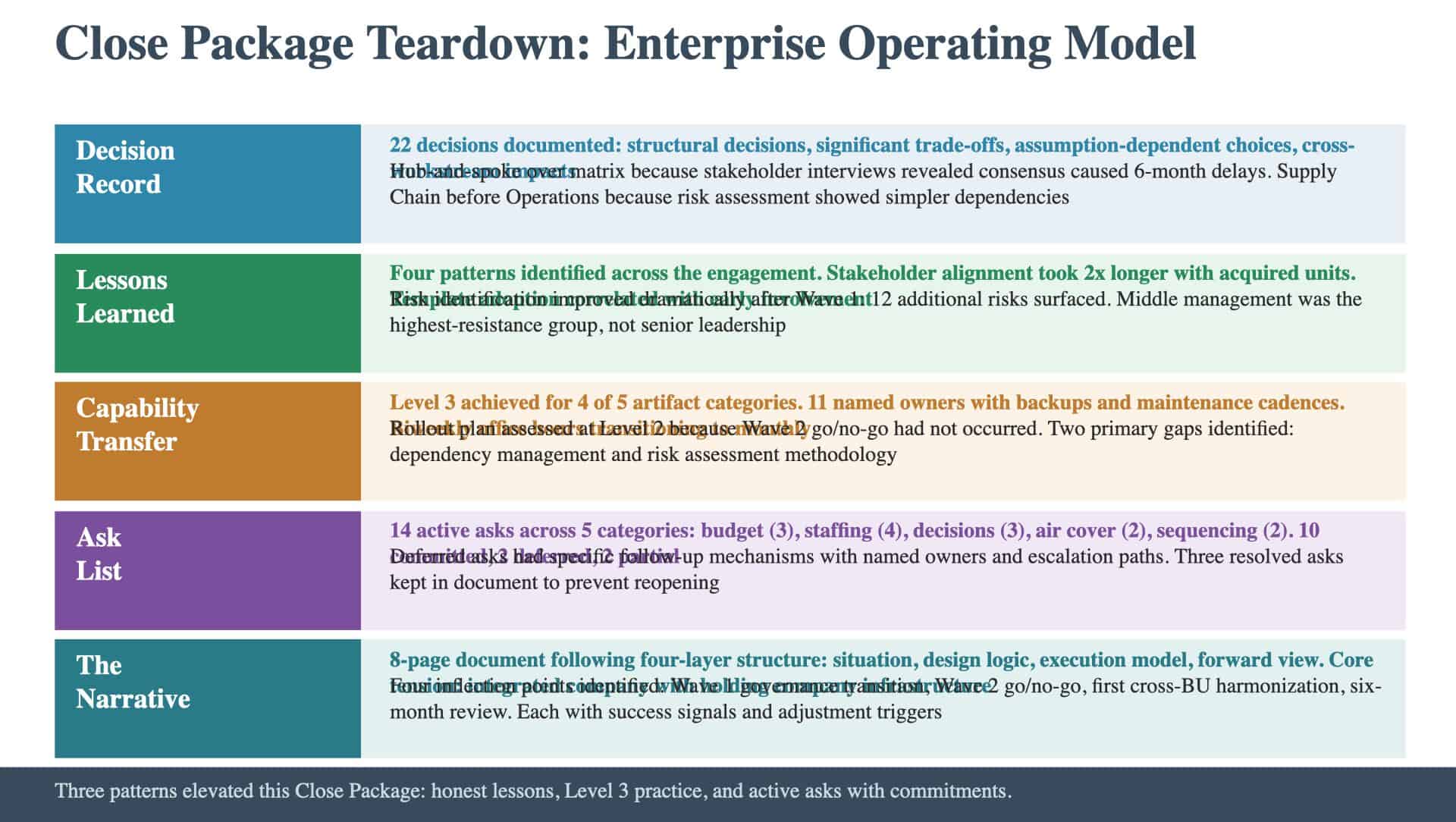
A Fortune 200 industrial company was redesigning its operating model across four business units. The existing model had evolved through acquisitions: each business unit ran its own planning processes, governance structures, and reporting cadences. The CEO wanted a unified operating model that could support the company’s shift from a holding company structure to an integrated operating company. The planning engagement ran 16 weeks and produced all nine artifacts. The close package was the final deliverable, designed to enable the internal transformation office to execute the plan without ongoing consulting support through a structured operating system handoff. Here is what each section contained and why it was built that way.
The Decision Record: 22 Decisions That Shaped the Plan
The engagement produced 22 decisions that met the documentation threshold: structural decisions, significant trade-offs, assumption-dependent choices, and cross-workstream impacts. Three examples illustrate the level of detail: Decision 7: Governance model uses a hub-and-spoke structure rather than a matrix. The team considered two governance models. A matrix model would give each business unit equal representation on every decision; a hub-and-spoke model would centralize cross-cutting decisions at the corporate level while delegating business-unit-specific decisions locally. The team chose hub-and-spoke because the stakeholder interviews revealed that the business unit presidents valued autonomy for operational decisions but acknowledged that cross-cutting decisions needed a single authority. The matrix model would have required consensus across four business units for every cross-cutting decision, which the landscape brief analysis showed had historically produced six-month delays. The assumption: the corporate transformation office has sufficient authority and credibility to make cross-cutting decisions without requiring business unit consensus for each one. Decision 12: Wave 1 starts with Supply Chain and Finance, not Operations. The initial assumption was that Operations would go first because it was the largest function. The risk assessment showed that Operations had the most complex dependency profile and the lowest readiness score. Starting with Operations would mean the most difficult transition first, with the least organizational learning to draw on. Supply Chain and Finance had simpler dependency profiles and stronger local leadership support; starting there would build organizational muscle for the harder transitions later. The assumption: Supply Chain and Finance can be meaningfully integrated before the Operations wave begins, and the lessons from those waves will transfer. Decision 19: The operating rhythm transitions from consultant-facilitated to internally-led at the end of Wave 1, not Wave 2. The original plan had the consulting team facilitating governance through Wave 2. The capability transfer assessment showed that the internal team had the skills to facilitate after Wave 1 if they received coaching during that wave. Extending consultant facilitation through Wave 2 would have delayed the team’s independence without proportional benefit. The assumption: the internal team’s Wave 1 facilitation experience, combined with a retained advisor for questions, is sufficient to maintain governance quality.
The Lessons Learned: Patterns That Shaped the Plan
The lessons learned document identified key patterns across the engagement. Pattern 1: Stakeholder alignment takes twice as long with acquired business units. The business units acquired within the last five years required significantly more alignment time than the legacy units. The stakeholder mapping took one week for legacy units and two to three weeks for acquired units. The lesson: future phases should budget double the alignment time for acquired entities and should engage the acquired unit’s legacy leadership, not just current management. Pattern 2: Template adoption correlates with early involvement. Teams involved in customizing the operating model templates adopted them faster than teams that received pre-built templates. The Finance team, which co-designed its governance cadence, was running independently by week 12. The Supply Chain team, which received a completed template in week 8, was still adapting it at week 14. The lesson: involvement during design accelerates adoption during execution. Pattern 3: Risk identification improves dramatically after the first wave. The pre-mortem identified 34 risks before Wave 1. The Wave 1 experience revealed 12 additional risks that the pre-mortem missed, all related to the transition period between old and new operating models. The lesson: the risk register should be treated as a living document with a formal update cycle after each wave. Pattern 4: The biggest resistance came from middle management, not senior leadership. The change plan initially focused communication and engagement efforts on senior leaders and front-line employees. Middle managers, who experienced the most day-to-day disruption, received less attention. The readiness assessment at week 10 showed middle management as the highest-resistance group. The lesson: middle management should be a primary audience for change planning from the start.
The Capability Transfer: Level 3 Achieved for Four of Five Artifact Categories
The capability transfer achieved Level 3 (practice under realistic conditions) for the roadmap, governance model, risk register, and change plan. The rollout plan was assessed at Level 2 (training) because the Wave 2 go/no-go decision hadn’t occurred during the engagement period. The ownership assignment named 11 owners across the five artifact categories. Each owner had a named backup, a maintenance cadence, and access to the retained advisor for the first six months. The support plan specified biweekly office hours with the lead consultant for the first quarter, transitioning to monthly in the second quarter. The capability transfer documentation included a gap assessment: the areas where the internal team’s competence was weakest. The two primary gaps were dependency management (updating cross-workstream dependencies when plans changed) and risk assessment methodology (applying consistent severity and likelihood ratings to new risks). The support plan specifically allocated office hours time to these two areas.
The Ask List: 14 Active Asks with Commitment Status
The ask list documented 14 leadership asks across five categories: budget (3), staffing (4), decisions (3), air cover (2), and sequencing (2). Of the 14 asks, 10 received commitments in the final readout session. Two were deferred with follow-up dates and owners; two were partially committed, with the full commitment contingent on Q2 budget finalization. The two deferred asks had specific follow-up mechanisms: the CFO’s chief of staff owned the follow-up for both budget-related asks, with a commitment date of February 15 and an escalation path to the CEO if the date was missed. The ask list also tracked three asks that had been resolved during the engagement. These were kept in the document with their resolution status to prevent them from being reopened.
The Narrative: 8 Pages That Told the Program’s Story
The narrative ran eight pages and followed the four-layer structure: situation, design logic, execution model, and forward view. The situation layer named the core tension: an organization that wanted to operate as an integrated company but had the infrastructure, habits, and incentive structures of a holding company. Every design choice in the program traced back to this tension. The design logic layer explained why hub-and-spoke governance, why the Supply Chain and Finance wave sequence, why the specific operating rhythm cadence. Each choice connected to a specific finding from the planning engagement. The forward view identified four inflection points: the Wave 1 governance transition, the Wave 2 go/no-go decision, the first cross-business-unit process harmonization, and the six-month operating model review. For each, the narrative described what success looked like and what signals would indicate the plan needed adjustment. A Close Package that transfers the capability to run the plan independently is what separates an engagement that ends well from one that ends with a handshake and a shared drive nobody opens after the first quarter.
Go Deeper: The Close Package
This article covers one dimension of the Close Package, the ninth and final artifact in the Planning & Roadmapping method. The Close Package answers the board question: “What do we leave behind?” Explore the full Close Package → Want us to build this with you? Book a consultation →
Keep Reading
Explore the foundations and common gaps:
- What a Close Package Is and Why Plans Die After the Consultants Leave
- You Have a Readout but Not a Decision Record