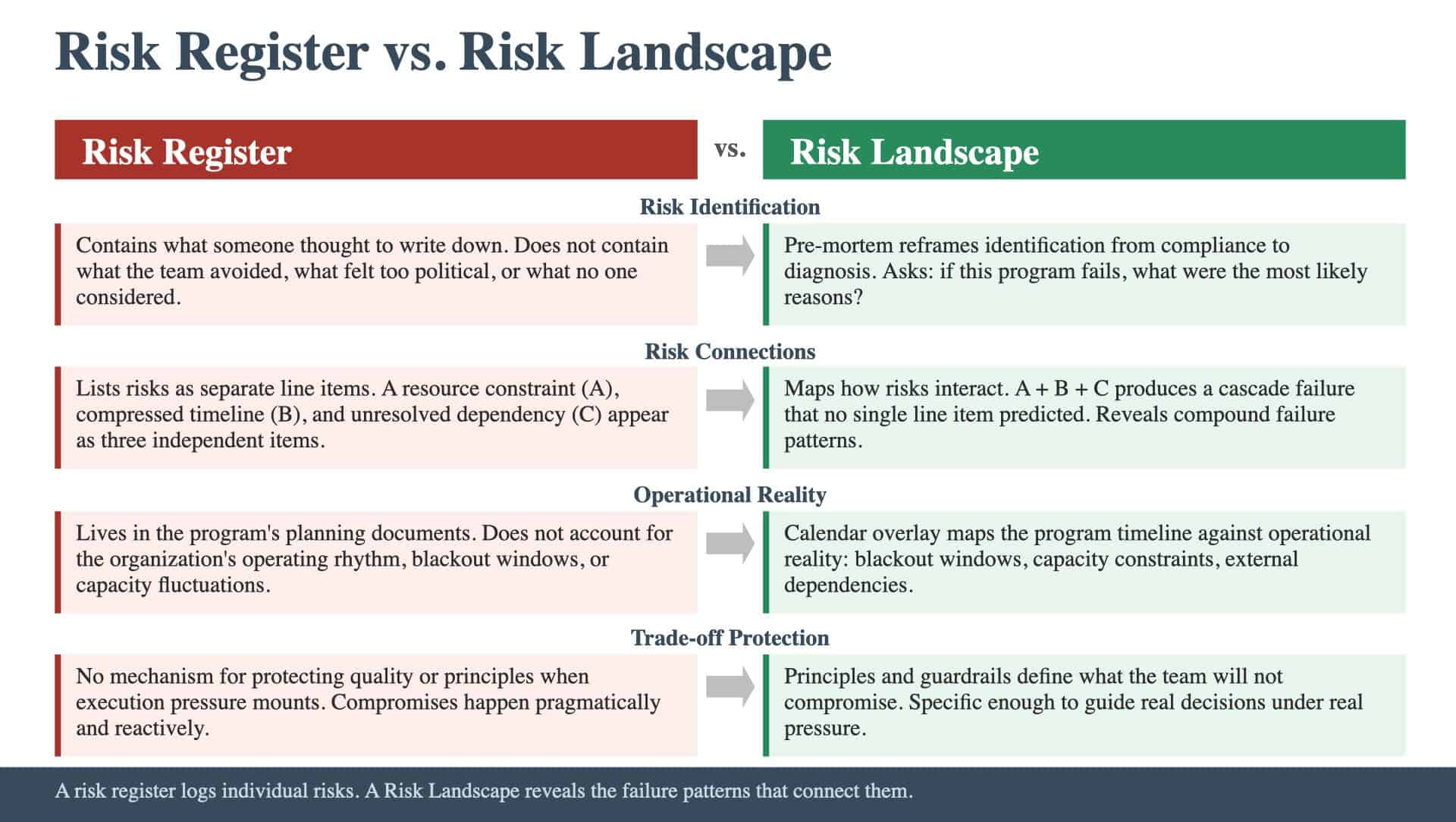
Every planning process includes some form of risk identification. The team names risks, assigns likelihood and impact scores, and logs them in a register. The register sits in a shared folder, referenced during status meetings and updated when someone remembers. The Risk Landscape is a different artifact. It does not replace the risk register. It contextualizes it. The Risk Landscape combines a pre-mortem exercise (what would cause this program to fail?), a structured risk register (which risks are being mitigated, monitored, or accepted?), a calendar overlay (which operational constraints intersect with the timeline?), and a principles and guardrails document (what will the team refuse to compromise on when execution gets difficult?). The distinction matters because risk registers treat risks as independent items. The Risk Landscape treats them as a system, revealing the connections between risks, the failure patterns that emerge when multiple risks interact, and the organizational constraints that amplify individual risks into program-level threats.
What a Risk Register Tells You (and What It Cannot)
A risk register tells the team that specific risks exist. It scores them by likelihood and impact. It assigns owners and mitigation actions. This is useful for tracking individual risks through the program lifecycle. Three things the risk register cannot do: It cannot identify risks that no one has named. The register contains what someone thought to write down. It does not contain what the team avoided discussing, what no one considered, or what felt too politically sensitive to raise. The pre-mortem is the mechanism that identifies these risks. By asking “if this program fails, what are the most likely reasons?”, the pre-mortem reframes risk identification from a compliance exercise to a diagnostic one. It gives people permission to name the elephants in the room. It cannot show how risks connect. A register lists risks as separate line items. In practice, risks interact. A resource constraint on the technology team (Risk A) compounds with a compressed timeline for data migration (Risk B) to create an integration failure (Risk C) that was not on the register because it only emerges from the combination. The Risk Landscape maps these connections. It cannot account for operational reality. The register lives in the program’s planning documents. The operational calendar lives in the business’s operating rhythm. When the two are not overlaid, the program discovers timing collisions during execution: a go-live date that falls during a regulatory filing period, a deployment window that conflicts with seasonal operations, a staffing assumption that ignores the organization’s annual budget cycle. The risk nobody put on the register describes the pattern: risks that were knowable but never registered because the process for identifying them did not exist.
What the Risk Landscape Contains
The Risk Landscape has four components. The pre-mortem output. A prioritized list of failure modes generated through a structured exercise where the team imagines the program has failed and works backward to identify the most likely causes. The pre-mortem generates failure modes that are more specific and more honest than traditional risk identification because the framing (the project has already failed) creates psychological permission to name uncomfortable realities. The risk register. A structured catalog of identified risks with likelihood, impact, owner, and disposition (mitigate, monitor, or accept). The register is populated from the pre-mortem output plus risks identified during stakeholder mapping, architecture sessions, and the calendar overlay. The calendar overlay. A visual mapping of the program timeline against the organization’s operational calendar. The overlay identifies:
- Blackout windows: periods when changes cannot occur
- Capacity constraints: periods when the organization’s bandwidth is reduced
- External dependencies (regulatory deadlines, vendor milestones, customer commitments) that intersect with the program timeline
The principles and guardrails one-pager. A concise document stating what the team will and will not compromise on when execution pressure mounts. Principles are specific enough to guide trade-offs. “Quality matters” is a platitude. “The team will not deploy without automated regression tests passing” is a guardrail. The difference is that guardrails actually prevent the compromises that execution pressure creates. Why pre-mortems change the conversation explains the psychological mechanism: by reframing risk identification as failure prevention rather than dissent, the pre-mortem unlocks candor that traditional risk workshops suppress.
Why Programs Fail Without It
Programs that rely on a risk register alone experience predictable failures. The unnamed risk. The program encounters a failure mode that no one registered because the risk identification process did not create space for honest, uncomfortable answers. The failure mode was knowable. It was not known because the process for identifying it did not exist. Pre-mortems surface these risks. Traditional risk workshops often do not. The compound risk. Two or three individual risks, each rated as medium-likelihood, interact to produce a high-severity outcome. The register treated them as independent items. In practice, they were connected: a resource constraint plus a timeline compression plus an unresolved dependency created a cascade failure that no single risk line item predicted. The timing collision. The program’s timeline assumed operational capacity that did not exist during a specific period. A go-live date landed during the organization’s busiest operational period. A milestone required infrastructure team availability during a period when that team was committed to another initiative. The collision was foreseeable with a calendar overlay. Without one, it was a surprise. Programs that failed with good plans documents programs where each of these three failure patterns occurred. In every case, the risk was knowable during planning. The planning process did not include the mechanism to identify it.
The Relationship to Upstream and Downstream Artifacts
The Risk Landscape sits between the Architecture Blueprint (Beat 3) and the Integrated Roadmap (Beat 5). It consumes the program structure, workstream definitions, dependencies, and governance model from the Architecture Blueprint and stress-tests them: given this architecture, what could go wrong? It feeds the Integrated Roadmap by providing the constraints the roadmap must accommodate: blackout windows from the calendar overlay, buffer requirements from high-priority risk mitigations, and the guardrails that define what the roadmap cannot sacrifice for speed. Without an Architecture Blueprint, the pre-mortem lacks a structure to stress-test. Without a Risk Landscape, the roadmap is built on unexamined assumptions about what could go wrong and when. The architecture nobody builds explains why the sequence matters: architecture defines the structure, and the pre-mortem tests it. The question is whether your next initiative will identify its failure modes during planning: or whether your team will discover them during execution, when the cost of response is highest and the options for mitigation are most constrained.
Go Deeper: The Risk Landscape
This article covers one dimension of the Risk Landscape, the fourth of nine artifacts in the Planning & Roadmapping method. The Risk Landscape answers the board question: “What could break this?” Explore the full Risk Landscape →
Keep Reading
Ready to close specific gaps in your Risk Landscape? These articles show you how: