
Problem Section
Header: Execution Readiness Starts in the Planning Phase Cross-functional programs enter execution with some version of a plan in place: a strategy deck, a project charter, workstream timelines assembled across functions. But the pieces rarely connect. Dependencies go unmapped, stakeholder alignment gets assumed rather than verified, and the operating model meant to coordinate across functions never gets designed. The Scorecard identifies those planning gaps before they show up mid-execution, when fixing them costs the most.
What It Measures
Header: Nine dimensions of execution readiness The Scorecard assesses your program across nine planning dimensions that determine whether programs deliver or stall. Each maps to a concrete deliverable: the artifact your team either has, partially has, or hasn’t built yet.
How Scoring Works
Header: Where to focus first Twenty-seven questions across nine pillars, each scored 0 to 2. Your total places you in one of three readiness tiers: 0-18: Fragmented Core artifacts are missing or incomplete. Start with artifact inventory and stakeholder mapping before building forward. 19-36: Foundation Exists Some artifacts are in place, but gaps remain at the integration points. Focus on dependency mapping and governance design. 37-54: Execution-Grade The plan holds under pressure. Focus on capability transfer and making sure what you’ve built outlasts the engagement.
What You Get
Header: A pillar-by-pillar prescription After completing the Scorecard, you get a breakdown tailored to your specific gaps. Low-scoring pillars point you to foundational content: what the artifact is, what it contains, and what happens when programs skip it. Mid-to-high scorers get the gap-closing playbook (moving from “we have something” to “it’s execution-grade”) along with quality benchmarks and teardowns from real engagements. Every recommendation connects to a specific artifact and a specific next step.
Credibility Section
Header: Built from the diagnostic we run with every client The Scorecard is the same assessment we run at the start of every Planning & Roadmapping engagement. The nine pillars are the nine artifacts we build with clients across a structured engagement sequence, each answering a board-level question:
- What did we find?
- Who matters?
- How is it structured?
- What could go wrong?
- What’s the plan?
- How will it run?
- Who needs to change?
- How do we roll it out?
- What stays when we leave?
Programs that answer all nine tend to deliver. Skip one, and it tends to show up mid-execution, when it’s expensive to fix.
Final CTA Section
Header: See Where Your Program Stands The Scorecard is free, takes five minutes, and returns a diagnosis specific to your program’s gaps. If you’re running a cross-functional program with board visibility and a traction window measured in months, this tells you where to focus before execution starts. CTA button: Take the Scorecard Below CTA (smaller text): Want us to build the plan with you? Book a consultation
Nine Dimensions of Execution Readiness
Three Readiness Tiers
Critical gaps across most dimensions. The program plan lacks the structural integrity to survive execution.
Some dimensions are addressed, but significant gaps remain. Execution will stall without focused remediation.
All nine dimensions are substantively addressed. The plan is built to survive contact with reality.
The Eight Program Archetypes
Every program falls into a pattern. These eight archetypes describe where your planning is strong, where it breaks down, and what to fix first.

The Strategist
Plans beautifully. Cannot execute.
Your program has a strong planning foundation: landscape understanding, stakeholder clarity, and architectural thinking are well above average. But execution infrastructure is underdeveloped. Operating model, change management, and rollout planning scored in the bottom third. This is the Strategist pattern: the plan is sound, but the organization lacks the installed structure to run it.
Read more →
The Operator
Executing fast on an underspecified plan.
Your program has built the coordination infrastructure: governance, rollout sequences, and change management. But the foundations are shaky. The team is running a program that was never properly scoped, with stakeholders who were never properly mapped. This is the Operator pattern: strong coordination pointed at the wrong targets because the planning beneath it was skipped.
Read more →
The Sprinter
Strong out of the gate. Fades before the finish.
Your program designed the plan, mapped the risks, and built the roadmap, but ran out of gas at the finish line. There is no rollout sequence, no transfer plan, and no close package. This is the Sprinter pattern: the program launches but does not land, because the organization was never equipped to run it independently after the consulting team leaves.
Read more →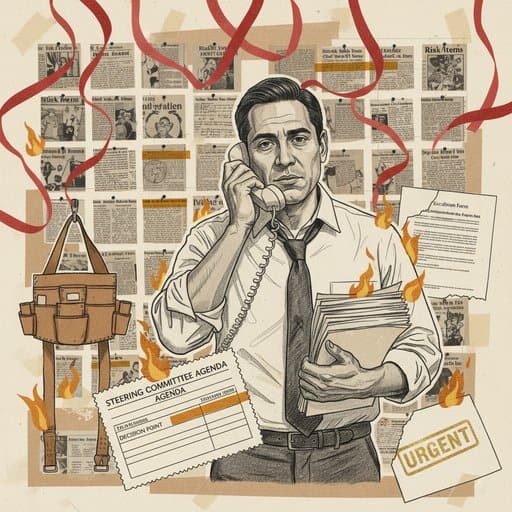
The Firefighter
Risk-aware but structurally unable to respond.
Your program has a sophisticated risk register and can articulate every failure mode, but the surrounding infrastructure is too fragmented to act on any of it. Governance, roadmap, and rollout plan are all underdeveloped. This is the Firefighter pattern: full visibility into what could go wrong, with no operational mechanism to respond when it does.
Read more →
The Coordinator
Meetings run on time. Nobody knows why.
Your program has built an impressive governance structure: meeting cadences, decision forums, and integrated timelines. But the fundamentals were skipped. Nobody baselined the landscape, and stakeholder dynamics were assumed rather than mapped. This is the Coordinator pattern: the coordination machinery is running, but nobody is sure it is coordinating the right things.
Read more →
The Island Builder
Five good plans that do not add up to one program.
Your program has strong individual workstreams: plans are detailed, milestones defined, and owners clear. But nothing connects them. Cross-functional dependencies were never mapped and no integration layer exists. This is the Island Builder pattern: five good plans that do not add up to one program, with siloed dashboards and handoffs that nobody owns.
Read more →
The Blank Slate
Not a failure. A starting point.
Your program has not yet built planning infrastructure across any phase: scope, design, or delivery are all in early stages. This is not a failure; it is a starting point. The risk is not a specific gap but the temptation to build everything at once. This is the Blank Slate pattern: the opportunity is to sequence correctly, starting with Phase 1 foundations before touching execution.
Read more →
The Complete Program
Mature across all dimensions. Now pressure-test it.
Your program shows genuine planning maturity across all 9 dimensions: foundations are solid, execution infrastructure exists, and the close is designed. The risk is not a gap but untested confidence. Has the plan been pressure-tested? Have assumptions been challenged? This is the Complete Program pattern: completeness is real, but the question is whether the plan reflects reality under stress.
Read more →Find Out Where You Stand
Five minutes. Nine dimensions. One clear picture of your program's readiness.
or book a call to talk through it directly