The Plan Was Ready. The Launch Wasn’t.
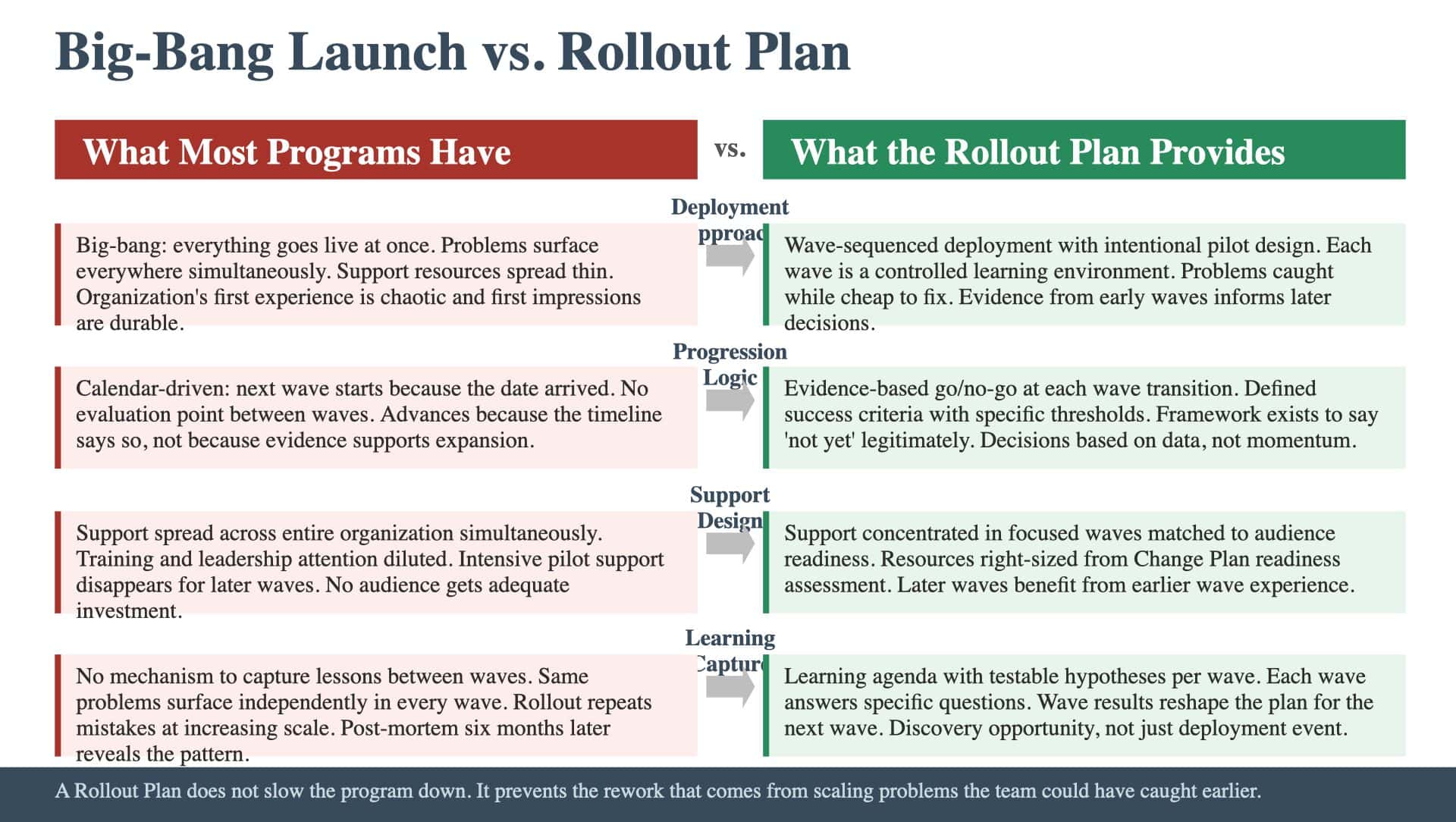
There is a moment in every large program when the planning work is done and the team faces the question: how do we actually deploy this? The roadmap is sequenced. The operating model defines governance. The change plan maps audiences and readiness. Everything looks ready. The instinct is to launch everywhere at once. The logic seems sound: the plan is complete, the team is aligned, momentum is high, and delay risks losing organizational attention. So the team flips the switch across all sites, all functions, all geographies simultaneously. This is the big-bang approach, and it fails for a predictable reason. When problems surface at scale, they’re hardest to fix and most visible to the organization. Issues that would have been learning opportunities in a controlled pilot become crises in full production. By the time anyone understands what went wrong, the damage extends beyond the technical failure to the organization’s confidence in the program itself.
What a Rollout Plan Actually Is
A Rollout Plan is the bridge from plan to production. It takes the completed roadmap and translates it into a sequenced deployment approach that manages risk while building toward full implementation. The artifact answers five questions:
- What is the rollout sequence? Which sites, teams, or functions go first, and why? Pilots, early waves, and full-scale deployment, each with intentional selection criteria.
- What are the success criteria? For each wave, what has to be true before the program expands? Specific, measurable thresholds that make go/no-go decisions explicit.
- What are the dependencies between waves? What must be complete in one wave before the next can begin? The gating logic that prevents premature expansion.
- What support is required? Training, tooling, staffing, and escalation paths for each wave, right-sized to the audience and the phase.
- What is the learning agenda? What questions should each wave answer? What hypotheses is the team testing? Each wave is a discovery opportunity, not just a deployment event.
The Rollout Plan is not a timeline with milestones. It’s a learning strategy that sequences deployment to maximize what the team discovers while minimizing the risk of discovering it at scale.
Why Sequencing Matters More Than Speed
The pressure to move fast is real. Executives want results. Stakeholders want visibility. The team has been planning for weeks or months and wants to see the work come to life. Speed feels like progress. But speed without sequencing is recklessness. A wave-based rollout manages risk by creating controlled environments where the team can learn cheaply. The pilot is where the team discovers what they got wrong. The early waves are where they refine. By the time they hit full scale, they’ve already worked through the edge cases and failure modes that would have been catastrophic in a simultaneous launch. Each wave also produces data. Are people adopting the change? Is the process working? Are the projected benefits materializing? Evidence from early waves informs decisions about later ones. Without that evidence, the team is scaling based on hope rather than signal. The sequencing also matches resource deployment to organizational capacity. Training and leadership attention are finite. Spreading them across the entire organization simultaneously dilutes everything. Concentrating them in focused waves ensures each audience gets the investment it needs.
What Happens Without One
Without a Rollout Plan, programs default to one of two patterns, both of which fail. The first is the big-bang launch. Everything goes live at once. Problems surface everywhere simultaneously, overwhelming the team’s ability to respond. Support resources are spread so thin that no audience gets adequate attention. The organization’s first experience with the change is chaotic, and first impressions are durable. The second is the informal rollout. The team knows a phased approach is better but doesn’t formalize it. Some sites go first because they volunteered or because their leaders are supportive. There are no explicit success criteria, no gating decisions, no learning agenda. The team moves to the next wave on the calendar rather than on the evidence. Problems from early waves aren’t captured systematically, so they repeat in later waves. Both patterns share the same root cause: the team treated rollout as an execution task rather than a planning discipline. The Rollout Plan brings the same rigor to deployment that the roadmap brought to sequencing and the operating model brought to governance.
The Pilot Is Not a Demo
The most common misunderstanding about rollout planning is the purpose of the pilot. A pilot is not a demonstration that the change works. It’s a stress test designed to reveal what doesn’t work. This distinction shapes every decision about pilot design. If the pilot is a demo, the team selects the friendliest audience in the most favorable conditions and declares success when nothing breaks. If the pilot is a stress test, the team selects an environment complex enough to identify real issues while contained enough that failures don’t cascade. The friendly-fire trap is running a pilot with the most enthusiastic team in the easiest environment. The pilot succeeds, but it reveals nothing about how the change will perform in less favorable conditions. When the program expands to harder environments, it encounters problems for the first time, at a scale where they’re harder to manage. A well-designed pilot answers the questions: What breaks? What takes longer than expected? Where do people struggle? What assumptions were wrong? The answers reshape the plan for subsequent waves. A pilot that reveals no problems either wasn’t designed to find them or wasn’t honest about reporting them.
Where This Fits in the Larger Method
The Rollout Plan is the eighth of nine artifacts in the planning and roadmapping method. It sits between the Change Plan, which defines how the organization will be brought along, and the Close Package, which transfers ownership from the consulting team to the client organization. The sequence is deliberate. The team needs to know what they’re building (the roadmap), how they’ll run it (the operating model), and how they’ll bring the organization along (the change plan) before they can plan how to deploy it. Rollout planning without these predecessors produces a deployment schedule without the organizational infrastructure to support it. The risk assessment done earlier in the method feeds directly into rollout sequencing. High-risk areas might warrant earlier pilot inclusion to identify issues, or later wave placement to allow the team to build capability first. The question is whether the team builds a rollout sequence that reflects the risk landscape and creates space for learning: or whether it deploys on the calendar and discovers problems at the scale where they’re hardest to fix.
Keep Reading
Ready to close specific gaps in your Rollout Plan? These articles show you how: