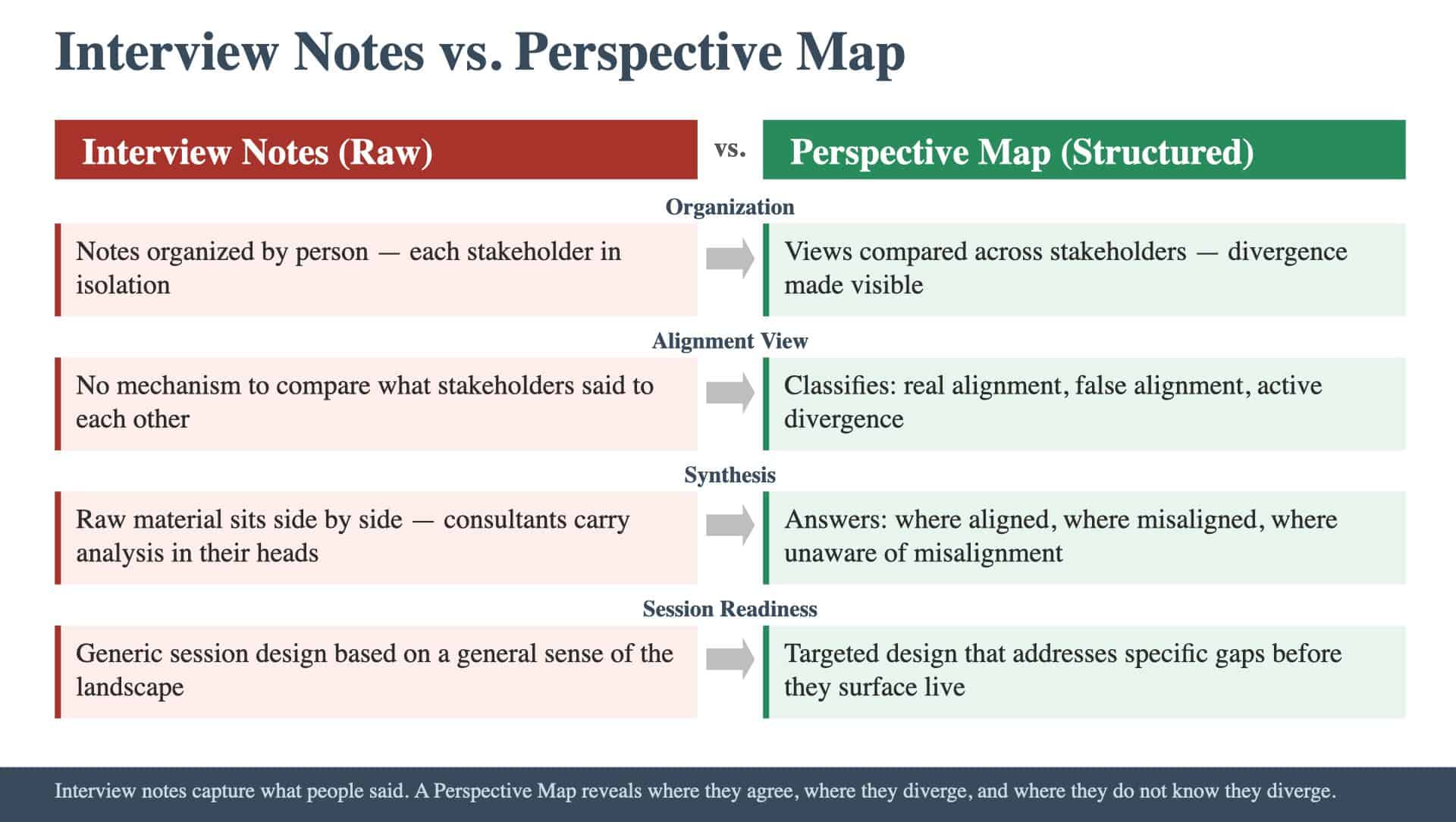
The consulting team conducted the one-on-ones. We sat with each leader for thirty to sixty minutes, asked about priorities, listened to concerns, and captured notes. The conversations were productive. The stakeholders felt heard. The notes went into a shared document. And then the planning team moved on to the architecture session. The problem is that interview notes are a record of what people said. They are not a structured view of where leaders agree, where they diverge, and where they assume alignment that does not exist. A Perspective Map takes the raw material from the one-on-ones and organizes it into an instrument the planning team can act on. The gap between notes and map is the gap between having conducted the conversations and having learned from them.
What Interview Notes Capture (and What They Miss)
Interview notes capture what each stakeholder said in their own conversation. They are organized by person: VP of Operations said X, VP of Technology said Y, SVP of Product said Z. Each set of notes is internally coherent. The problem is that the notes sit side by side without a mechanism to compare them. Three structural gaps persist: No cross-stakeholder comparison. The notes record each person’s view in isolation. They do not show where two stakeholders said the same thing using different language (real alignment), where two stakeholders used the same language to mean different things (false alignment), or where two stakeholders hold directly contradictory assumptions (active divergence). We have to hold these comparisons in our heads, and cognitive load increases with every additional conversation. No divergence classification. When two stakeholders disagree, the nature of the disagreement matters. Divergence on priority, i.e., both want the same thing but sequence it differently, is different from divergence on scope, i.e., one includes a function the other excludes. Interview notes record both as “they see it differently.” The Perspective Map classifies the divergence so the planning team knows which gaps require resolution before roadmap sessions and which will resolve naturally during the planning process. No synthesis question answered. The one-on-ones produce raw material. The Perspective Map answers a specific synthesis question: Where are people aligned, where are they misaligned, and where do they not realize they are misaligned? That third category, i.e., unconscious misalignment, is the most dangerous because it produces false consensus. Two VPs who both say they are aligned on the timeline but hold different assumptions about what the timeline includes will not discover the gap until the roadmap session forces a choice. The Perspective Map reveals that gap in advance.
What the Perspective Map Contains
The Perspective Map structures each stakeholder’s view into four fields:
- Definition of success. What outcome this stakeholder is personally measuring the initiative against. Not the official goal statement, but how they interpret it and what they prioritize within it.
- Primary concerns. What they believe is most likely to go wrong. This reveals risk perception, which varies significantly across functions.
- Assumptions about scope and timeline. What they believe is included and what they believe is achievable. Scope and timeline assumptions are the most common source of unconscious misalignment.
- Divergence from other stakeholders. Where their view differs from peers, whether they know it or not. This column is populated by the consultants after comparing across all interviews, not by the stakeholder themselves.
The quality bar: the map captures divergence, not just positions. If every stakeholder’s entry looks like a summary of what they said, the synthesis has not happened. The value is in the fourth column: the cross-stakeholder comparison that reveals gaps the individual conversations could not. The narrative takeaway from this section tells the board where real alignment exists and where alignment is assumed. The moment a VP realizes that their peers hold a different definition of success is the moment the planning engagement produces its first real value. The Perspective Map ensures that moment happens during pre-work rather than during a session designed to produce a roadmap.
How the Gap Costs You During Planning
The distance between interview notes and a Perspective Map produces three planning-stage costs. Session design lacks precision. We design the architecture or roadmap session based on our general sense of the stakeholder landscape rather than a structured diagnostic. They know there are differences but cannot name the specific divergences the session needs to address. The session agenda is generic rather than targeted. Time that could be spent resolving specific gaps gets spent discovering them. False consensus persists into the roadmap. Without a structured comparison, we may not realize that two stakeholders who both said “we need to move fast” mean different things. One means fast to pilot. The other means fast to full deployment. The roadmap reflects one interpretation. The other stakeholder discovers the mismatch during execution and contests the plan. The consulting team carries the synthesis in their heads. With six to twelve stakeholder interviews, the mental model becomes unwieldy. Details from early conversations blur. Patterns that were visible after the fifth interview get obscured by the eighth. The Perspective Map externalizes the synthesis so the planning team can reference it collectively, rather than depending on one person’s memory of fourteen conversations.
What “Complete” Looks Like
A complete Perspective Map passes four tests:
- Every stakeholder’s definition of success is documented in their own language. Not the charter’s language. Not our summary. The stakeholder’s actual framing, which reveals what they care about most.
- The divergence column is populated by cross-stakeholder analysis, not self-reporting. Stakeholders do not know where they diverge from peers. We identify divergences by comparing across interviews.
- Divergences are classified by type. Priority divergence, scope divergence, timeline divergence, and success criteria divergence each require different resolution approaches. The map names the type so the planning team can triage.
- The synthesis question has been answered. The map produces a narrative statement: “X stakeholders interviewed. Alignment is real on [specific areas]. Alignment is assumed but untested on [specific areas]. Active divergence exists on [specific areas] between [specific stakeholders].”
The question is whether your planning process answers where the room agrees and where it diverges: or whether you discover the answer during execution, when the cost of resolution is measured in weeks of replanning rather than hours of conversation.
Go Deeper: The Stakeholder Map
This article covers one dimension of the Stakeholder Map, the second of nine artifacts in the Planning & Roadmapping method. The Stakeholder Map answers the board question: “Who sees what?” Explore the full Stakeholder Map →
Keep Reading
New to the Stakeholder Map? Start with the foundations:
Ready to benchmark your work against best-in-class? See what excellence looks like: