The Pressure to Scale Is Always There
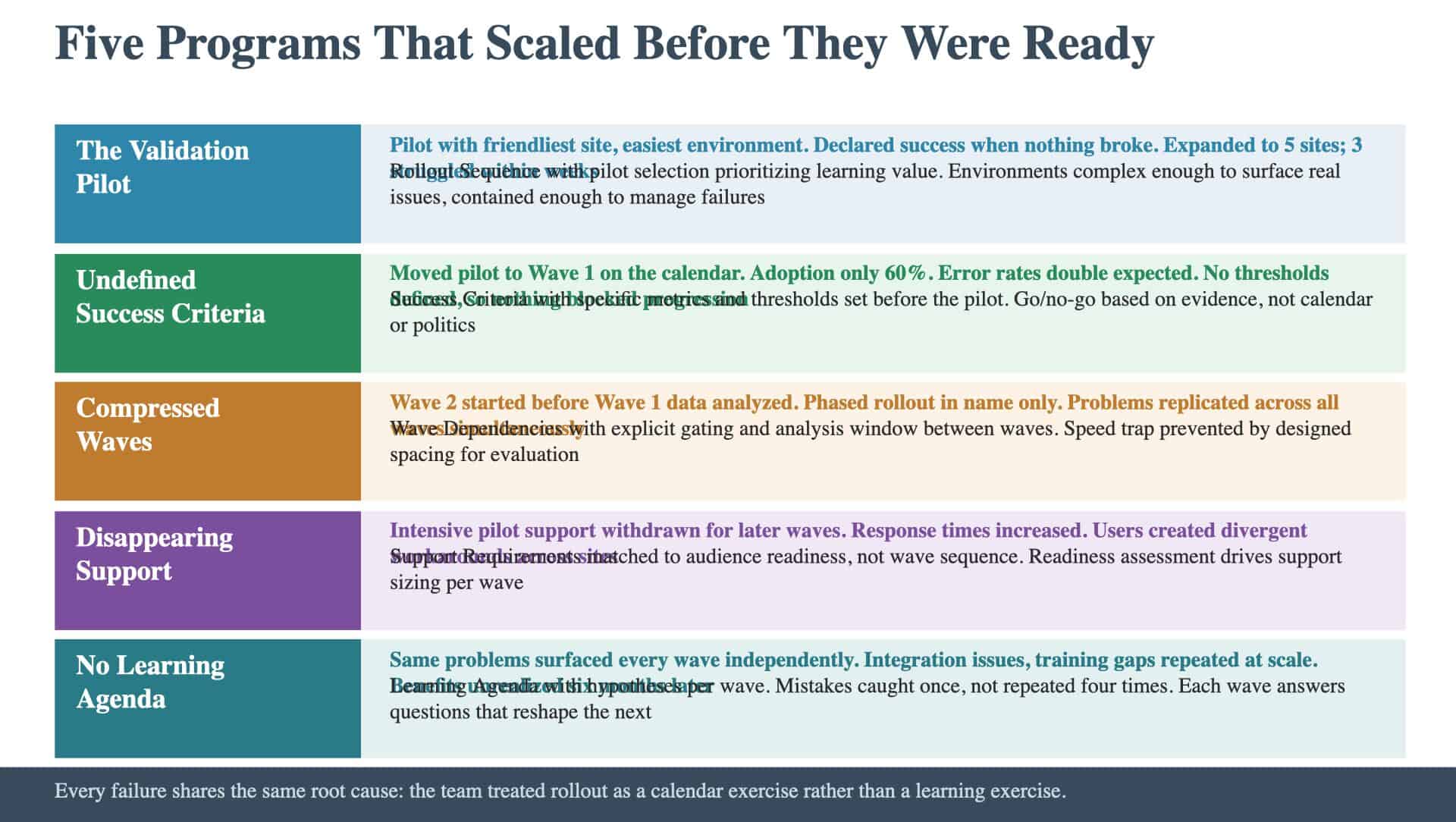
Every program team feels the pull to move faster. Executives want results. The planning phase has consumed weeks or months, and the organization wants to see something happen. The team has built the roadmap, the operating model, and the change plan. The work is done. The instinct is to deploy everything at once and demonstrate momentum. That instinct is understandable and consistently wrong. Here are the patterns that repeat when programs scale before they’ve earned the right to expand.
The Pilot That Validated Instead of Tested
The program team runs a pilot with the most enthusiastic site. The site leader is a vocal advocate. The team is eager to adopt. The environment is straightforward. The pilot succeeds by every measure. The team takes this as evidence that the change is ready for full deployment. Wave 1 expands to five sites simultaneously. Within weeks, three of the five sites are struggling. The processes that worked seamlessly at the pilot site break down in environments with different legacy systems, different team structures, and different levels of change readiness. The pilot didn’t fail. It was never designed to succeed in a way that mattered. By selecting the friendliest environment, the team optimized for a positive result rather than for learning. The pilot answered the question “Can this work under ideal conditions?” when it should have answered “Where will this break under real conditions?” A Rollout Plan with a properly designed pilot would have specified selection criteria that prioritized learning value: an environment complex enough to identify integration issues, change readiness gaps, and process edge cases. The pilot would have produced a list of problems to solve before expansion, not a slide declaring success.
The Success Criteria Nobody Defined
The program moves from pilot to Wave 1 on the calendar. The pilot ended on schedule, so the next wave starts on schedule. Nobody asks whether the pilot met any specific threshold because no thresholds were defined. Three weeks into Wave 1, the team realizes that adoption at the pilot site was only 60 percent. People completed training but reverted to old processes for anything complicated. Error rates were double what the team expected. User feedback was mixed at best. None of this blocked progression because there was nothing to block against. Without defined success criteria, go/no-go decisions default to the calendar or to politics. The program advances because the date arrived, not because the evidence supported expansion. Defined success criteria create accountability. They force the question: did this wave actually work? And they create a decision point where the team evaluates evidence rather than momentum. The absence of criteria doesn’t mean the absence of failure. It means the failure goes unrecognized until it’s too late to address cheaply.
The Waves That Ran in Parallel
Deadline pressure compresses the wave schedule. Wave 1 starts in January. Wave 2 is supposed to start in March, after Wave 1 data is analyzed. But the program timeline shows full deployment by June, and two-month gaps between waves make that impossible. Wave 2 starts in February, before Wave 1 data is available. The team tells itself this is still a phased rollout. Technically, Wave 2 started after Wave 1. In practice, it’s a simultaneous launch. The team never analyzed Wave 1 data before expanding. Wave 1 problems replicate in Wave 2 because nobody identified them. Wave 2 introduces its own problems. By Wave 3, the team is managing issues from all three waves simultaneously with support resources planned for one wave at a time. This is the speed trap. Compression eliminates the space between waves where learning happens. If Wave 2 starts before Wave 1 data is analyzed, the team isn’t doing a phased rollout. They’re doing a big bang with additional administrative overhead. A Rollout Plan with explicit wave dependencies would have gated progression on evidence. The dependency map would specify that Wave 1 success criteria must be met and the learning agenda must be reviewed before Wave 2 begins. The timeline would account for analysis time between waves. If the overall deadline couldn’t accommodate proper spacing, the team would have that conversation upfront rather than discovering it mid-deployment.
The Support That Disappeared After the Pilot
The pilot receives intensive support. A dedicated team is on-site. Training is hands-on and extended. Every issue gets immediate attention. Users have a direct line to experts who can resolve problems in real time. Wave 1 expands to five sites. The same support team that covered one pilot site now covers five. Response times increase. Training shifts from hands-on to virtual. The experts are spread so thin that issues queue rather than resolve. Wave 2 expands further. Support becomes reactive rather than proactive. By Wave 3, users at newer sites are troubleshooting on their own, creating workarounds that diverge from the intended process. The program’s first-wave users are running one version of the process. Later-wave users are running a different version based on whatever they figured out independently. The support-cliff trap assumes that later waves need less support because the team has learned from earlier ones. In practice, later waves often include audiences with lower change readiness who need more support. The readiness assessment from the Change Plan should size support requirements by audience readiness, not by wave sequence.
The Learning That Never Happened
The program completes all four waves on schedule. Deployment is done. The team moves to steady state. Six months later, the expected benefits haven’t materialized. Adoption is uneven. Process compliance varies by site. Some locations have abandoned parts of the new process entirely. The post-mortem reveals that the same problems identified in every wave. Integration issues and training gaps that forced workarounds. Each wave encountered them independently because nobody captured the lessons from earlier waves and fed them into the plan for later ones. A learning agenda would have treated each wave as a hypothesis to test. What questions are we trying to answer? What did we learn? How does that change the plan for the next wave? Without a learning agenda, the rollout is a deployment exercise that repeats its mistakes at larger and larger scale.
The Common Thread
Every one of these failures shares the same root cause: the team treated rollout as a calendar exercise rather than a learning exercise. A Rollout Plan doesn’t slow the program down. It prevents the rework, remediation, and credibility damage that come from scaling problems the team could have caught earlier. The question is whether the team invests in structured rollout planning that catches problems while they’re cheap to fix: or whether it scales on the calendar and pays for every missed lesson at full organizational price.
Keep Reading
Ready to close specific gaps in your Rollout Plan? These articles show you how: