Risk registers and principles serve different functions. The risk register identifies what could go wrong and assigns mitigations. The principles and guardrails document defines what the team will protect when something does go wrong and execution pressure mounts. Every program encounters execution pressure. Timelines compress. Resources are pulled to other priorities. Integration testing takes longer than planned. Stakeholders escalate competing demands. In these moments, the program team makes trade-off decisions. They decide what to cut, what to defer, and what to compress. The question is whether those trade-off decisions are guided by pre-defined principles or by whatever is easiest to sacrifice in the moment. Programs that lack guardrails make reactive trade-offs that often compromise the outcomes the program was designed to protect.
Why Risk Awareness Is Not Enough
A program can have a thorough risk register and still make poor trade-off decisions during execution. The risk register tells the team what could go wrong. It does not tell the team what to protect when things do go wrong. Consider a program that has identified the risk of timeline slippage in integration testing. The risk register has the mitigation: add buffer to the integration testing phase. The buffer is consumed. The program is still behind schedule. The team now faces a trade-off: compress user acceptance testing (faster but riskier), reduce the scope of the first deployment wave (slower but safer), or extend the timeline (safer but more expensive). The risk register does not answer this question. It identified the risk and the mitigation. The mitigation was insufficient. Now the team needs guidance on trade-offs, and the risk register provides none. Principles and guardrails fill this gap. If the principles state that user acceptance testing will not be compressed below two weeks regardless of timeline pressure, the team knows that option is off the table. The trade-off decision is narrowed to scope reduction or timeline extension, both of which are acceptable under the guardrails. Programs that failed with good plans documents cases where risk registers were thorough but guardrails were absent. The programs identified the right risks. When those risks materialized, the teams made reactive trade-offs that undermined the program’s core objectives.
What Principles and Guardrails Contain
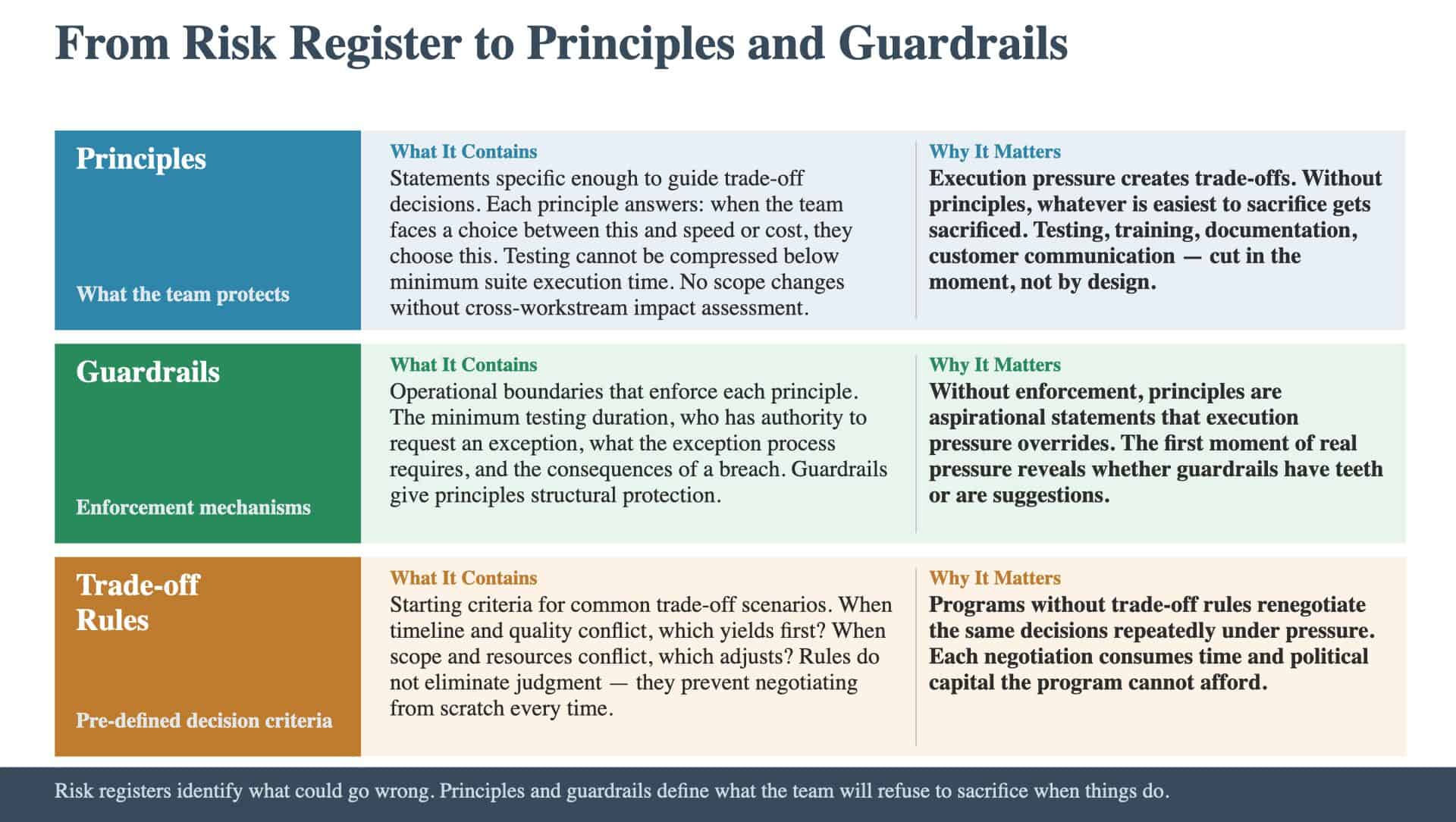
The principles and guardrails one-pager has three sections: Principles. Statements of what the team values and will protect. Principles are specific enough to guide trade-off decisions. Each principle answers the question: when we face a choice between this and speed (or cost, or convenience), we choose this. Examples of specific principles:
- “Every deployment includes automated regression testing. The testing phase cannot be compressed below the minimum suite execution time.”
- “No workstream scope changes without impact assessment across all dependent workstreams.”
- “Customer-facing changes require customer communication at minimum 10 business days before deployment.”
Guardrails. The operational boundaries that enforce the principles. If a principle says testing cannot be compressed, the guardrail specifies: the minimum testing duration, who has authority to request an exception, what the exception process requires, and what the consequences are if the guardrail is breached. Guardrails are enforcement mechanisms. Without them, principles are aspirational statements that execution pressure overrides. With them, principles have structural protection. Trade-off rules. Pre-defined decision criteria for common trade-off scenarios. When timeline and quality conflict, which one yields first? When scope and resources conflict, which one adjusts? Trade-off rules do not eliminate the need for judgment. They provide a starting point so the team does not negotiate from scratch every time pressure mounts. The risk nobody put on the register connects to why guardrails matter: the risks that are not on the register are the ones most likely to trigger unguided trade-off decisions.
How Guardrails Prevent Reactive Compromises
Execution pressure creates a predictable pattern. The team faces a timeline or resource constraint, someone proposes cutting something, and the thing proposed for cutting is typically whatever is easiest to remove in the moment rather than whatever is least important to the program’s success. Testing is frequently proposed because it occurs late in the sequence when pressure is highest. Training is frequently proposed because its absence is not immediately visible. Customer communication is frequently proposed because it can be “caught up later.” Each of these items may have been identified as important during planning. But in the moment of execution pressure, importance competes with urgency, and urgency wins. Guardrails interrupt this pattern by pre-committing the team to protect specific items regardless of pressure. The guardrail does not prevent the pressure. It prevents the reactive response to the pressure. The team still faces the constraint. They face it with fewer options for compromise and more clarity about which options are available. The governance problem nobody talks about connects to guardrails through enforcement: who has authority to invoke a guardrail, who has authority to override one, and what the escalation process looks like when guardrails are under pressure.
What “Complete” Looks Like
Principles and guardrails are complete when they pass three tests:
- The trade-off test. A reasonable person facing a specific trade-off decision during execution can read the principles and determine which option the principles support. If the principles are too abstract to guide a real decision, they are not specific enough.
- The enforcement test. Every guardrail has a named authority who can invoke it and a named authority (at a higher level) who can override it. Guardrails without enforcement mechanisms are aspirational documents.
- The realism test. The guardrails have been reviewed by the team that will operate under them, and the team confirms they are achievable. Guardrails that the team views as unrealistic will be bypassed during the first moment of pressure.
The question is whether your program’s guardrails are specific enough to guide real trade-off decisions when execution pressure mounts: or whether every compromise is negotiated from scratch in the moment it arises.
Go Deeper: The Risk Landscape
This article covers one dimension of the Risk Landscape, the fourth of nine artifacts in the Planning & Roadmapping method. The Risk Landscape answers the board question: “What could break this?” Explore the full Risk Landscape →
Keep Reading
New to the Risk Landscape? Start with the foundations:
Ready to benchmark your work against best-in-class? See what excellence looks like: