The Plan Was Excellent. It Didn’t Survive the First Quarter.
The planning engagement produced everything it was supposed to. A sequenced roadmap. A functioning operating model. A change plan with audiences mapped and communication designed. A rollout plan with waves, success criteria, and a learning agenda. The artifacts were thorough. The leadership team was aligned. Then the consultants left. Within three months, the roadmap began to drift. Nobody remembered why certain sequencing decisions were made. The operating rhythm wasn’t maintained. The artifacts didn’t get updated. Decisions that required leadership support were never escalated because nobody made explicit what leadership needed to do. By the end of the second quarter, the organization was running a version of the plan that bore little resemblance to what was designed. The plan didn’t fail because it was bad. It failed because nobody transferred the capability to run it.
What a Close Package Actually Is
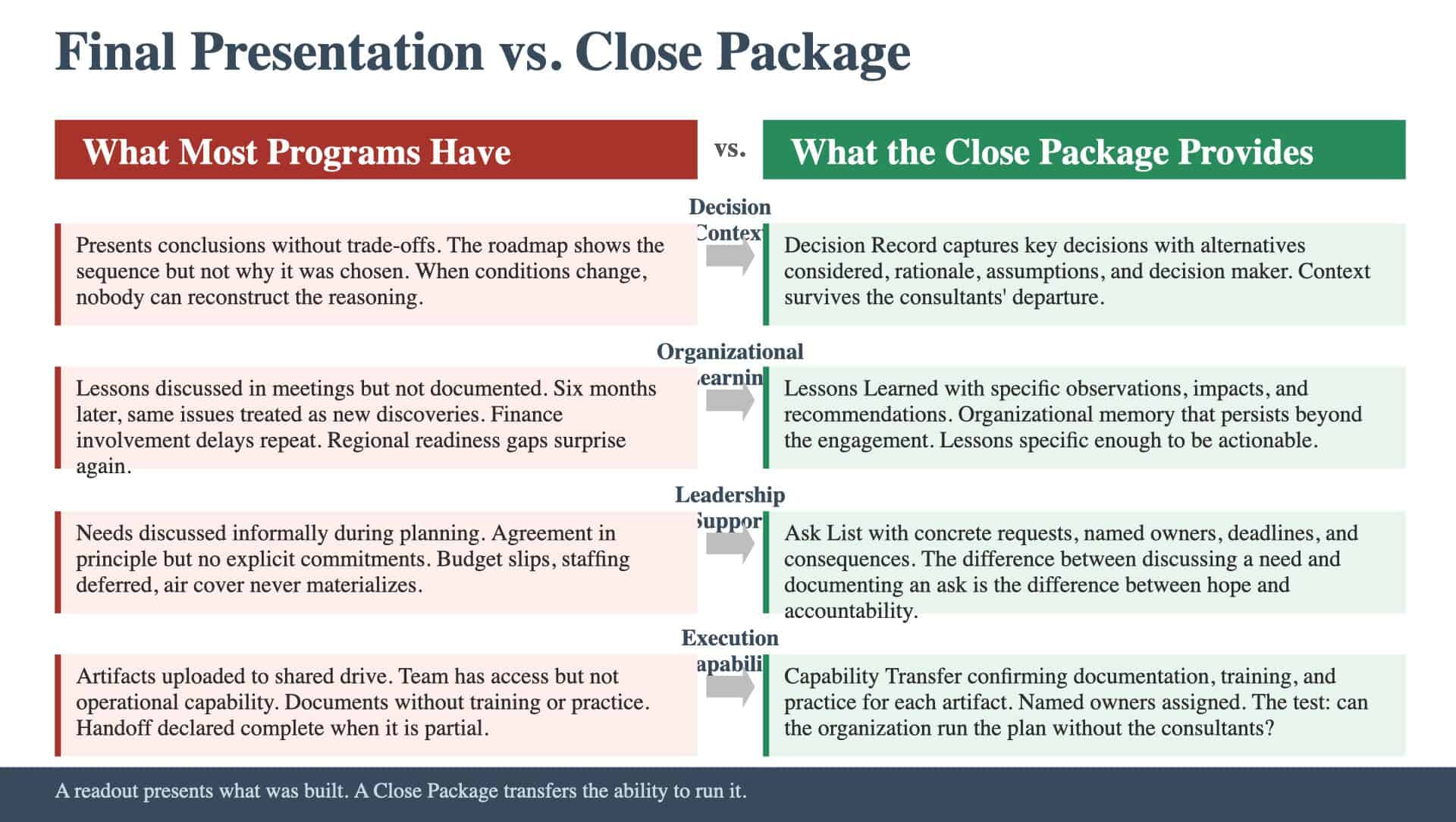
A Close Package is the capstone artifact of the planning engagement. It transfers ownership from the consultants to the organization so the plan survives their departure. The artifact answers five questions:
- What decisions did we make? A decision record capturing what was decided, by whom, with what trade-offs. The conclusions and the reasoning. When circumstances change, the organization needs to know what assumptions underlay the original decisions.
- What did we learn? Lessons learned from the engagement: what surprised the team, what worked, what didn’t, and what they’d do differently. Specific enough to be actionable, not generic enough to ignore.
- What are our recommendations? Guidance for leadership on what to watch, what to prioritize, and what questions remain open. The planning engagement gives the consultants a view into the organization that leadership may not have. The recommendations translate that view into action.
- What support does the plan need? An ask list specifying decisions, resources, or air cover required from leadership that hasn’t been committed yet. Plans fail when they don’t get the support they need. The ask list makes those needs explicit.
- Can the organization run this without us? A capability transfer checklist confirming what’s been handed off, what’s been trained, and what’s documented. The ultimate test: if the consultants disappeared tomorrow, could the organization execute the plan?
The Close Package is not a final presentation. It’s not a project summary. It’s an operational handoff that sets the organization up to run the program independently.
Why Leaders Don’t Think About This
The handoff seems like the easy part. The hard work was building the plan. The artifacts exist. The team has been in the room for months. Surely they know what to do. This assumption fails for two reasons. Context evaporates. Decisions made during planning have context that’s easy to forget. Why did the team choose a four-wave rollout instead of three? Why was the procurement workstream sequenced after the operations workstream? Why did the risk register prioritize regulatory risk over technology risk? The people who made these decisions remember the reasoning today. In six months, they won’t. And when someone new joins the program, they’ll have no way to reconstruct the logic. Leadership attention shifts. During the planning engagement, leaders were focused on the initiative. After it ends, their attention moves to the next priority. The decisions that still need to be made, the resources that still need to be committed, the air cover that the program needs during execution, these requirements don’t disappear. Without an explicit ask list, they fall through the cracks. Meanwhile, the team can have every artifact in a shared drive and still not know how to use them. Operating models need to be operated. Roadmaps need to be updated when conditions change. The artifacts are tools; without training on how to use them, they’re files.
What Happens Without One
Without a Close Package, planning engagements end in one of these ways, none of which sets the program up for success. The victory lap. The consultants present the plan in a final readout. Leadership applauds the work. Everyone shakes hands. The consultants move on. The presentation becomes the handoff, which means the handoff was a PowerPoint deck rather than a capability transfer. Within weeks, the team starts asking questions nobody can answer about why the plan was designed the way it was. The document dump. The consultants upload every artifact to a shared drive and send a “here’s everything” email. The organization now has the documents but not the understanding. The artifacts sit in the folder. The team builds their own interpretations, which may or may not align with what the plan intended. The gradual fade. The engagement doesn’t formally end. The consultants stay on in a diminishing capacity: answering questions, joining meetings, providing guidance. The organization never develops the capability to run the plan independently because the consultants are always available as a crutch. When the budget for the consulting engagement finally runs out, the abrupt departure creates the same gap that a structured operating system handoff would have prevented. All three patterns share the same root cause: the team treated the plan as the deliverable instead of treating organizational capability as the deliverable.
The Difference Between Presenting the Plan and Transferring Ownership
A readout presents what was built. A Close Package transfers the ability to run it. The readout says: here’s the roadmap, here’s the operating model, here’s the change plan, here’s the rollout plan. It walks leadership through the artifacts. It answers questions. It aligns the room. The Close Package goes further. It documents the decisions and their rationale so the organization can revisit them when conditions change. It captures lessons learned while the experience is fresh. It makes explicit what leadership needs to do to support execution. And it confirms that the receiving team has been trained on the artifacts, not just briefed on them. The test for a successful Close Package is operational: can the organization run the plan without the consultants? Not theoretically. Actually. Can the person who owns the roadmap update it when a dependency shifts? Can the person who owns the operating rhythm run the cadence without the consultants facilitating? Can the person who owns the risk register add new risks and assess them using the same methodology? If the answer is yes, the handoff is clean. If the answer is no, the engagement isn’t over regardless of what the contract says.
Where This Fits in the Larger Method
The Close Package is the ninth and final artifact in the planning and roadmapping method. It comes after the Rollout Plan, which defines how the program deploys. The sequence is deliberate. The Close Package can’t be built until every other artifact is complete because it draws on all of them. The decision record captures decisions from every step. The lessons learned span the full engagement. The recommendations reflect what the consultants observed across the entire planning process. The capability transfer covers every artifact the organization needs to run. The question is whether the organization builds a handoff that transfers the capability to run independently: or whether the plan joins the archive of excellent work that never survived the consultants’ departure.
Keep Reading
Ready to close specific gaps in your Close Package? These articles show you how: