The Communications Plan That Reached Everyone and Prepared No One
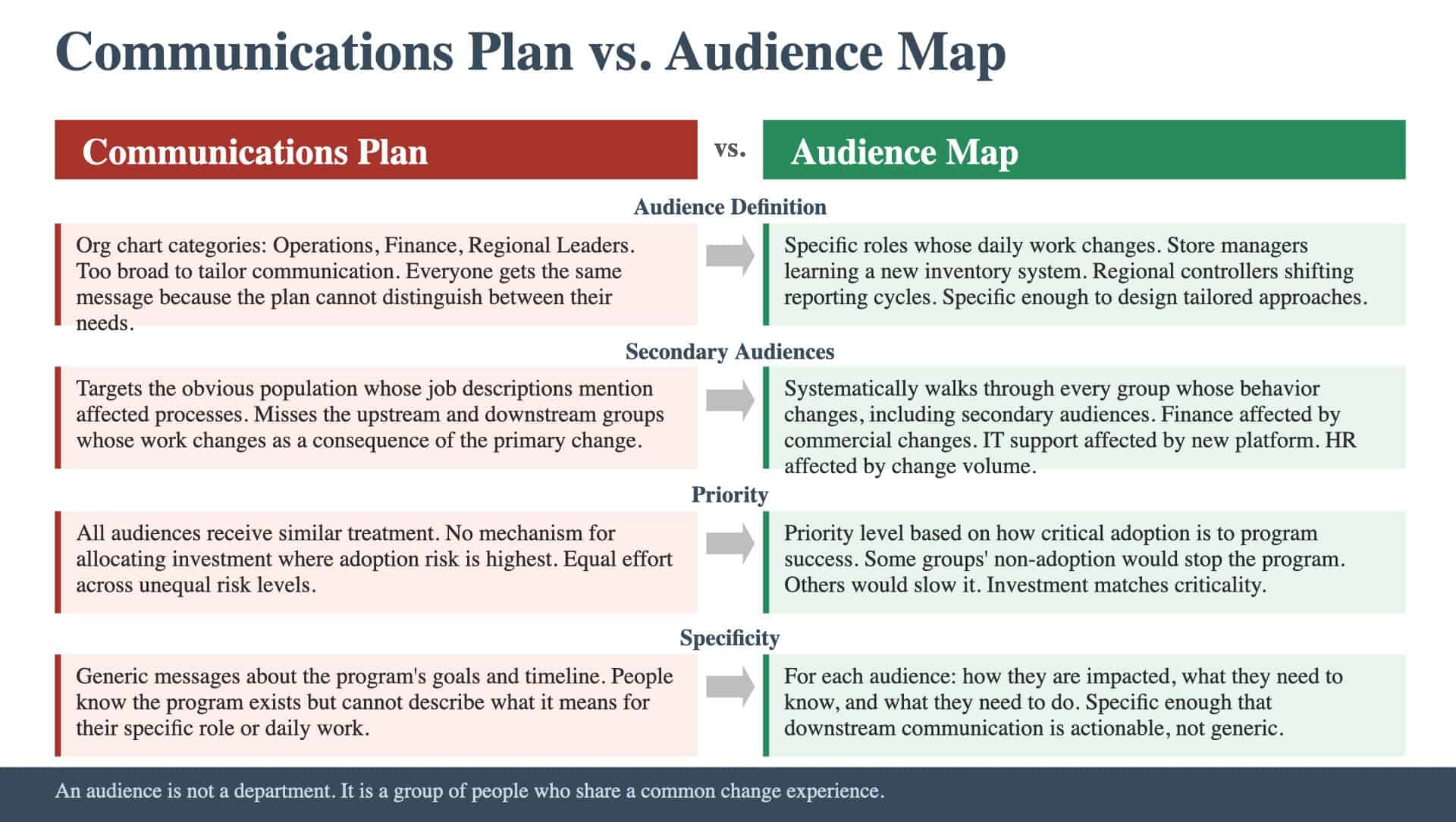
The program has a communications plan. Messages go out on schedule. Town halls happen. Updates appear in the newsletter. The executive sponsor sends personal notes at key milestones. By activity metrics, change management is running smoothly. Then the team surveys the people who need to change their behavior, and the results reveal a gap. People know the program exists. They can name it. They cannot describe what it means for their specific role. They cannot articulate what changes in their daily work or when those changes arrive. The issue is not communication volume. It is communication targeting. The program is sending one set of messages to a broad population instead of tailored messages to specific audiences. And it is doing this because nobody built an audience map that identifies who those specific audiences are.
What a Communications Plan Misses Without an Audience Map
A communications plan answers three questions: what gets said, to whom, and when. These are necessary questions, but they assume the team already knows who the audiences are and what each audience needs to hear. Without an audience map, the “to whom” defaults to organizational units: “Operations,” “Finance,” “Regional leaders.” These are org chart categories, not audiences. An audience is a group of people who share a common change experience. “Store managers who will need to learn the new inventory system” is an audience. “Operations” is a department. The difference determines whether the communication plan can be specific enough to drive understanding. When the audience definition is too broad, every downstream decision degrades. The messages become generic because they have to apply to everyone in the group; the timing becomes uniform because there’s no basis for sequencing by audience. The messenger selection becomes political rather than strategic because the team hasn’t identified who has credibility with each specific group.
The Audiences You’re Probably Missing
The most common audience mapping failure is not getting the primary audiences wrong. It’s missing the secondary audiences entirely. Primary audiences are obvious: the people whose job descriptions mention the affected processes. If the program changes the commercial workflow, the sales team and account managers are primary audiences. They appear on every version of the plan. Secondary audiences are the people whose work changes because of upstream or downstream dependencies. The finance team whose close process changes because the new commercial workflow alters revenue recognition. The IT support team whose ticket volume shifts because of the new platform. The HR business partners whose change management conversations multiply because their client groups are in the middle of a transformation. These groups don’t appear in the program charter. They don’t sit in the affected functions. They discover the impact when it arrives, and by then, resistance has already formed. The Resistance Analysis maps exactly where these behavioral barriers concentrate, turning invisible opposition into addressable planning inputs. A structured audience map that walks through every group whose behavior changes, not just the groups whose behavior is targeted, identifies these populations before they become problems.
What an Audience Map Actually Contains
An audience map captures four things for each group: Role or group. Specific enough to describe their daily work. Not “Finance” but “Regional controllers who will shift from monthly to weekly reporting cycles.” The specificity determines whether the downstream work, the change inventory and communication plan, can be tailored. How they’re impacted. What changes in their world. This is a summary, not the full change inventory. It answers the question: why is this group on the map? What makes them an audience? What they need to know. The information required for them to act. This is different from what the program team wants to tell them. It’s what they need to hear to understand the change, prepare for it, and execute it. Priority level. Based on how critical their adoption is to program success. Not every audience is equally important. Some groups’ non-adoption would stop the program. Others would slow it. Prioritization lets the team allocate its change management investment where it matters most. The quality bar: the team can look at the map and identify every group whose non-adoption would threaten the program. No critical audience is missing. No audience is described so broadly that the change approach can’t be tailored.
The Difference Between the Stakeholder Map and the Audience Map
Programs that have done stakeholder mapping sometimes assume the work is redundant. It isn’t. The two maps serve different purposes. The stakeholder map identifies who has influence and perspective. It’s a tool for understanding the political and decision-making landscape. The audience map identifies who has to change their behavior. It’s a tool for planning adoption. These populations overlap but are not identical. A senior leader who shapes program decisions but doesn’t change their own workflow appears on the stakeholder map but not the audience map. A frontline team that has no political influence but whose adoption is critical to program success appears on the audience map but may not appear on the stakeholder map. The stakeholder map feeds the audience map. The perspective interviews from stakeholder mapping often surface audiences that the program team hadn’t considered. But the audience map requires its own discipline: systematically walking through every group whose behavior changes, assessing their priority, and documenting what they need.
How to Build the Audience Map from What You Have
Programs at this stage typically have a communications plan, a stakeholder map, and a general sense of who’s affected. The audience map builds on all three.
- Start with the change itself. Walk through each major change the program introduces and ask: whose daily work is different because of this? List every group, not just the intended targets. For each group, ask: if this group doesn’t adopt the change, what happens to the program? The answer determines their priority.
- Check against the stakeholder map. The perspective interviews often named groups or roles that the program team hadn’t considered. Cross-reference to make sure those groups appear on the audience map if their behavior needs to change.
- Check the dependencies. For every primary audience, ask: who is upstream from them? Who is downstream? If the primary audience’s workflow changes, whose workflow changes as a consequence? These are the secondary audiences that most programs miss.
The question is whether the team maps its audiences before communication begins: or whether it discovers the missing populations when their adoption gaps surface during execution.
Keep Reading
New to the Change Plan? Start with the foundations:
Ready to benchmark your work against best-in-class? See what excellence looks like: