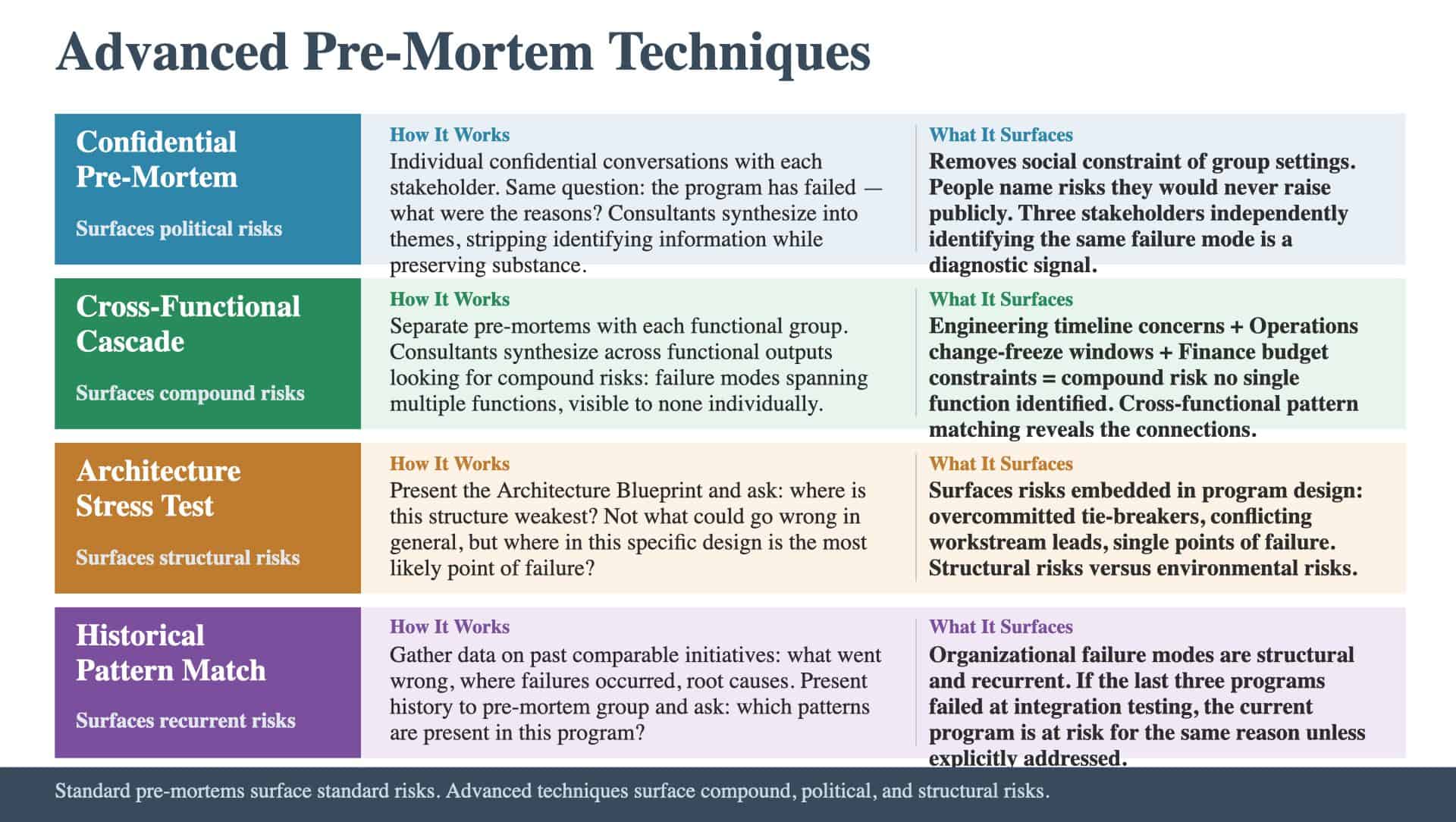
The standard pre-mortem asks the team to imagine the program has failed and identify the most likely causes. This technique identifies risks that participants are willing to name in a group setting. It is more effective than traditional risk workshops because the framing creates psychological permission for candor. But it has limits. Some risks cannot be named in a group setting regardless of framing. Some risks are invisible to the individuals in the room because they emerge from interactions between functions that no single person can see. Some risks are structural, embedded in how the program is designed rather than in what might happen during execution. Advanced pre-mortem techniques address these limits. They extend the standard exercise with additional methods designed to reveal the risks that the standard technique misses.
Technique 1: The Confidential Pre-Mortem
The standard pre-mortem is conducted in a group. Even with good facilitation, group dynamics constrain what people will say. The most politically sensitive risks, ones that involve specific leaders, organizational dysfunctions, or historical failures, are often too dangerous to name in a room where the wrong person might be present. The confidential pre-mortem runs the same exercise through individual, confidential conversations. The consultants meet one-on-one with each stakeholder and ask the same question: “The program has failed. What were the most likely reasons?” The confidentiality removes the social constraint. People name risks they would never raise in a group. The consultants then synthesize the confidential inputs into themes, stripping identifying information while preserving the substance. The synthesis is presented to the program team as aggregated failure modes. “Three stakeholders independently identified the same failure mode: the program’s resource plan assumes capacity from a team that is already overcommitted to another initiative.” The confidential pre-mortem is particularly valuable in organizations with strong hierarchical dynamics, where junior team members will not contradict senior leaders in group settings, or in politically charged environments where naming certain risks carries career risk. Making the invisible visible describes why confidential mechanisms surface information that group processes cannot. The dynamic is the same as in stakeholder one-on-ones: people share more when the conversation is private.
Technique 2: The Cross-Functional Cascade
The standard pre-mortem assembles a mixed group and asks everyone the same question. The cross-functional cascade runs separate pre-mortems with each functional group, then synthesizes across them. Each function’s pre-mortem produces failure modes from that function’s perspective. Engineering identifies technical failure modes. Operations identifies operational failure modes. Finance identifies resource and budget failure modes. Each set is internally consistent but functionally bounded. The synthesis step is where the value emerges. The consultants lay the functional pre-mortem outputs side by side and look for compound risks: failure modes that span multiple functions and are visible to none of them individually. Engineering’s concern about integration testing timelines, combined with Operations’ concern about change-freeze windows, combined with Finance’s concern about Q4 budget constraints, produces a compound risk that none of the three functions identified independently. The cascade technique identifies compound risks because it creates the conditions for cross-functional pattern matching. No single function has the perspective to see the compound risk. The synthesis process, conducted by the consultants who have seen all three functional outputs, identifies the connections. The risk nobody put on the register documents compound risks that appeared only when functional perspectives were combined. The risks were invisible within each function and became visible only through cross-functional synthesis.
Technique 3: The Architecture Stress Test
The standard pre-mortem asks participants to imagine failure from their current perspective. The architecture stress test asks participants to imagine failure from the perspective of the program’s architecture. The consultants present the Architecture Blueprint: workstream definitions, dependency diagram, governance model, and handoff contracts. They then ask the team to identify where the architecture is weakest. Not “what could go wrong in general” but “where in this specific structure is the most likely point of failure?” This technique identifies structural risks: risks that are embedded in how the program is designed rather than in what might happen during execution. A governance model that relies on a single tie-breaker who is overcommitted. A handoff contract between two workstreams that are led by individuals with a history of conflict. A dependency diagram that creates a single point of failure through a shared resource. The architecture stress test produces failure modes that the standard pre-mortem misses because it directs attention to the program’s structure rather than its environment. Standard pre-mortems tend to generate environmental risks (things that might happen to the program). Architecture stress tests generate structural risks (weaknesses built into the program). The architecture nobody builds describes why architecture stress testing is essential: programs invest in architecture but rarely subject that architecture to deliberate failure analysis.
Technique 4: The Historical Pattern Match
The organization has attempted similar initiatives before. Those initiatives had outcomes. The historical pattern match uses those outcomes as inputs to the pre-mortem. The consultants gather data on the organization’s past two to three comparable initiatives: what went wrong, where the failures occurred, and what the root causes were. They then present this history to the pre-mortem group and ask: “Which of these historical failure patterns are present in the current program?” This technique is powerful because organizational failure modes tend to be structural and recurrent. If the last three programs failed at integration testing because handoff contracts were never written, the current program is at risk for the same reason unless the architecture explicitly addresses it. If the last two initiatives experienced decision stalls because cross-functional governance was insufficient, the current program needs to demonstrate that its governance model has addressed the specific decision-stall pattern. The historical pattern match prevents the common failure mode where the organization learns from each failed initiative but does not apply those lessons to the next one. The pre-mortem creates a structured mechanism for applying historical lessons to current risk identification. Programs that failed with good plans is itself a resource for historical pattern matching. The failure patterns documented across programs provide a reference set for identifying which patterns are present in the current initiative.
Combining the Techniques
The four techniques address different blind spots. The confidential pre-mortem identifies politically sensitive risks. The cross-functional cascade identifies compound risks. The architecture stress test identifies structural risks, and the historical pattern match identifies recurrent risks. An execution-grade Risk Landscape typically uses two or more of these techniques in combination with the standard group pre-mortem. The specific combination depends on the organizational context: politically charged environments benefit most from the confidential technique; complex cross-functional programs benefit most from the cascade; programs with detailed architecture benefit most from the stress test; organizations with a history of similar initiatives benefit most from the pattern match. The synthesis across all techniques produces the Risk Landscape’s narrative takeaway: the statement that names the highest-risk failure patterns and their implications for program design. A strong narrative takeaway connects individual risks to patterns and patterns to architectural decisions. The question is whether your pre-mortem identifies the compound, political, and structural risks that standard techniques miss: or whether the risks that matter most remain invisible until execution reveals them.
Go Deeper: The Risk Landscape
This article covers one dimension of the Risk Landscape, the fourth of nine artifacts in the Planning & Roadmapping method. The Risk Landscape answers the board question: “What could break this?” Explore the full Risk Landscape →
Keep Reading
Explore the foundations and common gaps: