A Final Presentation Is Not a Close Package
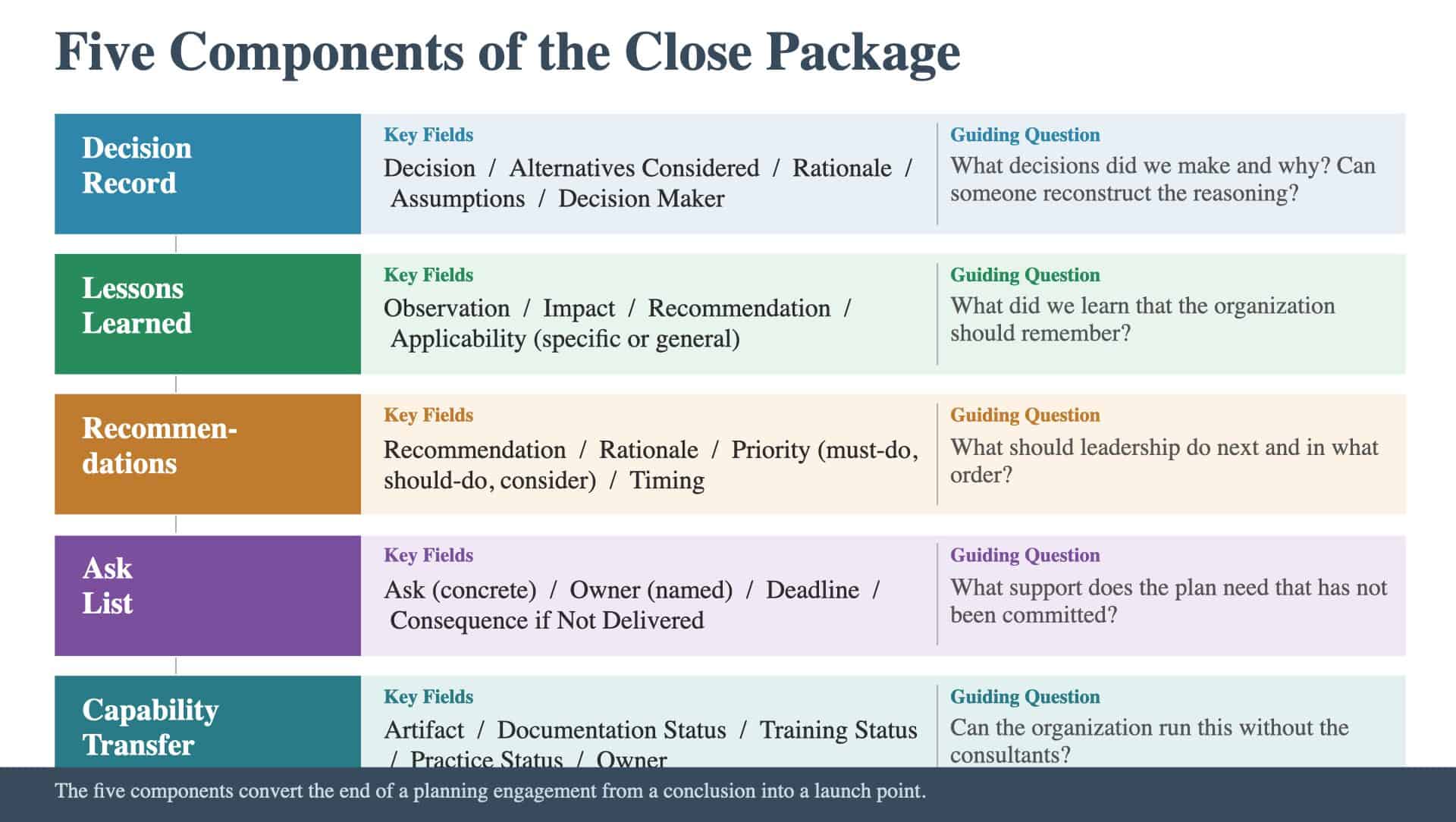
Most planning engagements end with a readout: a presentation that walks leadership through what was built. The readout is valuable, but it’s a communication event, not a handoff mechanism. It tells leadership what the plan says. It doesn’t transfer the capability to run it. A Close Package turns the ending of the engagement into an operational handoff. Here is what each component contains and what separates a useful version from a ceremonial one.
Component 1: The Decision Record
The Decision Record documents the key decisions made during the planning engagement, including the trade-offs that were considered and the rationale behind each choice. For each decision, the record captures:
- The decision. What was decided, stated clearly enough that someone who wasn’t in the room can understand it.
- The alternatives considered. What other options were on the table. This is what gives the decision context.
- The rationale. Why this option was chosen over the alternatives. The specific factors, data, or stakeholder input that drove the choice.
- The assumptions. What has to remain true for this decision to hold. When assumptions change, the organization knows which decisions to revisit.
- The decision maker. Who made the call, and who was consulted.
The quality bar: when someone new joins the program six months later, they can read the decision record and understand not just what was decided, but why. When circumstances change, the team can revisit decisions knowing what trade-offs were originally considered. The most common failure in decision records is capturing conclusions without trade-offs. “We decided on a four-wave rollout” is a conclusion. “We decided on a four-wave rollout instead of three because the support team can only cover two sites simultaneously, and a three-wave structure would have required Wave 2 to cover three sites” is a decision with context. The context is what makes the record useful when the team needs to adapt.
Component 2: Lessons Learned
Lessons Learned captures what the team discovered during the engagement: what surprised them, what worked, what didn’t, and what they’d do differently. For each lesson, the record captures:
- The observation. What happened, described specifically.
- The impact. How it affected the engagement or the plan.
- The recommendation. What to do differently next time.
- The applicability. Whether this lesson applies to this initiative specifically or to how the organization plans in general.
The quality bar: the lessons are specific enough to be actionable. “Communication could have been better” fails this test. “The team should have involved Finance in the stakeholder mapping process because they surfaced budget constraints in week six that reshaped the timeline; earlier involvement would have caught this in week two” passes it. The rose-colored trap is softening lessons to avoid uncomfortable truths. The most valuable lessons are often the hardest ones. If the planning engagement revealed that leadership alignment was weaker than assumed, or that a key stakeholder was actively working against the initiative, capturing that honestly serves the organization better than diplomatic gloss.
Component 3: Recommendations
Recommendations translate the consulting team’s observations into guidance for leadership. They distinguish between what needs immediate action, what should be monitored, and what’s a longer-term consideration. For each recommendation, the record captures:
- The recommendation. What leadership should do, stated as a clear action.
- The rationale. Why this matters, grounded in what the engagement revealed.
- The priority. Must-do (required for plan success), should-do (improves chances of success), or consider (longer-term value).
- The timing. When the action needs to happen.
The quality bar: recommendations are prioritized and actionable. A list of 30 recommendations with equal weight is not useful. A prioritized set with clear timing gives leadership a roadmap for the post-engagement period. The planning engagement gives the consulting team a view into the organization that leadership may not have. The stakeholder interviews surfaced dynamics that aren’t visible from the top. The risk assessment revealed vulnerabilities that the organization may not have acknowledged. The recommendations translate these observations into actions.
Component 4: The Ask List
The Ask List specifies what the plan needs from leadership that hasn’t been committed yet. Plans fail when they don’t get the support they need, and the ask list makes those needs explicit. For each ask, the record captures:
- The ask. What’s needed, stated concretely.
- The owner. Who needs to deliver it.
- The deadline. When it’s needed.
- The consequence. What happens if it doesn’t happen.
The quality bar: each ask is specific enough to create accountability. “We need support” is vague. “The CFO needs to confirm the Q3 budget allocation by March 15; without it, Wave 2 cannot begin on schedule” is an ask that can be tracked, committed to, and delivered. The passive-ask trap is presenting the list as information rather than as requests requiring commitment. The readout should end with explicit commitments from the people who own each ask. If a commitment can’t be made in the room, the ask should have a follow-up date and owner for resolution.
Component 5: Capability Transfer
Capability Transfer confirms that the organization can run the plan without the consultants. This is the component that separates a handoff from a document dump. For each artifact and process, the checklist captures:
- The artifact or process. What’s being transferred (e.g., the integrated roadmap, the operating rhythm, the risk register).
- Documentation status. Is it documented clearly enough for someone who wasn’t in the room to understand it?
- Training status. Has the receiving team been trained on how to use it, not just briefed on what it says?
- Practice status. Has the receiving team practiced using it? Have they updated the roadmap, run a governance meeting, or added a risk to the register?
- Owner. Who in the organization now owns this artifact or process?
- Ongoing support plan. What happens when the team encounters a question or situation the training didn’t cover?
The quality bar: the capability transfer goes beyond documentation. Training is part of it. Practice is part of it. Coaching is part of it. The checklist should confirm that knowledge was transferred and that the receiving team can execute. The document-dump trap is handing over artifacts without ensuring the organization knows how to use them. The clean-hands trap is declaring the handoff complete when it’s partial. If there are gaps in capability transfer, the Close Package should name them explicitly rather than creating a false sense of readiness.
How the Five Components Work Together
The Decision Record preserves the planning context. Lessons Learned preserves the engagement learning. Recommendations give leadership a post-engagement roadmap. The Ask List creates accountability for outstanding support needs. Capability Transfer ensures the organization can execute. Together, they convert the end of a planning engagement from a conclusion into a launch point. The narrative ties these components into a coherent story that leadership can act on. The question is whether the handoff launches the program with everything it needs to succeed: or whether the final presentation becomes the last time anyone looks at the plan.
Keep Reading
Ready to close specific gaps in your Close Package? These articles show you how: