The Plan Was the Easy Part
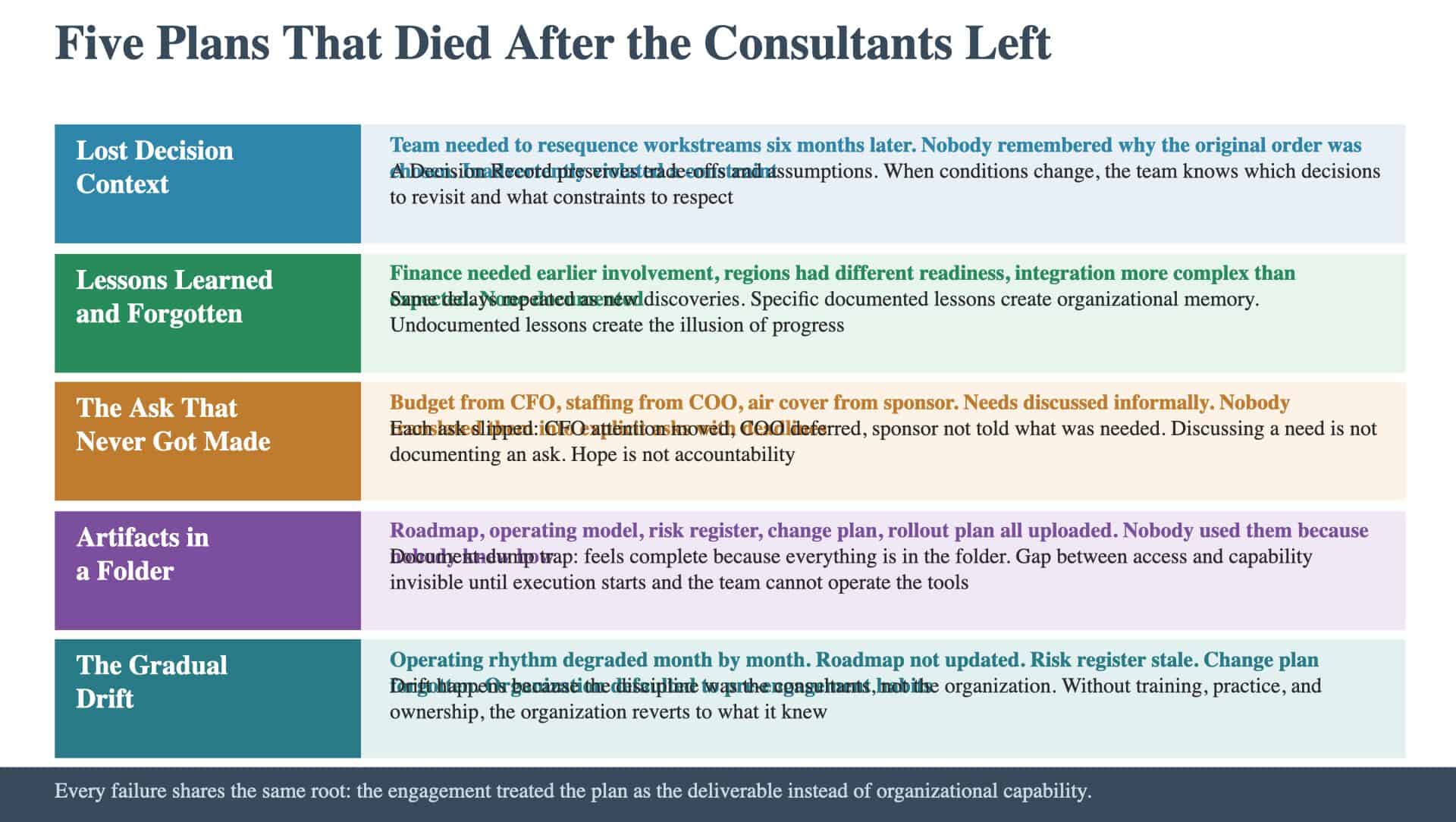
The planning engagement produced a comprehensive set of artifacts. The roadmap was sequenced. The operating model was designed. The change plan mapped every audience. The rollout plan defined waves, criteria, and learning agendas. By any measure, the planning work was excellent. Then came execution. And execution required something the planning engagement didn’t produce: an organization that could run the plan independently. Here are the patterns that repeat when programs build great plans but don’t transfer the capability to execute them.
The Decision That Nobody Could Explain
Six months after the consultants left, the program encounters a situation the original plan didn’t anticipate. A key vendor delays a deliverable, which shifts a dependency in the roadmap. The program team needs to resequence two workstreams. To resequence intelligently, the team needs to understand why the workstreams were ordered the way they were. What trade-offs were considered? What constraints drove the original sequence? What assumptions would need to hold for the original order to remain correct? Nobody knows. The people who made the decision remember that they discussed it, but not the specifics. The consultants who facilitated the discussion are gone. The roadmap shows the sequence but not the reasoning. The team makes their best guess at a new sequence, which inadvertently violates a constraint that the original design was built to respect. A decision record would have preserved the context. When the team needed to adapt, they would have known what assumptions to check, what trade-offs were considered, and what constraints to respect. Without it, adaptation becomes guesswork.
The Lessons That Were Learned and Immediately Forgotten
The engagement identified important discoveries. The team learned that Finance needed to be involved earlier than expected. They learned that the regional offices had different levels of change readiness than headquarters assumed. They learned that the technology integration was more complex than the vendor’s timeline suggested. None of this was documented. It lived in the memories of the people who were in the room. Six months later, when the program hits the same issues during execution, the team treats them as new discoveries. The Finance involvement delay repeats. The regional readiness gap surprises the team again. The technology integration requires the same emergency response it would have required without the planning engagement’s learning. The engagement produced learning. The learning didn’t survive the engagement because nobody captured it in a form that persisted beyond the consultants’ departure. Lessons learned that are specific and documented create organizational memory. Lessons learned that are discussed and forgotten create the illusion of progress.
The Ask That Never Got Made
The planning engagement identified several requirements for execution success: a budget commitment from the CFO for Q3 and air cover from the executive sponsor when the rollout hit its first wave of resistance. the consulting team mentioned these needs during the planning process. They were discussed in meetings. Everyone agreed they were important. But nobody translated them into explicit asks with owners, deadlines, and consequences for non-delivery. The budget commitment slipped because the CFO’s attention moved to a different priority. The staffing decision was deferred because the COO was managing a reorganization. The air cover never materialized because the executive sponsor wasn’t explicitly told what was needed and when. Each of these failures was preventable with an ask list: a concrete document specifying what was needed, from whom, by when, and what would happen if it didn’t arrive. The difference between discussing a need and documenting an ask is the difference between hope and accountability.
The Artifacts That Sat in a Folder
The consultants uploaded everything to a shared drive: the roadmap, the operating model, the risk register, the change plan, the rollout plan. Every artifact was there. Every template was complete. Nobody used them. Not because they weren’t valuable, but because nobody knew how. The roadmap was a complex document with dependencies, sequencing logic, and milestone definitions. Updating it when conditions changed required understanding the methodology behind it. The operating model defined cadences and governance, but running the cadences required facilitation skills the consultants had and the internal team didn’t. The artifacts were tools. Without training on how to use them, they were files. This is the gap that capability transfer is designed to close. The difference between a document dump and a capability transfer is whether the receiving team can operate the artifacts, not just access them. The document-dump trap is the most common handoff failure because it feels complete. Everything was delivered. Everything is in the folder. The team has access. The gap between access and capability is invisible until execution starts and the team discovers they can’t update the roadmap, can’t run the governance meetings, and can’t maintain the risk register.
The Gradual Drift That Nobody Noticed
The most insidious failure is not a dramatic collapse. It’s gradual drift. The operating rhythm starts strong. Weekly meetings happen on schedule for the first month. By month two, meetings are sometimes canceled. By month three, they’re biweekly. By month four, they’re ad hoc. The roadmap stops being updated after the first resequencing. The team intended to maintain it, but the process for updating it was never documented. It’s easier to track changes informally than to modify the formal artifact. Within six months, the roadmap on the shared drive bears no resemblance to what the team is actually executing. The risk register goes stale because nobody was assigned ownership and nobody was trained on the methodology for adding and assessing new risks. The change plan is forgotten entirely because the team responsible for communication never understood it as an operational tool rather than a planning document. Drift happens because the discipline that created the artifacts was the consultants’ discipline, not the organization’s. Without explicit capability transfer, including training, practice, and assigned ownership, the organization defaults to its pre-engagement habits. The artifacts exist, but the discipline to maintain them doesn’t. A structured operating system handoff prevents this drift by embedding the discipline into the organization’s own cadences.
The Common Thread
Every one of these failures shares the same root cause: the engagement treated the plan as the deliverable instead of treating organizational capability as the deliverable. The plan was excellent. The organization’s ability to run it wasn’t developed. A Close Package forces the question: can the organization run this without us? If the answer is no, the engagement isn’t over. The question is whether the organization builds the capability to run the plan independently: or whether the artifacts sit in a folder while execution drifts back to pre-engagement habits.
Keep Reading
Ready to close specific gaps in your Close Package? These articles show you how: