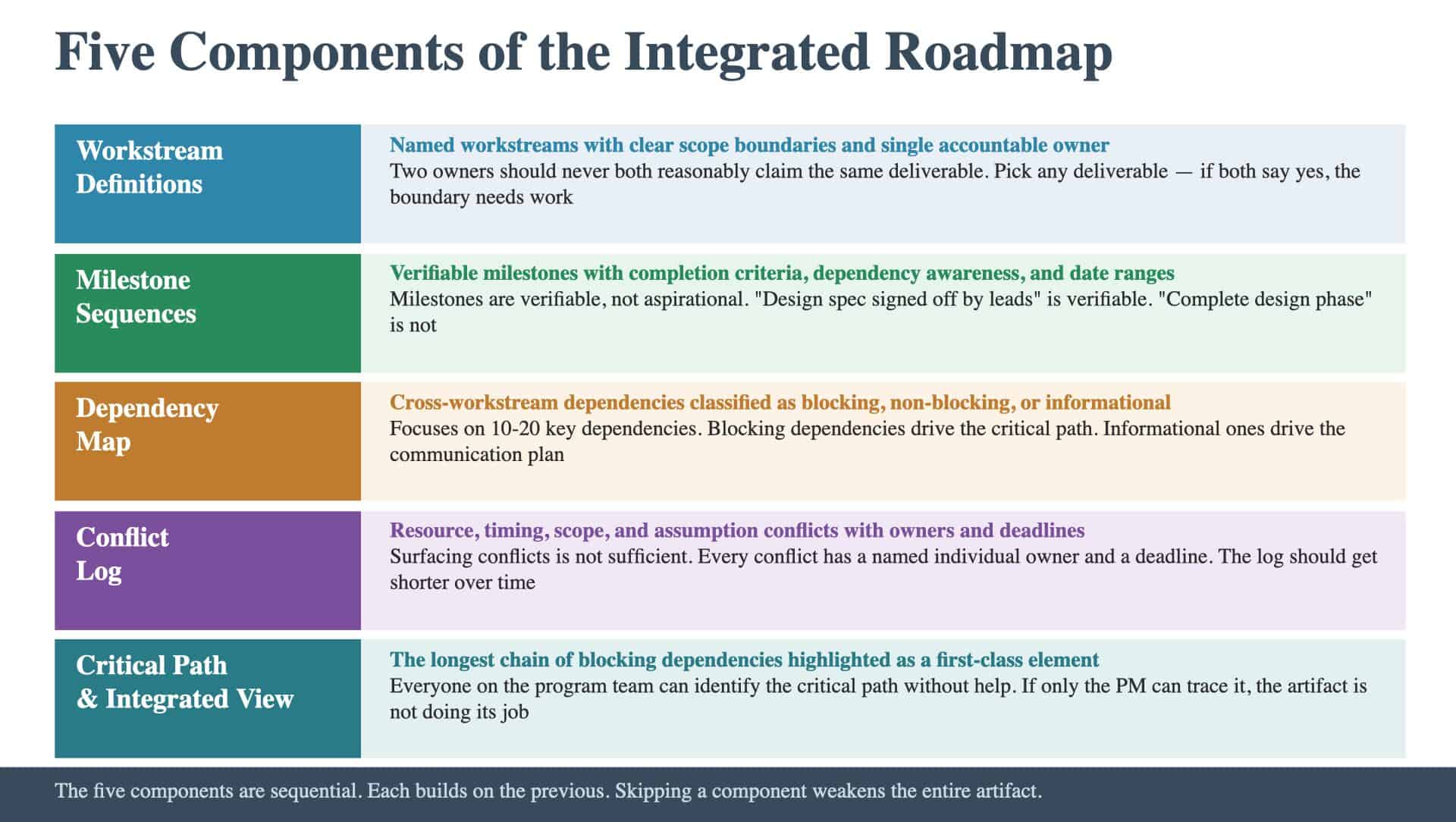
The Integrated Roadmap has five components. Each one answers a specific question, and each one builds on the one before it. This article walks through all five: what they contain, how they are built, and what separates a useful version from a decorative one.
Component 1: Workstream Definitions
What it contains
Named workstreams with clear scope boundaries and a single accountable owner for each. The definitions specify what is in scope for each workstream, what is out of scope, and where the handoff boundaries sit between adjacent workstreams.
How it is built
Workstream definitions come from the Architecture Blueprint. If the architecture defined workstreams with ownership and boundaries, those definitions carry forward. The roadmap session refines them: confirming that scope boundaries are unambiguous and that every deliverable in the program sits inside exactly one workstream.
What good looks like
Two workstream owners should never both reasonably claim the same deliverable. If there is ambiguity about where a deliverable belongs, the boundary is not clear enough. The test is simple: pick any deliverable and ask two workstream owners independently whether it belongs to them. If both say yes, the definitions need work. The architecture nobody builds describes why workstream definitions are architectural decisions, not administrative labels. The boundaries determine where handoffs happen, which determines where coordination risk concentrates.
Component 2: Milestone Sequences
What it contains
A sequence of verifiable milestones for each workstream, with target dates or date ranges. Each milestone has a clear completion criterion: a specific condition that must be true for the milestone to be considered done.
How it is built
Each workstream owner builds their milestone sequence, starting from the scope definition and working forward through the major checkpoints. The consultants push on verifiability: if a milestone says “complete design phase,” the question is what specifically would need to be true for two people to independently agree that the milestone is done.
What good looks like
Milestones are verifiable, not aspirational. “Design spec signed off by Product and Engineering leads” is verifiable. “Complete design phase” is not. The difference matters during execution: verifiable milestones create accountability because there is no ambiguity about whether they are met. Date ranges are acceptable where uncertainty exists. Claiming false precision (a specific date for an uncertain milestone) is worse than acknowledging a range. The team should be explicit about what would need to be true for the earlier date to hold. The roadmap that tells you nothing describes what happens when milestones are vague: the roadmap becomes a decoration rather than a management tool. No one can tell whether the program is on track because “on track” is undefined.
Component 3: The Dependency Map
What it contains
A map of cross-workstream dependencies showing who depends on whom, for what, and by when. Each dependency is classified by type: blocking (work cannot proceed without it), non-blocking (work could proceed but would benefit from it), or informational (awareness is needed but nothing is waiting).
How it is built
The consultants facilitate a structured exercise. Each workstream identifies what it needs from other workstreams (inputs) and what it produces for other workstreams (outputs). The inputs and outputs are matched. Where a match exists, a dependency is documented. Where an input has no matching output, a gap exists that needs resolution. The classification step matters. Not every dependency is equally important. Blocking dependencies create hard constraints on sequencing. Non-blocking dependencies create preferences. Informational dependencies create communication needs. Treating all three the same produces an unmanageable map.
What good looks like
The map focuses on the dependencies that matter: blocking dependencies, high-risk dependencies, and dependencies on the critical path. A useful dependency map has ten to twenty key dependencies, not two hundred. The completeness trap, trying to map every possible connection, produces a hairball that no one reads and no one manages. The complete deliverable map describes the upstream work that feeds dependency mapping. If the deliverable inventory is incomplete, the dependency map will have gaps: connections that exist but were never documented because the deliverables themselves were not cataloged.
Component 4: The Conflict Log
What it contains
A log of identified conflicts: resource conflicts, timing conflicts, scope conflicts, and assumption conflicts. Each conflict has a description, a resolution owner (a specific individual responsible for resolving it), and a resolution deadline.
How it is built
Conflicts emerge from the dependency mapping exercise and from overlaying the milestone sequences. When two workstreams plan to use the same resource during the same period, that is a resource conflict. When a milestone’s target date does not account for an upstream dependency’s timeline, that is a timing conflict. When two workstreams define overlapping scope, that is a scope conflict. The consultants log every conflict as it identifies. The resolution is not necessarily immediate. Some conflicts require decisions that need stakeholder input or additional analysis. The conflict log tracks them to resolution.
What good looks like
Every conflict has a named individual owner and a deadline. identifying conflicts is necessary but not sufficient. A conflict log without owners and deadlines is a worry list. A conflict log with owners and deadlines is a management tool. The log should get shorter over the course of the roadmap sessions. If conflicts are being logged but not resolved, the sessions are not doing their job. The goal is to enter execution with a short list of managed conflicts, not a long list of unresolved ones. Programs that failed with good plans documents what happens when conflicts are identified during planning but not resolved: they reappear during execution as crises.
Component 5: The Critical Path and Integrated View
What it contains
The integrated visualization showing all workstreams, their milestone sequences, the dependencies between them, and the critical path highlighted as a first-class element. The critical path is the longest chain of dependent activities; a delay in any activity on the critical path delays the program’s end date.
How it is built
The critical path emerges from the dependency map. The consultants trace the chains of blocking dependencies from program start to program end. The longest chain is the critical path. There may be near-critical paths that are close to the critical path in duration and could become critical if conditions change. The integrated view combines all five components into one artifact. It is the roadmap that the program team will reference throughout execution. It needs to be readable: a senior leader should be able to look at it and understand the program’s structure, timeline, key dependencies, and critical path within five minutes.
What good looks like
Everyone on the program team can identify the critical path without help. If the critical path is buried in a complex visualization and only the project manager can trace it, the artifact is not doing its job. The critical path should be visually obvious. The integrated view should also show where buffer exists. Critical-path activities with no buffer between them and the next dependency are the program’s highest-risk points. Making that visible helps the team prioritize where to focus attention during execution. The roadmap that tells you nothing contrasts the integrated view with the common alternative: a timeline that shows dates without dependencies, making it impossible to understand what drives the schedule.
How the Five Components Connect
The components are sequential. Workstream definitions create the structure. Milestone sequences populate the structure with checkpoints. The dependency map connects the checkpoints across workstreams. The conflict log captures where the connections reveal problems. The critical path identifies the sequence that determines the end date. Skipping a component weakens the entire artifact. Milestone sequences without dependency mapping produce a collection of independent plans. Dependency mapping without a conflict log identifies problems without resolving them. A critical path without workstream definitions cannot be traced to accountable owners. The question is whether your roadmap integrates all five layers into a single stress-testable plan: or whether each component exists in isolation, producing a collection of documents instead of an executable sequence.
Keep Reading
Ready to close specific gaps in your Integrated Roadmap? These articles show you how: