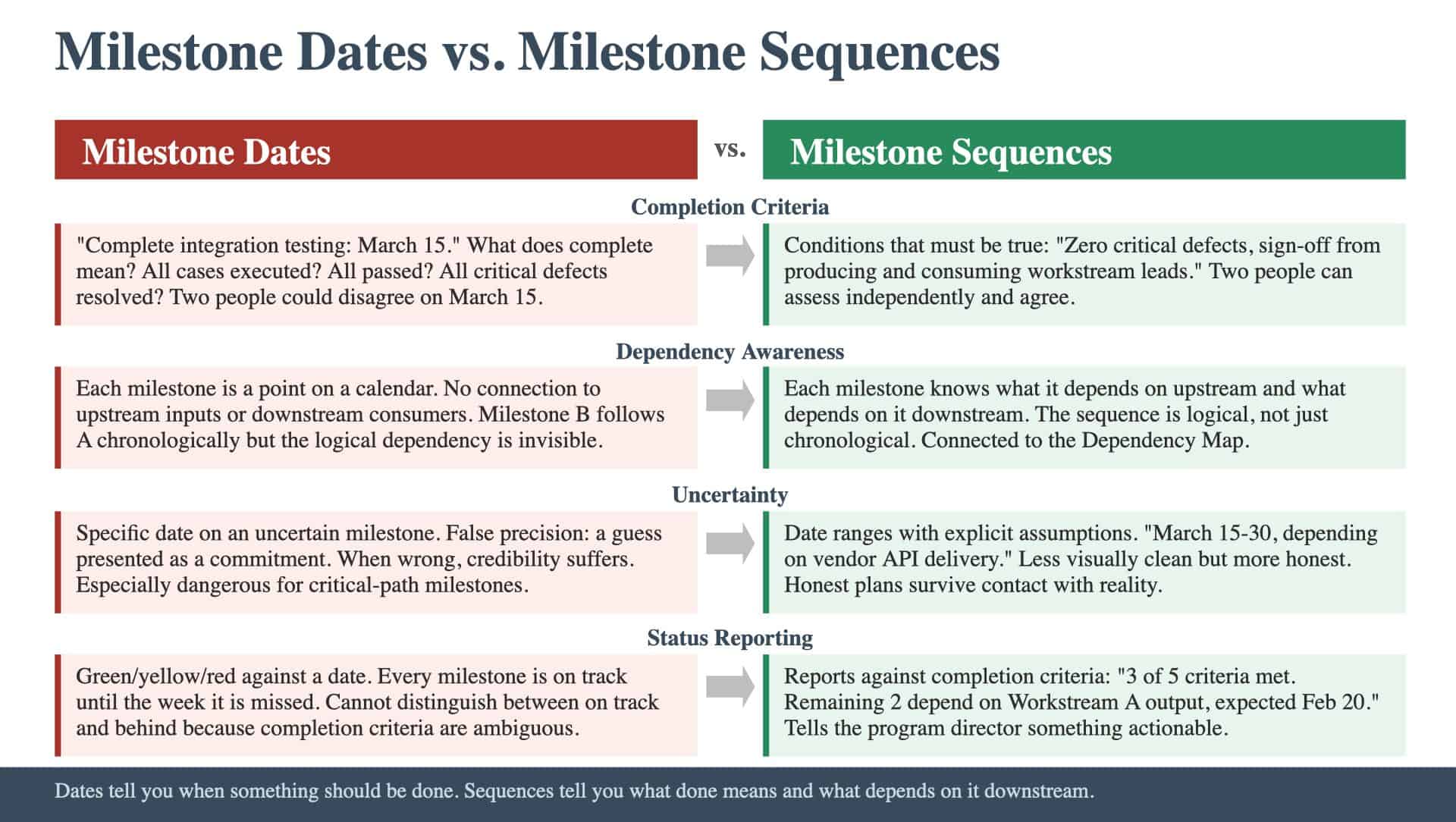
The roadmap has dates. Every major deliverable has a target completion date. The Gantt chart shows bars extending across weeks and months, each bar ending at a diamond-shaped milestone marker. It looks like a plan. But dates are not sequences. And milestone markers are not milestones. A milestone date tells you when something should be done. A milestone sequence tells you the order in which things must happen, what each milestone specifically requires, how you will know when it is actually complete, and what depends on it downstream. The Milestone Sequences sub-artifact captures exactly this structure. The gap between the two is the gap between a timeline and a plan.
What Milestone Dates Look Like
A milestone date is a point on a calendar. “Complete integration testing: March 15.” It appears in the project schedule, the status report, and the executive dashboard. It looks precise. The precision is usually false. “Complete integration testing” is not a verifiable milestone. What does complete mean? All test cases executed? All test cases passed? All critical defects resolved? All defects resolved? Two reasonable people could assess the same situation on March 15 and disagree about whether the milestone is met. Milestone dates without completion criteria create a specific management problem. The workstream owner reports the milestone as “on track” because their definition of complete is different from the downstream consumer’s definition. The downstream team begins their work assuming the milestone was met to their standard. The gap between definitions produces rework. This is not a communication failure. It is a specification failure. The milestone was never defined precisely enough to be verifiable. The roadmap that tells you nothing describes roadmaps where every milestone is “on track” until the week it is missed. The root cause is unverifiable milestones: the team cannot distinguish between on track and behind because the completion criteria are ambiguous.
What Milestone Sequences Look Like
A milestone sequence has properties that milestone dates lack. Verifiable completion criteria. Each milestone specifies the conditions that must be true for it to be considered done. “Integration test suite executed with zero critical defects and sign-off from both the producing and consuming workstream leads” is verifiable. Two people can assess it independently and agree. Dependency awareness. Each milestone knows what it depends on (upstream) and what depends on it (downstream). This is where milestone planning connects to the Dependency Map. The sequence is not just chronological; it is logical. Milestone B happens after Milestone A not because of calendar convention but because B requires A’s output. Ordering rationale. The sequence reflects why milestones are in a particular order, not just what order they happen to be in. When a stakeholder asks “Why can’t we do this sooner?” the sequence answers: because it depends on these specific inputs from these specific sources, and those inputs are not available until this date. Uncertainty acknowledgment. Where uncertainty exists, the sequence uses date ranges rather than specific dates. A range with explicit assumptions (“March 15-30, depending on vendor delivery of the API specification”) is more honest and more useful than a false-precision date that will be missed. Start with what already exists explains why upstream artifact quality determines milestone quality. If the goals are vague, the milestones will be vague. If the architecture is incomplete, the milestone dependencies will be incomplete.
The Gap in Practice
Consider a program with three workstreams. Each workstream has a milestone labeled “Complete Phase 1.” With milestone dates: each workstream has a target date. Workstream A: February 28. Workstream B: March 15. Workstream C: March 31. The program dashboard shows three bars with three diamond markers. The executive team sees a plan. With milestone sequences: the team discovers that Workstream B’s Phase 1 depends on Workstream A’s Phase 1 output (a data model specification). Workstream C’s Phase 1 depends on both A and B (the data model specification and the integration protocol). The completion criteria for each are specified: A’s milestone requires the data model signed off by the consuming teams. B’s milestone requires the integration protocol tested against A’s data model. C’s milestone requires end-to-end testing with both upstream outputs. The sequence reveals that the original dates are unrealistic. Workstream A’s February 28 date leaves Workstream B only fifteen days to receive A’s output, incorporate it, and complete their work. If A slips by one week, B’s March 15 date is impossible. The dependency chain means C’s March 31 date has effectively no buffer. This discovery happens during planning (when the team can adjust dates, add buffer, or restructure the sequence) or during execution (when the team discovers it in real time and the options are limited to rework and delay). Milestone sequences force the planning discovery. Milestone dates allow the execution discovery.
From Dates to Sequences: What Changes
The planning conversation changes. Instead of “When will this be done?” the question becomes “What does done mean, what does it depend on, and what is the realistic date range given those dependencies?” The conversation is harder during planning but produces a more reliable answer. Status reporting changes. Instead of green/yellow/red against a date, the team reports against completion criteria. “Three of five acceptance criteria met. Remaining two depend on Workstream A’s output, expected by February 20. If A delivers on time, we are on track for the February 28 range.” The status report tells the program director something actionable. Risk management changes. The sequence makes it visible where delays would cascade. The program director can look at the sequence and identify the milestones where a slip would propagate through dependencies to other workstreams. Those milestones get more attention, more buffer, and more frequent status updates. The complete deliverable map describes the deliverable inventory that feeds milestone specification. If the team does not know exactly what each workstream is producing, the milestone completion criteria will be vague because the deliverables themselves are undefined.
The False-Precision Trap
The most common resistance to milestone sequences is that they look less precise. A Gantt chart with specific dates for every milestone looks more professional than a sequence with date ranges and conditional dependencies. The executive dashboard with clean dates looks more controlled than one with ranges and caveats. The appearance of precision is not precision. A specific date on an uncertain milestone is a guess presented as a commitment. When the guess is wrong, the commitment is broken, and the team’s credibility suffers. Date ranges with explicit assumptions are less visually clean but more honest, and honest plans survive contact with reality. The false-precision trap is especially dangerous for critical-path milestones. A critical-path milestone with a false-precision date hides the program’s most important risk. If the date is wrong, the entire program timeline shifts, and the team does not know it until the milestone is missed. Programs that failed with good plans documents programs where false precision in milestone dates concealed the real state of the program until the gap was too large to close.
What This Means for the Roadmap
Converting milestone dates to milestone sequences is not a formatting change. It is a planning discipline change. The team must specify what done means, map what depends on what, acknowledge where uncertainty exists, and build the sequence based on logical dependencies rather than calendar preferences. The result is a roadmap that can be stress-tested. Pull on any milestone, and the sequence shows what would happen downstream. Change an assumption, and the sequence shows which dates move. Add a delay, and the sequence shows which workstreams are affected. The question is whether your milestones are verifiable checkpoints with dependency-aware sequencing and explicit completion criteria: or whether they are dates on a calendar that tell you when something should be done without telling you what done means.
Keep Reading
New to the Integrated Roadmap? Start with the foundations:
Ready to benchmark your work against best-in-class? See what excellence looks like: