Most programs have a roadmap. Or rather, most programs have multiple roadmaps: one per workstream, each built by the team responsible for that slice of the work. Technology has a roadmap. Operations has a roadmap. The business transformation team has a roadmap. Each one looks reasonable in isolation. The problem is that no one has built the roadmap that shows how those plans connect. Where Team A’s milestone depends on Team B’s deliverable, which depends on Team C’s resource availability, which depends on a vendor commitment that Procurement hasn’t finalized. That connected view is the Integrated Roadmap, and most programs don’t have one. It starts with Workstream Scoping and culminates in a Critical Path Risk Map that shows what actually determines the end date. That connected view is the Integrated Roadmap, and most programs don’t have one. This article introduces the artifact: what it is, how it differs from a collection of workstream plans, and what happens to programs that proceed without it.
What the Integrated Roadmap Actually Is
The Integrated Roadmap is a single view of the entire program’s execution path. It shows every workstream’s milestone sequence, the dependencies between workstreams, the conflicts that need resolution, and the critical path that determines the program’s end date. It is not a Gantt chart, though it may include timeline elements. It is not a project plan, though it connects to project-level detail. It is the artifact that answers the question: given everything we know about scope, dependencies, constraints, and risks, what is the realistic sequence of work and what determines whether we finish on time? The distinction matters because most planning artifacts answer a narrower question. A workstream plan answers: what does this team need to do, in what order? A project schedule answers: what are the dates? The Integrated Roadmap answers: how do all the pieces fit together, and what happens to the whole when one piece slips? The roadmap that tells you nothing describes the common failure: a roadmap that shows timelines without showing connections. Dates without dependencies are guesses. The Integrated Roadmap turns guesses into a stress-testable plan.
How It Differs from Workstream Plans
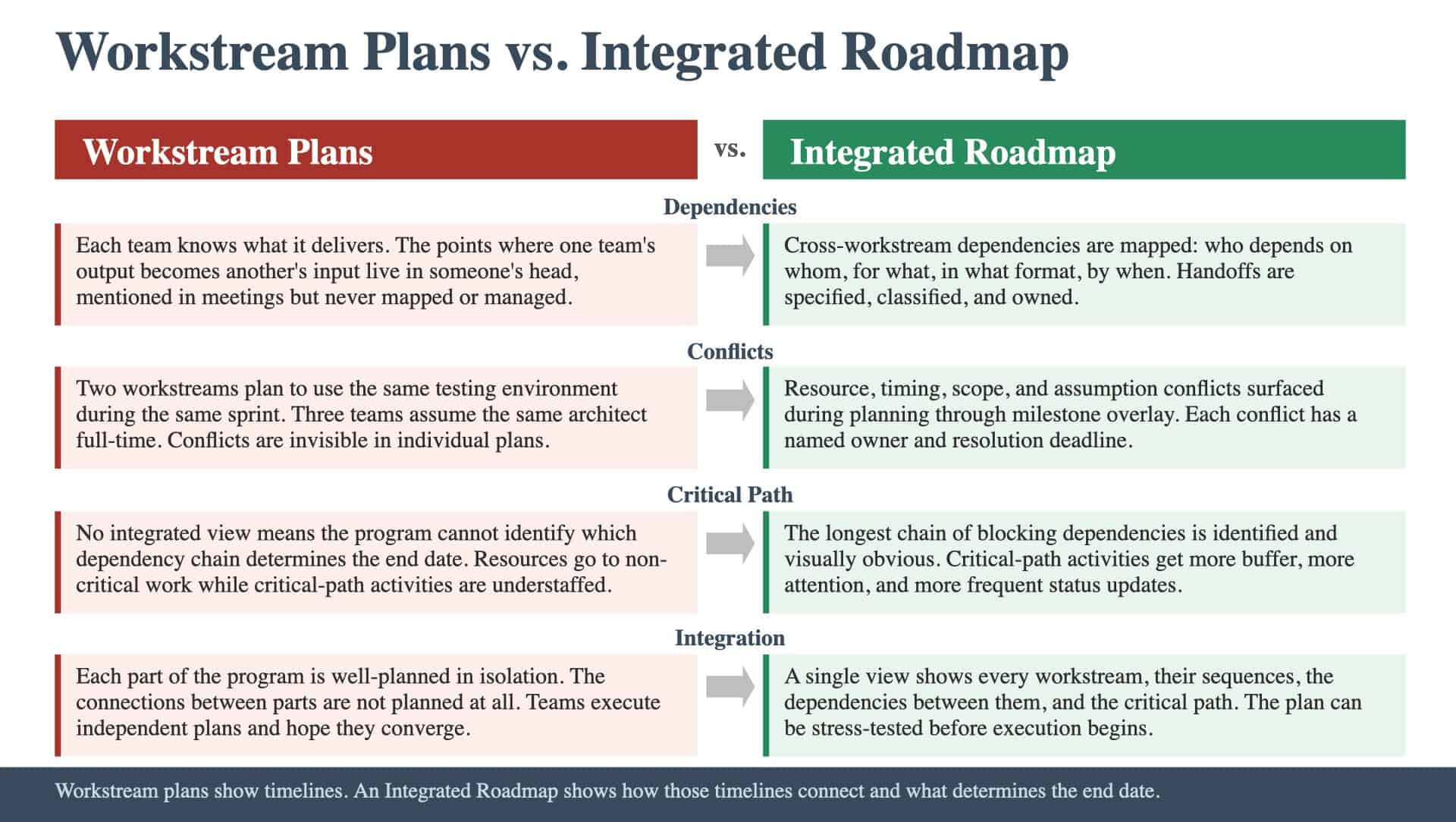
Workstream plans are built from the inside out. Each team looks at its own scope and builds a sequence of milestones that makes sense for its work. This is necessary but insufficient. What’s missing falls into a few categories. Dependencies are invisible. Each team knows what it needs to deliver, but the points where one team’s output becomes another team’s input are not documented in either team’s plan. The dependency lives in someone’s head, mentioned in a meeting but never mapped, tracked, or managed. When the dependency is missed, the downstream team discovers it in real time. Conflicts are unresolved. Two workstreams plan to use the same testing environment during the same sprint. Three teams assume the same architect will be available full-time during their critical integration phase. The business team’s user acceptance testing schedule conflicts with the technology team’s deployment window. None of these conflicts are visible in any individual workstream plan because each plan only sees its own resource needs. The critical path is unknown. Without an integrated view, the program cannot identify which sequence of dependencies determines the end date. The critical path is the chain of activities where a delay in any single activity delays the entire program. If the team doesn’t know what’s on the critical path, they cannot protect it. Resources get allocated to non-critical activities while critical-path work is understaffed. The complete deliverable map describes the upstream work that makes integration possible. Without a complete inventory of what each workstream is producing and consuming, the dependency map has gaps.
What Happens Without One
Programs that execute with workstream plans but without an Integrated Roadmap experience a predictable pattern of failures. Discovery during execution. Dependencies that should have been mapped during planning are discovered during execution, when the cost of accommodation is highest. A workstream reaches a milestone and discovers that its downstream consumer assumed a different format, a different timeline, or a different scope. The rework happens under deadline pressure. Cascade failures. A slip in one workstream cascades through dependencies that were never mapped. The program director learns about the cascade when the downstream team misses its milestone and explains that they were waiting for an input that was delayed three weeks ago. The three-week delay is now a six-week program delay because the downstream team had no warning and couldn’t adjust. Resource collisions. Without visibility into cross-workstream resource needs, the same people are over-allocated at the same times. The collisions surface as missed commitments and burned-out staff, not as planning failures. The root cause is invisible because no one mapped where resource demands overlap. Unprotected critical path. The program misses its end date because critical-path activities were delayed while non-critical activities received priority. No one knew which activities were on the critical path, so the trade-off decisions during execution were uninformed. The team worked hard on the wrong things. Why programs fail documents these patterns across multiple engagements. The common thread is not incompetence or insufficient effort. It is insufficient integration: each part of the program was well-planned in isolation, but the connections between parts were not planned at all.
The Preparation That Makes It Possible
An Integrated Roadmap cannot be built from scratch. It requires four upstream artifacts. The Architecture Blueprint provides workstream definitions with clear boundaries and a governance model for cross-functional decisions. Without architecture, the roadmap has no structure to integrate. The Risk Landscape provides the constraints the roadmap must respect: calendar conflicts from the overlay, failure modes the sequencing must mitigate, and guardrails the timeline cannot violate. Without the Risk Landscape, the roadmap is optimistic. The Stakeholder Map provides the organizational context: who owns what, where political dynamics create risk, and which dependencies are technically simple but organizationally complex. Without the Stakeholder Map, the roadmap ignores the human factors that determine whether handoffs actually happen. The Landscape Brief provides the foundation: goals, current state, artifact inventory, and scope boundaries. Without the Landscape Brief, the roadmap is built on assumptions rather than evidence. Start with what already exists explains why this upstream work matters. The Integrated Roadmap is not the first step in planning. It is the step where all prior planning work converges into an executable sequence.
Why This Is the Centerpiece
The Integrated Roadmap sits at the center of the planning methodology because it is the artifact that transforms preparation into a plan. Everything before it (the Landscape Brief, Stakeholder Map, Architecture Blueprint, and Risk Landscape) is input. Everything after it (the Operating Model, Change Plan, Rollout Plan, and Close Package) is operationalization. The quality of the Integrated Roadmap determines whether execution will be coordinated or chaotic. A program with a strong Integrated Roadmap knows its dependencies, has resolved its conflicts, understands its critical path, and has built buffer where risk is highest. A program without one is executing a collection of independent plans and hoping they converge. The question is whether your program has a single integrated view showing how workstreams connect, where dependencies create risk, and what determines the end date: or whether each team is executing its own plan and hoping they converge.
Keep Reading
Ready to close specific gaps in your Integrated Roadmap? These articles show you how: