Most programs know they have dependencies. The teams mention them in status meetings. The project plan has a column for “dependencies” that contains phrases like “pending input from IT” or “waiting on vendor.” Someone compiled a list during a planning workshop. Knowing dependencies exist is different from managing them. The gap between a dependency list and a dependency map is the gap between awareness and action. Programs that fall into that gap discover it at the handoff points, where one workstream’s work ends and another’s begins, and where unmapped dependencies produce the delays and rework that consume program budgets.
What Partial Dependency Management Looks Like
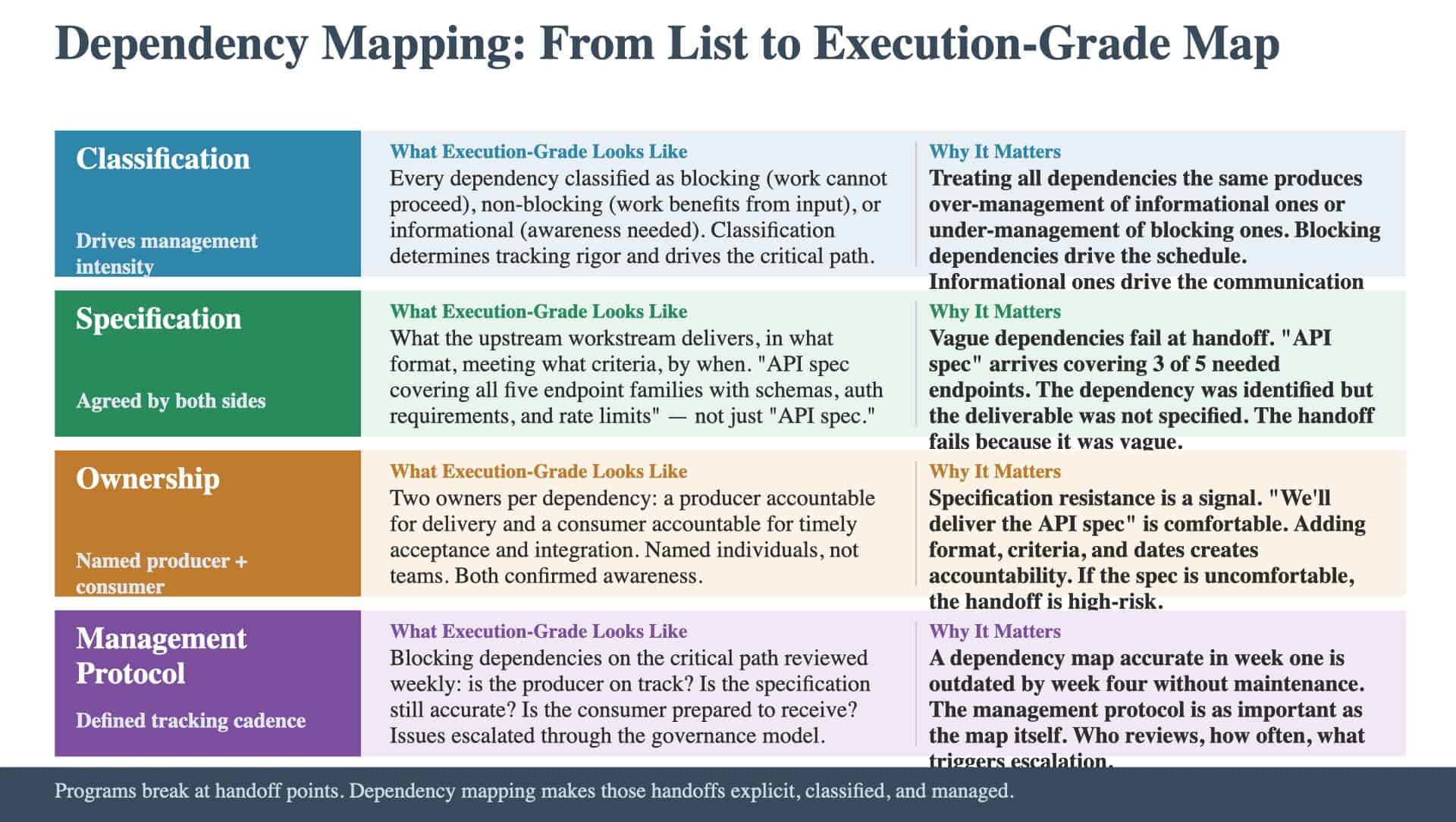
Partial dependency management has consistent characteristics. Dependencies are noted but not classified. The list says “Workstream B depends on Workstream A.” It does not specify whether the dependency is blocking (B literally cannot start without A’s output), non-blocking (B could start but the work would be higher quality with A’s input), or informational (B needs to know what A decided but is not waiting for a deliverable). The distinction matters because blocking dependencies drive the critical path while informational dependencies drive the communication plan. Treating all dependencies the same produces either over-management (tracking informational dependencies with the same rigor as blocking ones) or under-management (treating blocking dependencies as casually as informational ones). Dependencies are identified but not specified. The list says “API specification from Technology” but does not define the format, the completeness criteria, or the acceptance process. When the API specification arrives, the consuming team discovers it covers three of the five endpoints they need. The dependency was identified but the deliverable was not specified. The handoff fails not because it was missed but because it was vague. Dependencies are documented but not managed. The list exists in a spreadsheet that was created during a planning workshop and has not been updated since. No one owns the dependency tracking. No one checks whether upstream dependencies are on schedule. The downstream team learns that an input is delayed when the input fails to arrive. The architecture nobody builds describes the upstream cause: without architecture that defines workstream boundaries and handoff points, dependencies are discovered ad hoc rather than designed into the program structure.
What Execution-Grade Dependency Mapping Looks Like
An execution-grade Dependency Map differs from a dependency list in several ways. Classification. Every dependency is classified as blocking, non-blocking, or informational. The classification drives management intensity. Blocking dependencies are tracked weekly with named owners and specific due dates. Non-blocking dependencies are tracked at the program level with escalation triggers. Informational dependencies are managed through the communication plan. Specification. Each dependency specifies what the upstream workstream will deliver, in what format, meeting what criteria, by what date. The specification is agreed upon by both the producing and consuming workstreams. “API specification” becomes “API specification covering all five endpoint families, with request/response schemas, authentication requirements, and rate limit definitions, reviewed and accepted by the consuming team’s technical lead.” Ownership. Each dependency has two owners: a producer (the person responsible for delivering the output) and a consumer (the person responsible for accepting and integrating the input). Both owners are named individuals, not teams. The producer is accountable for delivery. The consumer is accountable for timely acceptance and integration. Management protocol. Dependencies are tracked through a defined cadence. Blocking dependencies on the critical path are reviewed weekly. The review checks whether the producer is on track, whether the specification remains accurate, and whether the consumer is prepared to receive the output. Issues are escalated through the governance model. The complete deliverable map provides the deliverable inventory that feeds dependency specification. Each dependency references a specific deliverable from the inventory. If the inventory is incomplete, the dependency map will have gaps.
Where Programs Get Stuck
The transition from dependency list to dependency map stalls at predictable points. The completeness trap. The team tries to map every possible dependency, producing a diagram with two hundred connections that no one can read or manage. Execution-grade dependency mapping is not comprehensive dependency mapping. It focuses on blocking dependencies, high-risk dependencies, and dependencies on the critical path. A useful map has fifteen to twenty-five key dependencies, not two hundred. The test is whether the program director can review the entire dependency map in a single meeting. The specification resistance. Producing workstreams resist specifying their deliverables in detail because it creates accountability. “We’ll deliver the API spec” is comfortable. “We’ll deliver the API spec covering five endpoint families with schemas, auth requirements, and rate limits, reviewed by the consuming team’s lead by March 1” is a commitment. The resistance is a signal that the dependency is real and important: if the specification is uncomfortable, the handoff is high-risk. The management gap. The map is built but no one owns the ongoing tracking. Dependencies change during execution. Dates shift. Specifications evolve. A dependency map that was accurate in week one is outdated by week four if no one is maintaining it. The management protocol (who reviews, how often, what triggers escalation) is as important as the map itself. The roadmap that tells you nothing describes the downstream consequence: when dependencies are not managed, the roadmap’s dates become fiction. The program operates on a timeline that no longer reflects reality.
The Critical Path Connection
Dependency classification directly determines the critical path. The critical path is the longest chain of blocking dependencies from program start to program end. If blocking dependencies are not distinguished from non-blocking ones, the critical path cannot be identified. Programs with partial dependency management cannot answer the question: which chain of activities determines our end date? They can list activities. They can list dependencies. But they cannot trace the chain because the classification that distinguishes blocking from non-blocking is missing. This matters most when delays occur. A delay in a critical-path dependency delays the program. A delay in a non-critical dependency creates slack in one workstream but does not affect the end date. Without classification, the program treats all delays with equal urgency (wasting management attention on non-critical delays) or equal casualness (failing to escalate critical delays). Why programs fail documents the pattern: programs that cannot distinguish critical from non-critical dependencies make poor resource allocation decisions throughout execution. The team works hard on the wrong things because they cannot tell which things matter to the timeline.
From List to Map
The conversion from dependency list to dependency map is a planning investment. It requires facilitated sessions where producing and consuming workstreams sit together and agree on what will be delivered, in what form, by when. It requires classification decisions that force the team to distinguish between dependencies that drive the schedule and dependencies that inform the communication plan. It requires naming owners who are accountable for specific handoffs. The investment pays during execution. Every dependency that is specified, classified, and owned is a handoff that has a management protocol around it. Every unspecified dependency is a handoff where both teams are guessing, and where the guess will be tested under deadline pressure. The question is whether your dependencies are specified, classified, and owned with management protocols around each handoff: or whether they exist as a list of connections that no one tracks until one of them breaks.
Keep Reading
New to the Integrated Roadmap? Start with the foundations:
Ready to benchmark your work against best-in-class? See what excellence looks like: