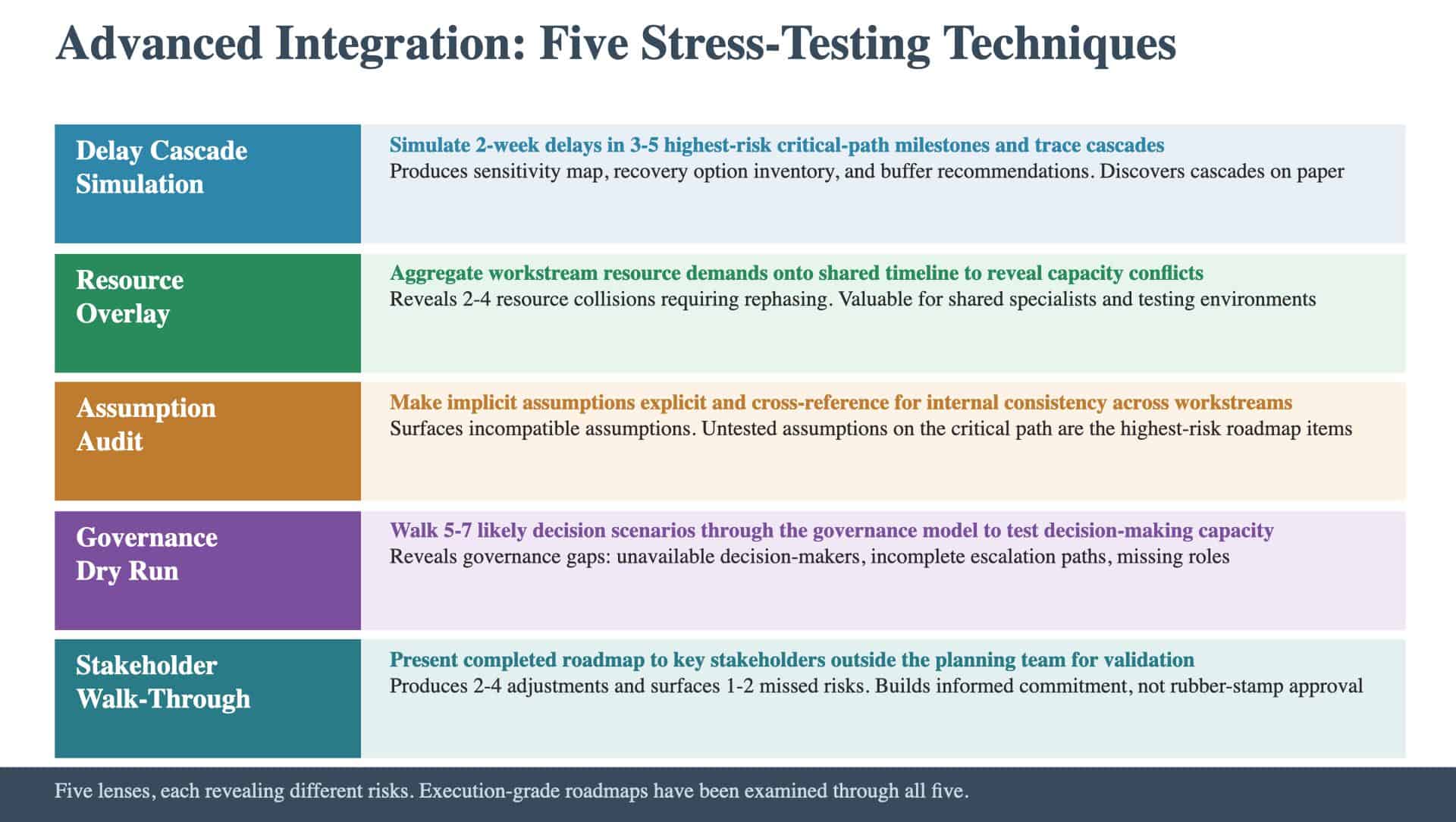
The standard roadmap session assembles workstream owners, maps their milestones, identifies dependencies, and produces an integrated timeline. This approach produces a roadmap. Whether it produces an execution-grade roadmap depends on what happens next. Advanced integration techniques go beyond the initial assembly. They stress-test the roadmap against scenarios, iterate through multiple versions, and harden the plan against the specific failure modes that cross-functional programs encounter. These are the techniques that separate roadmaps built to present from roadmaps built to execute.
Technique 1: The Delay Cascade Simulation
The standard roadmap shows what happens when everything goes according to plan. The delay cascade simulation shows what happens when it does not. The consultants take the three to five highest-risk milestones on the critical path and simulate a two-week delay in each one independently. For each simulation, they trace the cascade through the dependency chain: what downstream milestones move, which workstreams are affected, what the new end date becomes, and what options exist for recovery. This simulation feeds directly into the Critical Path Risk Map. The simulation produces two primary outputs. First, a sensitivity map showing which milestones have the highest cascade impact (a delay in this milestone affects the most downstream work), paired with a recovery option inventory for each high-impact scenario (can the downstream work be rephased, can parallel paths be created, can additional resources compress the timeline). These feed directly into buffer recommendations for the highest-sensitivity milestones. The delay cascade simulation changes the team’s relationship to the roadmap. Instead of “here is our plan,” the conversation becomes “here is our plan, here is what happens if these specific things slip, and here is what we would do.” The contingency thinking happens during planning, when options are abundant, rather than during execution, when options are constrained. Programs that failed with good plans documents programs where the first cascade was discovered during execution. The delay cascade simulation is a way to discover the cascades on paper.
Technique 2: The Resource Overlay
The standard dependency map shows logical dependencies: who needs what from whom. The resource overlay adds capacity dependencies: who needs how much of which shared resources, when. The consultants build a resource demand map by aggregating each workstream’s resource requirements onto a shared timeline. The map shows when demand peaks, which shared resources are oversubscribed, and where resource conflicts exist that the dependency map alone would not reveal. The resource overlay is particularly valuable for programs that share technical specialists, testing environments, or integration teams across workstreams. These shared resources create implicit dependencies that do not appear in the logical dependency map but constrain the schedule just as effectively. The overlay typically reveals two to four resource collisions that require rephasing. The rephasing changes the roadmap: milestones move, the critical path may shift, and the end date may change. These are changes the team wants to make during planning, not discover during execution when the shared resource becomes a bottleneck. The architecture nobody builds connects to the resource overlay: the governance model should define how shared resources are allocated when demand exceeds supply. The resource overlay provides the data. The governance model provides the decision process.
Technique 3: The Assumption Audit
Every roadmap is built on assumptions. Some are explicit (the vendor will deliver the API by March 1). Some are implicit (the team that owns the testing environment will make it available when we need it). The assumption audit makes implicit assumptions explicit and tests whether they are internally consistent. The consultants review the roadmap component by component, asking each workstream owner to state the assumptions their milestones depend on. The assumptions are compiled and cross-referenced. Where two workstreams hold incompatible assumptions, the conflict is surfaced for resolution. Common assumption conflicts include: different workstreams assuming different technology decisions that have not been finalized, different workstreams assuming access to the same environment during the same period, and different workstreams assuming different levels of executive support for scope or resource decisions. The assumption audit also identifies assumptions that are untested. “The vendor will deliver by March 1” is testable: has the vendor confirmed this date with a contractual commitment? “The legacy system will support the new integration protocol” is testable: has someone verified this technically? Untested assumptions on the critical path are the highest-risk items in the roadmap. The roadmap that tells you nothing describes roadmaps built on unexamined assumptions. The assumption audit is the mechanism for examination.
Technique 4: The Governance Dry Run
The roadmap defines what the team plans to do. The governance model (from the Architecture Blueprint) defines how the team will make decisions during execution. The governance dry run tests whether the governance model can actually handle the decisions the roadmap will require. The consultants identify five to seven decision scenarios that the program is likely to face during execution. Each scenario involves a cross-functional trade-off: a scope change that affects two workstreams, a resource reallocation between competing priorities, a timeline adjustment that cascades through dependencies. They then walk the scenarios through the governance model: who would make this decision, with what information, through what process, in what timeframe. The dry run reveals governance gaps. A decision that requires the program director’s approval but the program director is available only biweekly. An escalation path that routes through a committee that does not include the affected workstream owners. A trade-off decision that the governance model assigns to a role that does not exist on the program. These gaps are fixable during planning. The governance model can be adjusted to address the scenarios. During execution, governance gaps produce decision stalls: the team identifies a problem but cannot resolve it because the decision-making process does not accommodate the situation. Why programs fail documents decision stalls as a leading cause of timeline slippage. The governance dry run is preventive: testing the decision-making machinery before it is needed.
Technique 5: The Stakeholder Walk-Through
The final integration technique presents the completed roadmap to the program’s key stakeholders (not the program team that built it) and asks them to identify gaps, risks, and assumptions they disagree with. The walk-through serves two purposes. First, it validates the roadmap against perspectives that were not in the room during roadmap sessions. The executive sponsor may identify political risks the team did not consider. The operations leader may identify capacity constraints the team did not know about. The finance partner may identify budget assumptions that have changed. Second, it builds stakeholder commitment. A roadmap that stakeholders have reviewed and endorsed is more resilient during execution than one they are seeing for the first time when problems arise. The endorsement is not passive approval; it is an informed commitment based on understanding the plan’s dependencies, risks, and trade-offs. The walk-through typically produces two to four adjustments and identifies one to two risks that the planning team missed. The adjustments are incorporated into the final version. The risks are added to the Risk Landscape. The roadmap that tells you nothing describes roadmaps that were built in isolation and presented for approval without genuine review. The stakeholder walk-through replaces rubber-stamp approval with substantive validation.
Combining the Techniques
The five techniques are not sequential steps. They are lenses applied to the roadmap, each revealing different risks and weaknesses. The delay cascade simulation reveals timeline fragility, the resource overlay reveals capacity conflicts, the assumption audit reveals hidden premises, the governance dry run reveals decision-making gaps, and the stakeholder walk-through reveals blind spots. An execution-grade roadmap has been examined through all five lenses. The result is captured in the Integrated Roadmap Visual. The specific order depends on the program’s context: programs with high dependency complexity benefit most from the cascade simulation; programs with shared resources benefit most from the overlay; programs in politically complex organizations benefit most from the stakeholder walk-through. The question is whether your roadmap has been stress-tested through delay simulations, resource overlays, assumption audits, and governance dry runs: or whether its first test comes during execution when surprises carry the highest cost.
Keep Reading
Explore the foundations and common gaps: