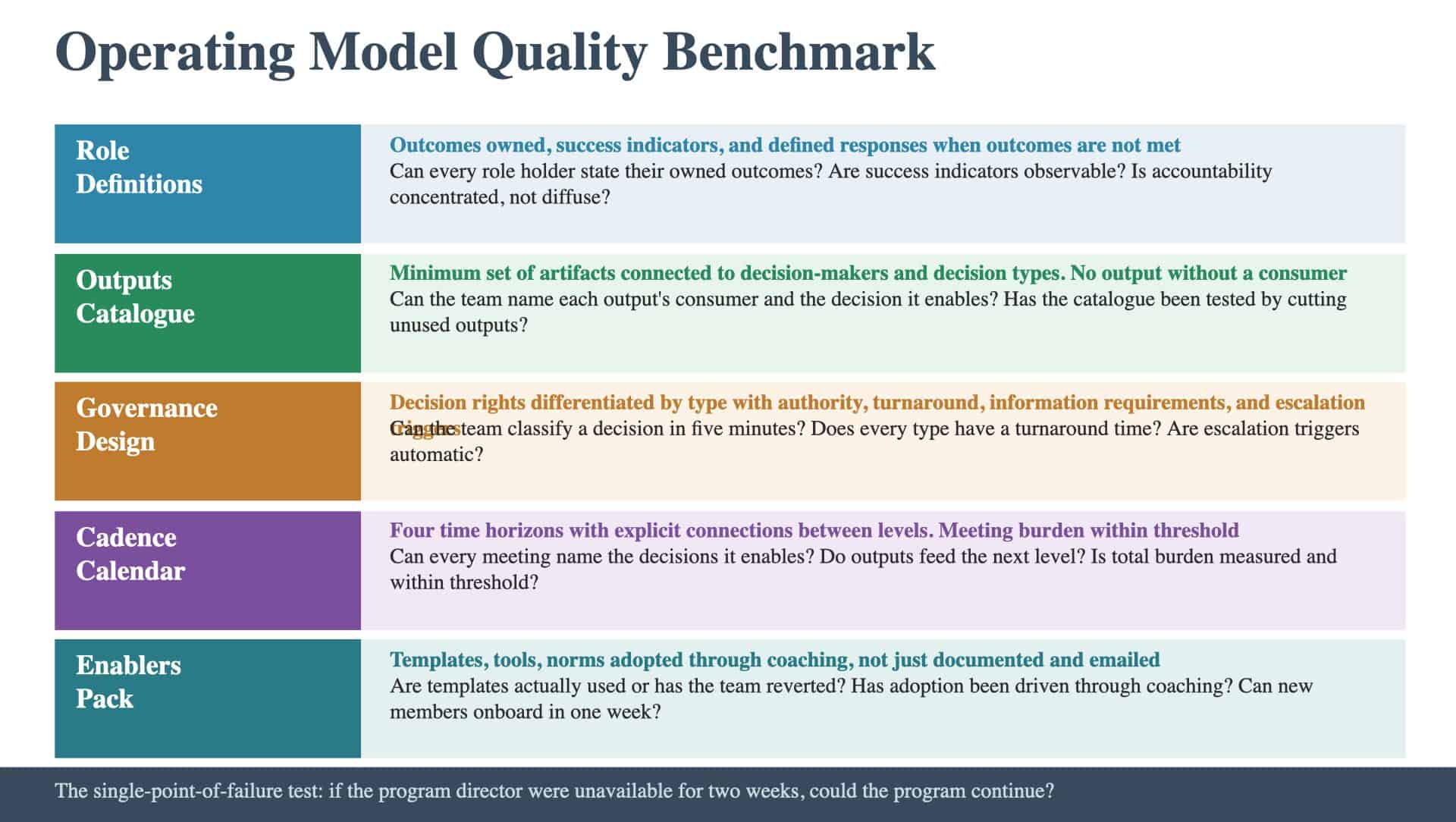
Having an Operating Model is not the same as having one that is execution-grade. Most programs produce some version of operating infrastructure during planning. A RACI chart exists. A governance document was endorsed. Meetings are scheduled. The question is whether what exists meets the quality bar required for the model to do its job: keeping the program coordinated through the duration of execution without depending on individual heroics. This article defines the quality benchmark across all five components of the Operating Model. It is written for leaders whose programs already have operating infrastructure and who want to evaluate whether that infrastructure is execution-grade.
Component 1: Role Definitions
What execution-grade looks like
Every key role on the program has a definition that specifies outcomes owned (not activities assigned), observable success indicators, and defined responses when outcomes are not met. The definitions are concise: five to seven key outcomes per role. Each outcome is specific enough that two people could independently assess whether it is being met and agree. The Role Charters sub-artifact is where these definitions live.
The test
- Can every role holder state what outcomes they own without referencing the RACI chart?
- Are the success indicators observable and measurable?
- Does the definition specify what happens when outcomes are not met?
- Is accountability concentrated (one person per outcome) rather than diffuse (multiple people sharing accountability)?
The architecture nobody builds describes the upstream dependency: architecture defines ownership. Role definitions translate ownership into measurable accountability.
Component 2: The Outputs Catalogue
What execution-grade looks like
The catalogue lists the minimum set of artifacts the program produces during execution. Each output is connected to a specific decision-maker and a specific decision type. No output exists without a defined consumer. The total output burden is sustainable: the team can produce all required artifacts without it consuming more than a defined percentage of their capacity.
The test
- For every output, can the team name the decision-maker who consumes it and the decision it enables?
- If the team stopped producing any single output, would a specific decision-maker lose the information they need?
- Is the total output burden measured and managed?
- Has the catalogue been tested: have any outputs been cut because they failed the “what would break” test?
The roadmap that tells you nothing describes the failure mode when outputs are disconnected from decisions. The catalogue’s quality depends on the connection between information produced and decisions enabled.
Component 3: Governance Design
What execution-grade looks like
Decision rights are differentiated by type: execution decisions, integration decisions, strategic trade-offs, and organizational escalations. Each type has a defined authority, turnaround time, information requirements, and escalation trigger. The team can look at any decision and immediately know which pathway applies. Common decision types (resource reallocation, scope adjustment, timeline change, dependency resolution, risk response) are explicitly designed.
The test
- Can the team classify a new decision into the correct type within five minutes?
- Does every decision type have a defined turnaround time?
- Does every escalation pathway have defined information requirements?
- Are escalation triggers automatic (time-based) rather than discretionary?
- Has the governance design been tested against realistic decision scenarios?
Programs that failed with good plans documents decision stalls caused by governance that was structurally incomplete. The test is whether the design can process the decisions the program actually faces.
Component 4: The Cadence Calendar
What execution-grade looks like
The program has a designed rhythm across four time horizons (weekly, biweekly, monthly, quarterly) with explicit connections between levels. Every meeting has a defined purpose, owner, and connection to the outputs catalogue. The total meeting burden for any role does not exceed a defined threshold. Meeting formats are designed for decision-making, not presentation. The Operating Rhythm sub-artifact captures this designed cadence.
The test
- Can every meeting justify its existence by naming the decisions it enables?
- Do meeting outputs feed the next level’s inputs through a defined connection?
- Is the total meeting burden for each key role measured and within threshold?
- Are meeting formats designed for issue discussion and decision-making rather than status presentation?
- Has the cadence been reviewed for meetings that could be eliminated or consolidated?
Why programs fail identifies meeting proliferation as a coordination failure. The cadence calendar’s quality is measured by its restraint as much as its coverage.
Component 5: The Enablers Pack
What execution-grade looks like
Templates, tools, norms, and collaboration standards are adopted, not just documented. The pack matches the outputs catalogue (templates produce the required outputs) and the cadence calendar (meeting agendas match meeting purposes). Adoption has been driven through two to three initial cycles with coaching. The team uses the pack without prompting.
The test
- Are the templates actually being used, or has the team reverted to their own formats?
- Does the enablers pack match the outputs catalogue and cadence calendar?
- Has adoption been actively driven (coaching, initial cycles) or passively hoped for (sent in an email)?
- Can new team members onboard to the program’s operating practices within one week using the enablers pack?
Programs that failed with good plans documents the formality trap: beautifully designed operating artifacts that no one uses. Adoption is the quality measure.
The Integrated Quality Bar
The Operating Model passes the overall quality benchmark when all five components meet their individual tests and the model as a whole meets one additional standard: the program can sustain coordination without depending on any single individual’s personal knowledge or effort. The single-point-of-failure test: if the program director were unavailable for two weeks, could the program continue to operate? Would meetings happen on schedule with the right agendas? Would status reports be produced and consolidated? Would decisions follow the governance pathways? Would escalations reach the right authority? If the answer is yes, the Operating Model is doing its job. Coordination is structural, not personal. If the answer is no, the model has gaps that are covered by individual effort, and those gaps will be exposed when the individual is unavailable.
The Adoption Test
One additional quality indicator separates execution-grade Operating Models from planning-phase documents: evidence of adoption. The model was not just designed; it was implemented. The team is using it. Evidence of adoption includes: templates that show signs of use (filled-in examples, not blank documents), a cadence calendar that matches the actual meeting schedule (not a plan that diverged from reality), and governance pathways that have been exercised (at least one decision has been processed through the defined pathway). The formality trap is the most common quality failure at this level. The Operating Model was carefully designed, professionally documented, and never adopted. The team defaulted to their existing practices because the model was presented as a document rather than embedded as a way of working. Adoption requires active investment: running the first cycles using the model, coaching the team through the transition, and reinforcing the new practices through leadership behavior. Without this investment, the model is a planning artifact, not an operating system. Why programs fail documents the pattern: programs with well-designed Operating Models that were never adopted, producing the same coordination failures as programs with no model at all.
The Evolution Test
The final quality indicator is whether the model has evolved. An Operating Model designed during planning and unchanged six months into execution is either perfectly designed (unlikely) or not being used (likely). Execution reveals what planning cannot anticipate. A governance pathway that works in theory produces a bottleneck in practice. A meeting cadence that seemed right produces meeting fatigue. An output that seemed essential turns out to be redundant. The model should be adjusted based on execution experience. Evidence of evolution includes: meetings that were added, removed, or restructured based on experience; governance pathways that were adjusted based on decision-processing data; and outputs that were cut because they failed the “what would break” test during execution. The question is whether the team treats the Operating Model as a living system that evolves with execution: or whether it files the document after planning and discovers the gaps when coordination failures begin.
Keep Reading
Explore the foundations and common gaps: