The planning phase produced an Integrated Roadmap. The team knows what to build, in what order, with what dependencies. The question that most programs fail to answer is: how will the team stay coordinated while building it? The Operating Model is the answer. It defines who owns what, how decisions get made, what evidence the program produces to prove progress, what rhythm keeps everyone synchronized, and what tools and templates make execution repeatable. Without it, the roadmap degrades from a coordinated plan into a collection of independent efforts within weeks of execution starting. This article introduces the artifact: what it is, how it differs from a governance document, and what happens to programs that proceed without one.
What the Operating Model Actually Is
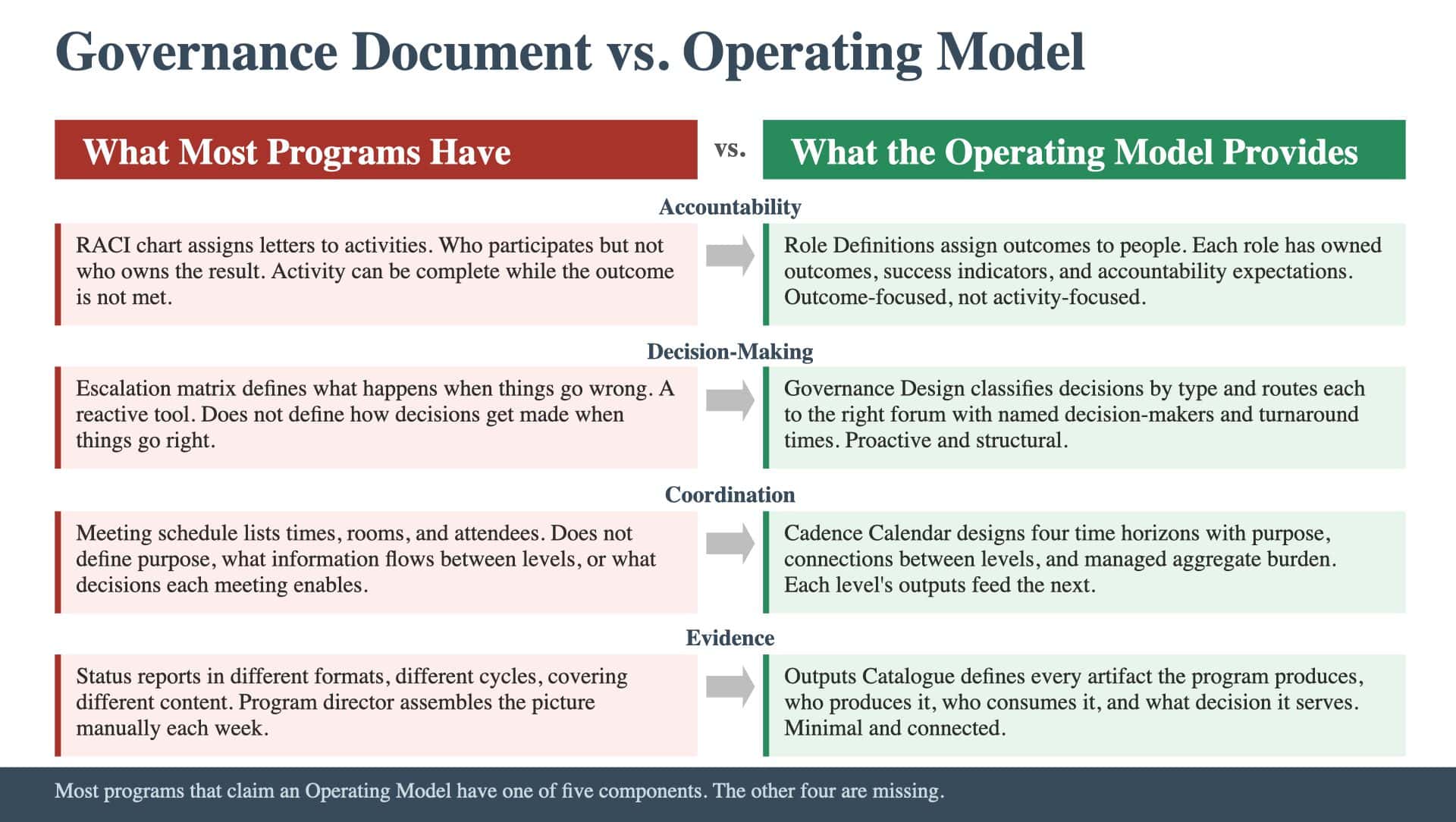
The Operating Model is the program’s operating infrastructure. It has five components: role definitions, an outputs catalogue, governance design, a cadence calendar, and an enablers pack. Together, they answer the question: once the plan is built, how does the team run? It is not a governance document, though governance is one of its components. A governance document describes decision rights. An Operating Model describes the entire coordination system: who is accountable for what outcomes, what artifacts the program produces to maintain visibility, how decisions get made and conflicts get resolved, what meetings happen at what frequency for what purpose, and what standards and tools the team uses to keep execution consistent. The distinction matters because most programs that claim to have an Operating Model actually have a governance document. They defined escalation paths and decision rights. They did not define role accountability, outputs cadence, meeting rhythm, or enablement infrastructure. The governance document covers one of five components. The other four are left to emerge organically, which means they emerge inconsistently or not at all. The architecture nobody builds describes the upstream dependency: the Operating Model operationalizes the architecture. Without architecture that defines workstream boundaries, ownership, and governance, the Operating Model has no structure to codify.
Why Programs Need One
Alignment erodes the moment the team leaves the planning room. This is not a failure of intent. It is a structural reality. Programs involve multiple teams, multiple leaders, multiple priorities, and multiple communication channels. Without an explicit coordination system, each team defaults to its own norms: its own meeting cadence, its own status format, its own definition of “on track,” its own escalation assumptions. Within weeks, the program is not running one plan. It is running six versions of the plan, each filtered through a different team’s interpretation. The roadmap becomes a historical artifact, referenced occasionally but not used to manage work. Decisions get made in side conversations because no one is sure which forum handles which type of decision. Status updates arrive in different formats on different timelines, making it impossible to build a coherent picture of program health. The Operating Model prevents this drift by defining the coordination infrastructure before execution starts. The drift still occurs at the margins, but the model provides the structure to detect it and correct it. Why programs fail documents this pattern across engagements. The programs did not fail because the plan was bad. They failed because the plan was not supported by an operating infrastructure that kept execution coordinated.
How It Differs from What Most Programs Have
Most programs have some version of three things: a RACI chart, an escalation matrix, and a meeting schedule. These are useful but incomplete. A RACI chart is not role definitions. RACI describes who is Responsible, Accountable, Consulted, and Informed for specific activities. Role definitions describe what outcomes each role owns and what success looks like. The difference: a RACI chart tells the program manager they are responsible for status reporting. A role definition tells the program manager they are accountable for program health visibility, measured by stakeholder confidence in timeline accuracy and risk transparency. An escalation matrix is not governance design. Escalation describes what happens when something goes wrong. Governance describes how decisions get made when things are going right. Governance design specifies decision rights by type (execution decisions, strategic trade-offs, resource allocation, scope changes), who has authority for each type, and what process ensures decisions are made within a defined timeframe. The Decision Escalation Framework sub-artifact is where this design is codified. A meeting schedule is not a cadence calendar. A schedule lists meetings with times and attendees. A cadence calendar defines the purpose of each meeting (what decisions it enables, what information it identifies), the owner responsible for preparation and follow-through, and the connections between meetings at different frequencies (how weekly operational meetings feed into monthly strategic reviews). The Operating Rhythm sub-artifact defines this designed cadence. Programs that failed with good plans describes programs that had RACI charts, escalation matrices, and meeting schedules and still failed at coordination. The artifacts existed but did not create the operating infrastructure the program needed.
What Happens Without One
Programs that execute without an Operating Model experience a predictable set of coordination failures. Accountability gaps. When something falls through the cracks, no one owns fixing it because role accountability was never defined at the outcome level. The RACI chart says three people are “responsible” for integration testing. None of them believe they are accountable for the outcome. The gap is discovered when integration testing fails and each of the three points to the other two. Decision stalls. A cross-functional trade-off needs to be made. The workstream leads cannot agree. There is no defined escalation path for this type of decision. The decision sits unresolved for three weeks while the teams wait. The three-week stall cascades through the dependency chain. Visibility gaps. Each workstream reports status in its own format, on its own timeline, to its own leadership. The program director cannot build a coherent picture of program health because the inputs are inconsistent. By the time a pattern becomes visible (three workstreams are behind on the same dependency), the window for intervention has passed. Meeting proliferation. Without a designed cadence, meetings multiply. Each new problem spawns a new meeting. Each new stakeholder creates a new touchpoint. Within months, the team is spending more time in meetings than doing work. The meetings are individually justified but collectively unsustainable. Tool fragmentation. Each team uses its own templates, its own status formats, its own project management tools. Information exists but cannot be aggregated. The program management office spends hours each week translating between formats to produce a consolidated view. The roadmap that tells you nothing describes the downstream effect: without operating infrastructure, the roadmap’s dates become fiction within weeks because no coordination mechanism keeps execution aligned with the plan.
The Relationship to What Comes Before
The Operating Model is not built from scratch. It operationalizes the artifacts that were built in the preceding steps. Role definitions extend the Architecture Blueprint’s ownership model. The architecture assigned owners to workstreams and defined the governance hierarchy. The Operating Model specifies what those owners are accountable for and how they are measured. Governance design extends the Architecture Blueprint’s governance model. The architecture defined decision rights and escalation paths. The Operating Model specifies the process: how decisions are surfaced, what information is required, how long the process takes, and what happens when it stalls. The cadence calendar operationalizes the Integrated Roadmap. The roadmap defines what milestones the team is tracking and what dependencies need monitoring. The cadence calendar defines when and how the team reviews progress, identifies risks, and makes course corrections. The enablers pack standardizes the tools and templates that make all of the above consistent. Templates for status reports, risk logs, decision records, and meeting agendas create the infrastructure that holds the model together. Without the upstream artifacts, the Operating Model is built on assumptions. The question is whether the team builds this coordination infrastructure before execution starts: or whether they discover the need for it after the first coordination failure has already cascaded.
Keep Reading
Ready to close specific gaps in your Operating Model? These articles show you how: