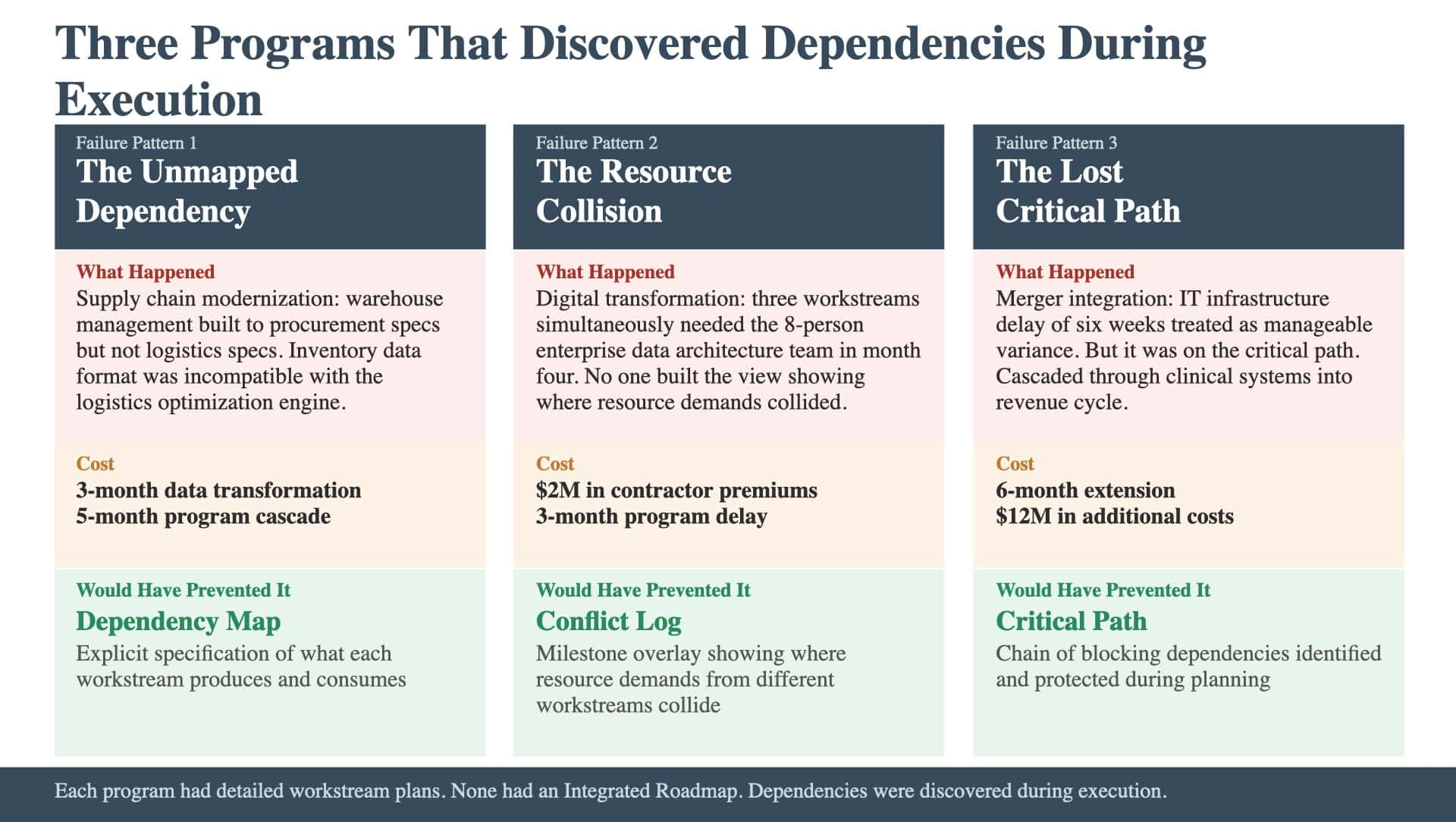
These three programs had workstream plans, project schedules, and Gantt charts. What they lacked was an Integrated Roadmap: a single view showing how their workstreams connected, where dependencies created risk, and what sequence of activities determined whether they would finish on time. Each program discovered its cross-workstream dependencies during execution. The cost of that discovery was measured in months of delay and millions in budget overrun, with organizational credibility that took years to rebuild.
Program 1: The Supply Chain Modernization That Couldn’t Integrate
A consumer goods company launched a supply chain modernization program with four workstreams: procurement systems, warehouse management, logistics optimization, and demand planning. Each workstream had a detailed project plan with milestones, resource allocations, and target dates. The program director reviewed all four plans and confirmed they were “aligned.” Alignment meant the end dates were compatible. It did not mean the dependencies were mapped. The warehouse management workstream completed its new inventory system on schedule. The logistics workstream then discovered that the inventory system’s data format was incompatible with the logistics optimization engine. The warehouse team had built to the procurement system’s specifications (its primary integration point) but had not consulted the logistics team about their data requirements. The incompatibility required a three-month data transformation layer. During those three months, the demand planning workstream could not begin its integration phase because it depended on both warehouse and logistics data feeds. A single unmapped dependency between two workstreams produced a cascade that delayed the entire program by five months. The dependency was not obscure. Both teams knew they would need to exchange data. But “we’ll figure out the data format during integration” was treated as a reasonable assumption rather than a risk. An Integrated Roadmap would have mapped the dependency explicitly: warehouse management produces inventory data that logistics consumes, in a specific format, by a specific date. The format mismatch would have been discovered during planning, when the cost of resolution was a design conversation rather than a three-month rework. The roadmap that tells you nothing describes why timeline alignment is not the same as integration. These four workstream plans had compatible dates and incompatible assumptions.
Program 2: The Digital Transformation That Hit the Resource Wall
A financial services firm launched a digital transformation with five workstreams spanning customer experience, core banking, risk management, regulatory compliance, and data analytics. The program had a combined team of 180 people across internal staff and three consulting firms. Each workstream planned independently. Each workstream’s plan was reviewed by the program management office. Each plan was approved. In month four, three workstreams simultaneously needed the enterprise data architecture team. Customer experience needed the team for API design. Core banking needed them for data migration mapping. Data analytics needed them for warehouse schema design. The enterprise data architecture team had eight people. The resource conflict was invisible in any individual workstream plan because each plan showed only its own resource needs. The program management office reviewed plans sequentially, not in overlay. No one built the view that showed where resource demands from different workstreams collided. The resolution took six weeks of renegotiation: rephasing milestones, bringing in additional contract resources at premium rates, and accepting delays in two of the three workstreams. The total cost was approximately two million dollars in additional contractor fees and a three-month program delay. A conflict log built during roadmap sessions would have surfaced this collision. The three workstreams’ milestone sequences, overlaid on a shared resource map, would have shown the collision in month four before a single line of code was written. The resolution during planning would have been a sequencing adjustment. The resolution during execution was a crisis. Programs that failed with good plans documents the resource collision pattern. The plans were individually sound and collectively impossible.
Program 3: The Merger Integration That Lost Its Critical Path
Two regional healthcare systems merged. The integration program had seven workstreams: clinical systems, revenue cycle, human resources, facilities, supply chain, IT infrastructure, and brand consolidation. The program had a twenty-four-month timeline with a board mandate to complete on schedule. Each workstream built a milestone sequence. The program director aggregated the sequences into a master timeline. The timeline showed all workstreams completing within the twenty-four-month window. The board approved the plan. What the timeline did not show was the critical path. Among the seven workstreams, a chain of dependencies ran from IT infrastructure (network consolidation) through clinical systems (application migration) through revenue cycle (billing system integration). A delay in any link of this chain delayed the program’s end date. The chain was the critical path, and no one had identified it. In month eight, IT infrastructure encountered an unexpected network configuration issue that delayed network consolidation by six weeks. The program director assessed the delay as manageable: six weeks on a twenty-four-month program seemed like acceptable variance. Resources were not reallocated. The executive committee was informed but not alarmed. But network consolidation was on the critical path. The six-week delay cascaded through clinical systems (which could not begin application migration until the network was consolidated) and into revenue cycle (which could not begin billing integration until clinical applications were migrated). The six-week infrastructure delay became a four-month program delay because each downstream dependency added its own lead time. By the time the program leadership recognized the cascade, the twenty-four-month timeline was unrecoverable. The board extended the program to thirty months, at an additional cost of twelve million dollars in extended program staffing. The failure was not in execution. The infrastructure team resolved the network issue competently. The failure was in planning: no one identified the critical path, so no one protected it. The six-week delay in a critical-path activity was treated the same as a six-week delay in a non-critical activity. The response was proportional to the apparent severity, not the actual severity. Why programs fail identifies this pattern: programs that cannot distinguish between critical and non-critical delays make poor trade-off decisions throughout execution.
The Common Pattern
All three programs had competent teams, adequate budgets, and executive support. All three had detailed workstream plans. None of them had an Integrated Roadmap. The missing artifact cost them the same thing in different forms. The supply chain program paid in rework. The digital transformation paid in premium contractors and replanning. The merger integration paid in timeline extension and organizational credibility. The pattern is consistent: without dependency mapping, connections between workstreams are assumptions rather than managed interfaces. The Dependency Map sub-artifact turns those assumptions into specified, classified, owned handoffs. Without a conflict log, resource and timing collisions are discovered during execution rather than resolved during planning. Without critical path identification, every delay looks the same and the team cannot prioritize. An Integrated Roadmap does not prevent problems during execution. It prevents the specific category of problems that arise from insufficient integration: the problems that exist not because any single team failed, but because the connections between teams were never planned. The question is whether your program maps its cross-workstream dependencies, resolves its conflicts, and identifies its critical path during planning: or whether those realities reveal themselves during execution when the cost of discovery is highest.
Keep Reading
Ready to close specific gaps in your Integrated Roadmap? These articles show you how: