The program has a meeting schedule. Weekly status meetings on Tuesdays. Biweekly steering committee on alternating Thursdays. Monthly executive reviews on the last Friday. The calendar invites are sent. The rooms are booked. The schedule lists when people meet. It does not define why they meet, what information flows between meetings at different levels, or what decisions each meeting is designed to enable. The gap between a meeting schedule and a cadence calendar is the gap between occupying time and coordinating work.
What Meeting Schedules Miss
A meeting schedule has structural gaps that cadence design addresses. Purpose is assumed, not designed. The weekly status meeting exists because weekly status meetings are what programs do. But what is the meeting’s actual purpose? Is it to identify issues for resolution? To track milestone progress? To coordinate cross-workstream dependencies? To all three? When the purpose is undefined, the meeting becomes a general discussion that covers whatever seems important that week. Some weeks it is productive. Other weeks it is an hour that everyone regrets. Connections between levels are missing. The weekly meeting, biweekly steering committee, and monthly executive review each operate independently. Information identified in the weekly meeting does not reliably reach the steering committee. Decisions made at the steering committee are not reliably communicated back to the weekly meeting. Each meeting level is an island. The aggregate burden is unmanaged. Each meeting was added for a reason. Each meeting is individually justifiable. But the total meeting load has never been assessed. A workstream lead attends the weekly status meeting, the biweekly coordination meeting, the biweekly steering committee, the monthly executive review, their own workstream’s weekly meeting, and three ad hoc meetings that were scheduled to address emerging issues. They spend twenty hours per week in meetings and have twenty hours left to do the work the meetings are tracking. Why programs fail identifies meeting proliferation as a coordination failure pattern. The meetings are a symptom: the program is trying to coordinate through meetings because it lacks the operating infrastructure to coordinate through structure.
What a Cadence Calendar Actually Does
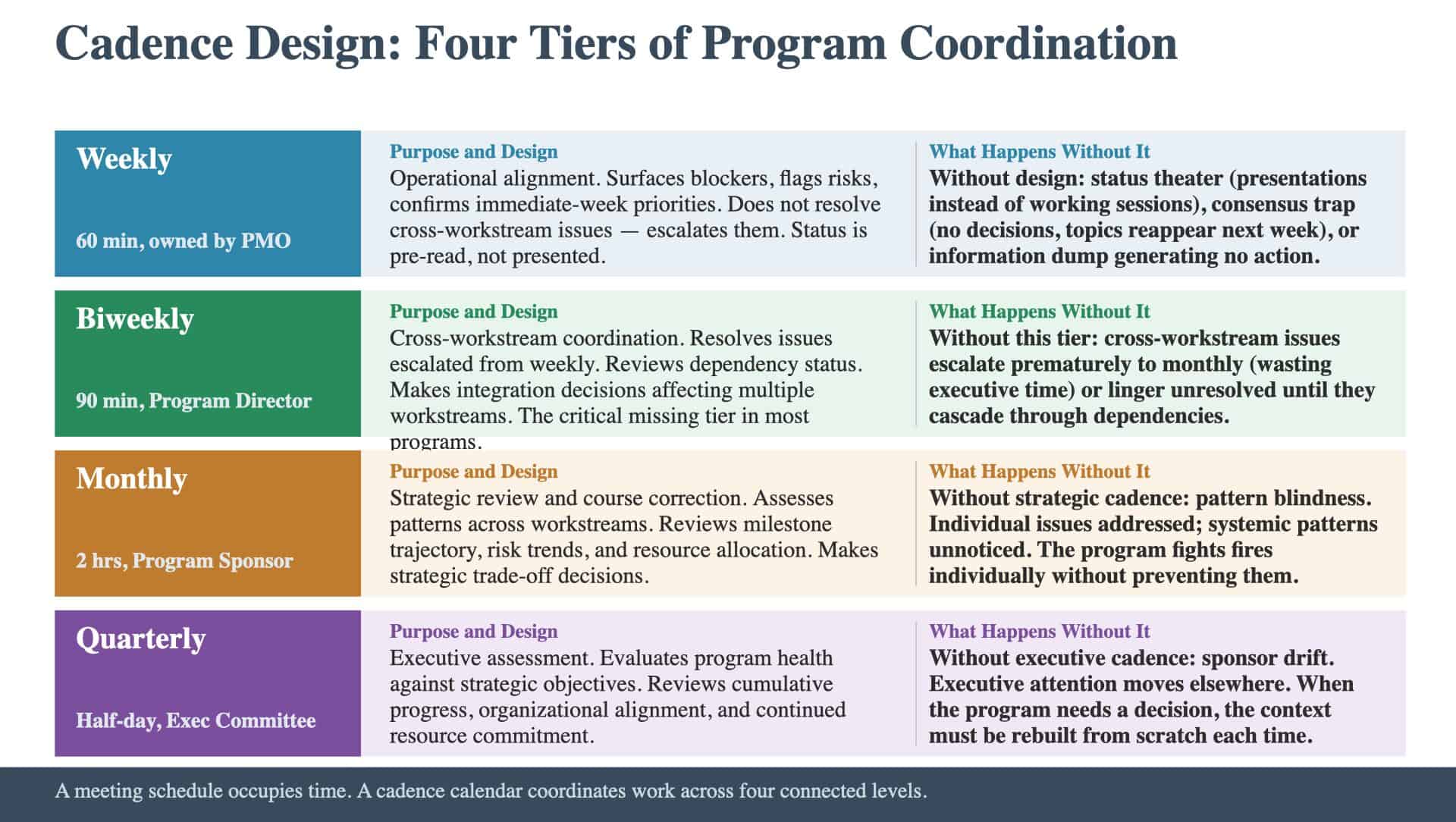
A cadence calendar designs the program’s operating rhythm across four time horizons, with explicit connections between them. Weekly: operational alignment. Purpose: track milestone progress against the roadmap, identify issues that require cross-workstream attention, confirm dependency deliveries are on track. The meeting produces a consolidated status view and a list of issues requiring escalation. Owner: program management office. Duration: sixty minutes. Output: weekly status report (feeds into the biweekly coordination meeting). Biweekly: cross-workstream coordination. Purpose: resolve cross-workstream issues identified in weekly meetings, review dependency health, address resource conflicts. The meeting receives the escalated issues from weekly meetings and resolves them or escalates to the steering committee. Owner: program director. Duration: ninety minutes. Output: resolution decisions and escalation recommendations (feeds into monthly review). Monthly: strategic review and course correction. Purpose: assess program health against the roadmap’s critical path, review risk register status, make strategic trade-off decisions that exceed the program director’s authority. The meeting receives the monthly consolidated view built from weekly and biweekly inputs. Owner: program sponsor. Duration: two hours. Output: strategic decisions and direction adjustments (feeds into quarterly executive assessment). Quarterly: executive assessment. Purpose: assess whether the program is meeting its strategic objectives, approve or adjust the program’s direction, and address organizational-level constraints. The meeting receives the quarterly summary built from monthly reviews. Owner: executive committee. Duration: half-day. Output: strategic endorsement or redirection. The Operating Rhythm sub-artifact captures this four-level cadence design as a single integrated calendar. The roadmap that tells you nothing describes what happens when the operating rhythm is disconnected from the roadmap: status meetings track activities but not progress against the integrated plan. The cadence calendar connects the meeting rhythm to the roadmap’s milestones and dependencies.
The Connection Design
The critical difference between a meeting schedule and a cadence calendar is the connection design: how information flows between levels. Weekly meetings identify issues. Biweekly meetings resolve them. Monthly meetings assess patterns. Quarterly meetings address strategic implications. Each level produces specific outputs that feed the next level’s inputs. Without connection design, each meeting level reinvents the conversation. The steering committee asks questions that were answered in the weekly meeting. The executive review covers ground that the monthly review already covered. The repetition wastes time and, worse, creates inconsistency: different levels of the program have different understandings of the same situation because the information was retranslated at each level.
Where Programs Get Stuck
The everything-weekly trap. The program defaults to weekly meetings for everything: status, coordination, governance, planning. The weekly cadence is appropriate for operational alignment. It is too frequent for strategic review (not enough changes between weeks to justify the meeting) and too infrequent for issue resolution (waiting until next Tuesday to address an urgent issue surfaced on Wednesday). The consensus trap. Every meeting requires consensus. When consensus cannot be reached, the meeting ends without a decision and the topic reappears next week. Cadence design includes governance integration: decisions that cannot be resolved at one level are escalated to the next level through the defined pathway, with a defined timeline. The Decision Escalation Framework specifies these pathways and the timelines that prevent consensus from becoming an excuse for inaction. The status theater trap. Status meetings become presentations rather than working sessions. Each workstream presents their status, the audience listens, and the meeting ends. No issues are surfaced because the format discourages it. No decisions are made because the format does not allocate time for them. Cadence design specifies meeting format: the status is pre-read, the meeting time is for issue discussion and decision-making. Programs that failed with good plans documents the status theater pattern: programs where meetings were held on schedule and provided no value because the format was presentation, not coordination.
The Minimum Viable Cadence
The discipline of cadence design is in restraint. The goal is the minimum rhythm that keeps the program coordinated. Every meeting that exceeds the minimum consumes time that could be spent on execution. The minimum viable cadence for a cross-functional program typically includes: one weekly operational meeting per workstream (thirty to sixty minutes), one weekly or biweekly cross-workstream coordination meeting (sixty to ninety minutes), one monthly program review (ninety minutes to two hours), and one quarterly executive assessment (half-day). The total recurring meeting burden for a workstream lead should not exceed eight to ten hours per week, leaving the majority of their time for the work the meetings are designed to coordinate. If the meeting burden exceeds this threshold, the cadence is over-designed and needs simplification. The question is whether the team designs this rhythm before execution starts: or whether they discover the need for it after meeting proliferation has already consumed the time they needed for the work itself.
Keep Reading
New to the Operating Model? Start with the foundations:
Ready to benchmark your work against best-in-class? See what excellence looks like: