The standard Operating Model defines the five components: roles, outputs, governance, cadence, and enablers. This is necessary for coordination. Whether it is sufficient depends on the program’s complexity, duration, and organizational context. Advanced operating model design addresses the limitations of the standard approach. It builds coordination infrastructure that scales as the program grows, adapts as execution reveals what planning could not anticipate, and sustains itself through mechanisms rather than through the relentless effort of a program director.
Technique 1: The Decision Velocity Dashboard
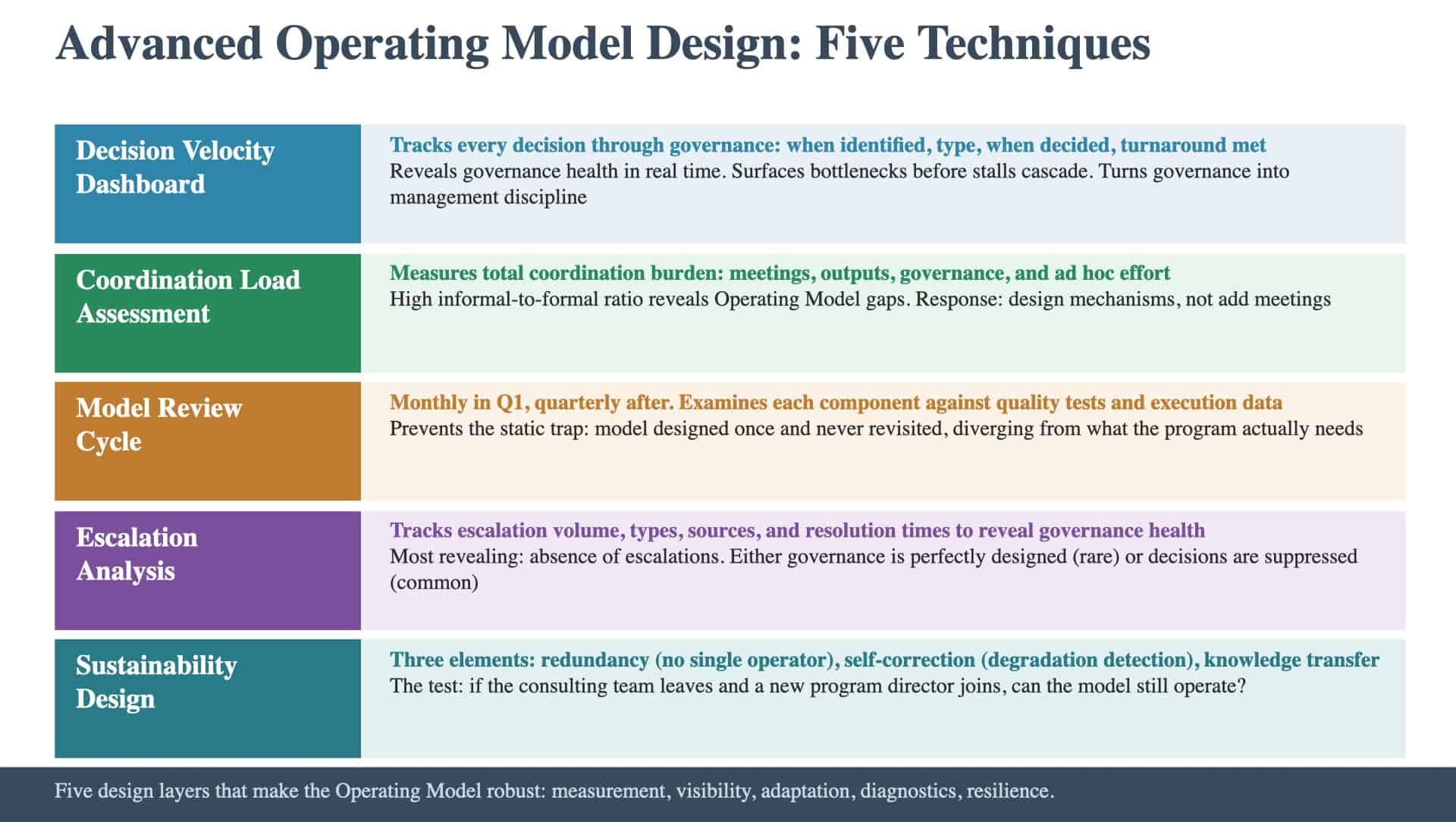
Governance design defines decision types and turnaround times. The decision velocity dashboard measures whether those turnaround times are being met. The dashboard tracks every decision that enters the governance system: when it was identified, what type it was classified as, when it was decided, and whether the turnaround time was met. The data reveals governance health in real time. When decision velocity is on track, the governance design is working. When decisions are consistently exceeding their turnaround times, the dashboard identifies where the bottleneck sits: are integration decisions stalling at the program director level (capacity issue), are strategic trade-offs waiting for steering committee meetings (cadence issue), or are escalations stuck in information gathering (requirements issue)? The dashboard turns governance from a design exercise into a management discipline. Without measurement, governance quality is invisible until a decision stall produces a program delay. With measurement, governance quality is visible weekly, and adjustments can be made before stalls cascade. The Decision Escalation Framework defines the decision types and turnaround targets that the dashboard measures against. Programs that failed with good plans documents programs where decision stalls accumulated for months before anyone recognized the pattern. A decision velocity dashboard would have surfaced the pattern in weeks.
Technique 2: The Coordination Load Assessment
Meeting proliferation is a symptom of insufficient operating infrastructure. But meeting reduction is not always the answer. Sometimes the program genuinely needs more coordination as complexity increases. The coordination load assessment measures the total coordination burden across the program: time spent in meetings, time spent producing outputs, time spent in governance processes, and time spent in ad hoc coordination (the conversations, emails, and Slack messages that fill the gaps between formal mechanisms). The assessment reveals where coordination is happening through formal mechanisms (the Operating Model) and where it is happening through informal mechanisms (ad hoc effort). A high ratio of informal to formal coordination indicates that the Operating Model has gaps: the formal mechanisms do not cover the coordination the program needs, so people fill the gaps themselves. The response is not to add more meetings. It is to identify the coordination gaps and design mechanisms to address them. If workstream leads are spending two hours per week in ad hoc conversations about dependency status, the formal dependency tracking mechanism is insufficient. If the program director is spending three hours per week chasing decision status, the governance process lacks a tracking mechanism. Why programs fail identifies the coordination load pattern: programs where the formal operating model covers fifty percent of the coordination need, and the other fifty percent is covered by heroic individual effort.
Technique 3: The Model Review Cycle
The standard Operating Model is designed during planning and operated during execution. The model review cycle adds a third phase: periodic assessment and adjustment. The review happens monthly during the first quarter of execution and quarterly thereafter. The review examines each component against its quality tests and against execution data: Are role definitions producing clear accountability, or are accountability gaps emerging? Is the outputs catalogue producing information that decision-makers use, or are outputs being produced but not consumed? Is governance processing decisions within turnaround times? Is the cadence calendar maintaining coordination without excessive meeting burden? Is the enablers pack being used? The review produces specific adjustments. A meeting that has become status theater is restructured or eliminated. A governance pathway that consistently exceeds its turnaround time is redesigned. An output that no decision-maker reads is cut. A role definition that has produced accountability confusion is clarified. The model review cycle prevents the static trap: the operating model that was designed once and never revisited, gradually diverging from what the program actually needs. The architecture nobody builds connects to the model review: just as architecture should be stress-tested, the operating model should be assessed against execution reality.
Technique 4: The Escalation Analysis
Escalation patterns reveal operating model health. The analysis tracks what types of decisions are being escalated, how often, from which workstreams, and what the resolution time is. Healthy escalation patterns show: a low volume of escalations (most decisions are resolved at the appropriate level), a variety of decision types (no single type dominates), and resolution within defined turnaround times. Unhealthy escalation patterns show: a high volume of escalations (decisions are being pushed upward because authority at lower levels is unclear), concentration in specific decision types (the governance design does not adequately address those types), or long resolution times (the escalation pathway has bottlenecks). The most revealing pattern is the absence of escalations. If no decisions are being escalated, one of two things is true: the governance design at lower levels is so well-designed that every decision can be resolved without escalation (rare), or decisions that should be escalated are not being escalated because the pathway is unclear, intimidating, or perceived as ineffective (common). The escalation analysis identifies governance design failures that are invisible without data. The program may appear to be running smoothly while decisions that should receive strategic attention are being made at the wrong level, producing outcomes that will need to be revisited later. The risk nobody put on the register connects to suppressed escalations: decisions made at the wrong level are risks that are being carried rather than managed.
Technique 5: The Sustainability Design
The standard Operating Model answers: how will the team coordinate? The sustainability design answers: how will the coordination sustain itself? Sustainability requires specific design elements. Redundancy. No single person should be the sole operator of any coordination mechanism. The program director facilitates the biweekly coordination meeting, but a designated backup can run it if the director is unavailable. The program management office produces the weekly status report, but the template and data sources are documented so that a substitute can produce it. Self-correction. The model should include mechanisms that detect when coordination is degrading. The decision velocity dashboard detects governance degradation. Meeting effectiveness surveys detect cadence degradation. Output utilization tracking detects outputs catalogue degradation. These mechanisms provide early warning before coordination failures produce program delays. Knowledge transfer. The operating model should be transferable. If the consulting team that designed it leaves, can the client team operate it? If a new program director joins, can they understand the model and operate within it? The enablers pack should include templates, tools, and an operating model guide: a document that explains the model’s design rationale, not just its components. The Enablement Stack sub-artifact is where these templates, tools, and transfer documentation are specified. The roadmap that tells you nothing describes the downstream effect of unsustainable operating infrastructure: the coordination degrades, the roadmap’s dates become fiction, and the program enters a cycle of replanning.
Combining the Techniques
The five techniques are not sequential. They are design layers that make the Operating Model more robust. The decision velocity dashboard provides governance measurement, the coordination load assessment provides workload visibility, the model review cycle provides adaptation, the escalation analysis provides diagnostic insight, and the sustainability design provides resilience. The question is whether the team builds coordination infrastructure that manages itself: or whether it builds a static model that requires heroic effort to operate and breaks the moment that effort is unavailable.
Keep Reading
Explore the foundations and common gaps: